
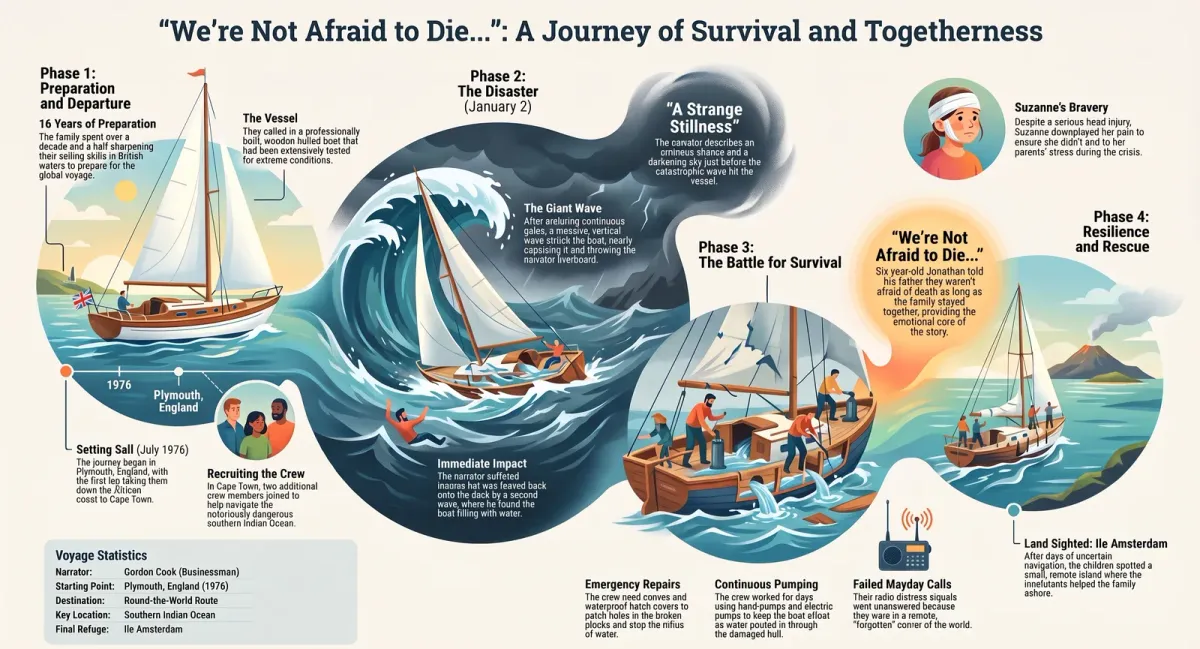
“We’re Not Afraid to Die… if We Can All Be Together” opens CBSE Class XI students to one of the most gripping true accounts in the Hornbill textbook. Written jointly by Gordon Cook and Alan East, this first-person narrative recounts a family’s brush with death during a round-the-world sailing voyage. For students preparing for CBSE exams, understanding the sequence of events, the emotional undercurrents, and the chapter’s structure is essential. This post walks through the complete story and explains why it remains a favourite for both literature discussion and examination questions.
About the Chapter and Its Authors
The account is narrated by Gordon Cook, a businessman who, along with his wife Mary, had long dreamed of retracing the historic round-the-world route once sailed by Captain James Cook. In 1976, the couple set out from Plymouth with their two young children, Jonathan and Suzanne, aboard their wooden-hulled boat. Alan East later helped shape the written account, giving the chapter its dual authorship. The narrative blends travel writing with survival memoir, making it distinct from the other prose pieces in the Hornbill syllabus.
The Voyage Begins: Setting Sail for Adventure
The family had spent sixteen years preparing for this journey, sharpening their sailing skills in British waters before finally departing. Their boat was solidly built and had been tested extensively before the voyage began. The opening section of the chapter establishes the family’s confidence and preparation, sailing calmly down the African coast to Cape Town, where two additional crew members joined to help navigate the notoriously difficult southern Indian Ocean. This calm beginning is a deliberate contrast that makes the disaster which follows feel even more sudden and overwhelming.
Into the Storm: The Wave That Changed Everything
Soon after leaving Cape Town, the crew met continuous gales and towering waves. The turning point arrives on January 2, when an unusually massive wave strikes the boat without warning. The narrator describes a strange stillness before the wave hits, followed by chaos as the vessel is nearly capsized. He is thrown overboard, injured, and briefly resigns himself to death before being hurled back onto the deck by another wave. This sequence is often examined in class for how the writer conveys terror and disorientation through short, urgent sentences and vivid sensory detail.
Fighting for Survival: Repairs, Pumps, and Mayday Calls
Once back aboard, the family and crew discover the boat has been badly damaged, with water pouring in through broken planks. What follows is a tense, hour-by-hour account of emergency repairs: patching holes with canvas, operating pumps that keep failing, and sending radio distress signals that go unanswered. The narrator’s practical resourcefulness under extreme pressure is a key discussion point, since it shows how calm decision-making, rather than panic, becomes the family’s real lifeline during the crisis.
The Children’s Courage Amid Crisis
A defining feature of this account is the composure shown by the two children despite serious injury and constant danger. Suzanne, badly hurt, downplays her pain so as not to add to her parents’ worry, while Jonathan offers a memorable reflection on facing death together as a family. Their responses provide the emotional core of the chapter and directly explain its title, illustrating how togetherness and trust can ease even the greatest fear.
Finding Ile Amsterdam: The Rescue
After days of relentless pumping, damaged rigging, and uncertain navigation, the family finally sights a small, remote island. The moment of discovery is delivered through the children rather than the adults, adding a touch of warmth to an otherwise harrowing account. The family is eventually welcomed ashore by the island’s small population, bringing the ordeal to a close and allowing the narrator to reflect on the courage shown by everyone aboard, especially the youngest members of the crew.
Why This Chapter Matters for CBSE Students
Beyond its dramatic plot, the chapter is frequently tested for its narrative structure, its first-person point of view, and the way it builds tension through pacing and detail. CBSE examiners often ask students to trace the stages of the disaster, identify the emotional shifts in the family, and comment on the chapter’s real-life origins as a work of survival literature rather than fiction.
Study Smarter with ChampionsPrep
Want deeper practice on this chapter? ChampionsPrep offers AI-powered question banks, chapter summaries, and exam-focused practice sets for CBSE and Maharashtra Board Class XI-XII Commerce students, plus prep support for CUET, IPMAT, JIPMAT, NPAT, and SET aspirants. Registration is free, and you only pay as you use the platform — so you can start practising this chapter’s important questions right away without any upfront cost.
Test Your Knowledge

We're Not Afraid to Die... If We Can All Be Together: Chapter Summary and Analysis
Frequently Asked Questions
Who wrote "We're Not Afraid to Die... if We Can All Be Together"? +
The chapter is a true account written by Gordon Cook, the narrator and captain of the voyage, along with Alan East, who helped compose the published version.
What is the name of the family's boat in the chapter? +
The family sailed aboard a wooden-hulled boat that had been professionally built and extensively tested before the journey began.
What caused the near-fatal accident in the story? +
An enormous, unusually shaped wave struck the boat without warning during a violent storm in the southern Indian Ocean, nearly capsizing it and injuring the narrator.
Where did the family finally find safety? +
After days of repairs and uncertain navigation, they reached a small, remote island in the Indian Ocean, where the local inhabitants helped them ashore.
What is the central message of the chapter? +
The chapter shows how courage, calm resourcefulness, and family togetherness can help people endure extreme danger, a theme reflected directly in its title.
AI-powered practice — free to start