
“The Adventure” by Jayant Narlikar rewards close reading, and CBSE papers regularly test both plot comprehension and the story’s deeper scientific ideas. This post works through the questions students are most likely to face — from the NCERT textbook’s Understanding-the-Text and Talking-about-the-Text sections to inference-based questions examiners often build around this chapter — with model answers structured the way a Class XI student should write them.
Understanding-the-Text: Comprehension Questions
Q1. Was Professor Gaitonde’s experience real, imaginary, or something else? Justify your answer.
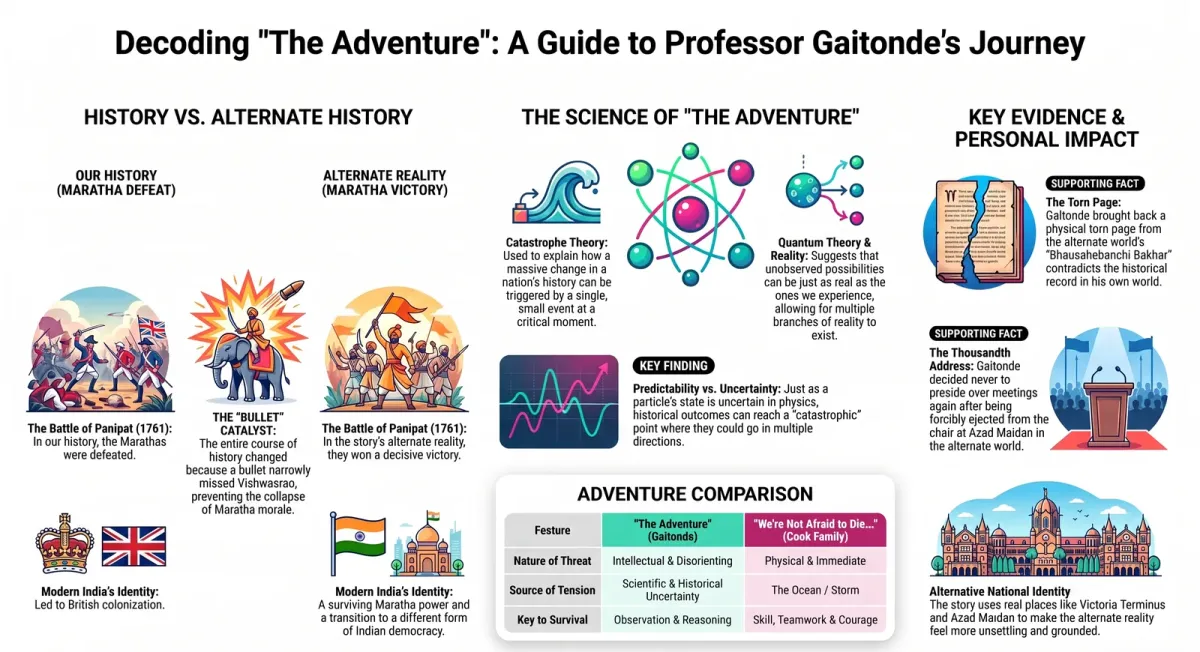
Gaitonde’s experience was neither purely real in the sense of physically happening in his own world, nor purely imaginary in the sense of being a dream or hallucination. The story presents it as a genuine transition into an alternate branch of reality, supported by physical evidence — the torn page from the alternate world’s Bakhar, which differs word-for-word from Gaitonde’s own copy of the same text. His friend Rajendra Deshpande treats this evidence seriously enough to build a scientific explanation around it rather than dismissing the professor’s account as fantasy.
Q2. Does the story hinge on a particular historical event? Which one, and why does it matter?
Yes, the story is built around the Third Battle of Panipat (1761), fought between the Marathas and Ahmad Shah Abdali. In the history we know, the Marathas suffered a devastating defeat that weakened their power for years. The story imagines the opposite outcome — a decisive Maratha victory — and traces how that reversal could have altered everything from the East India Company’s expansion to the shape of Indian democracy.
Q3. Who was Rajendra Deshpande, and what role does he play in the story?
Rajendra Deshpande is a physicist and close friend of Professor Gaitonde. He does not appear until the final section of the story, but his role is crucial: he is the one who takes Gaitonde’s bizarre account seriously and offers a scientific framework — combining catastrophe theory and quantum theory — to explain how the professor might have briefly experienced an alternate version of history.
Q4. Are the places mentioned in the story imaginary, or are they real locations?
The places are real. Pune, Bombay (Mumbai), Lonavala, Karjat, Kalyan, Victoria Terminus, Hornby Road, Azad Maidan, and the Town Hall are all genuine locations, which is precisely what makes the story unsettling — Gaitonde is not transported to a fantasy land but to a recognisable, real India that has simply taken a different historical path.
Q5. Does the story try to connect history with science? How?
Very deliberately. Narlikar, himself a scientist, uses Rajendra’s explanation to argue that the same unpredictability found in quantum physics — where a particle’s exact state cannot be known with certainty — might have a macroscopic counterpart in catastrophic historical moments, where a battle’s outcome could genuinely have gone either way.
Talking-about-the-Text: Analytical Questions
Q6. “A single event may change the course of the history of a nation.” Discuss with reference to the story.
The story argues strongly in favour of this idea. It shows how one detail — a bullet narrowly missing Vishwasrao — cascades into entirely different outcomes: the East India Company’s decline, the survival of Maratha power into the modern era, and a fundamentally different relationship between India and Britain. A counter-view would note that deeper structural forces, like economic and military strength, also shape history over the long run, meaning even a reversed battle might not have changed everything.
Q7. Explain: “Reality is what is directly experienced through the senses.”
This statement is central to the story’s second scientific argument. Rajendra questions whether reality is limited only to what we can see, touch, or measure directly. Using quantum theory as evidence, he suggests that unobserved possibilities can be just as real as the one we happen to experience — meaning Gaitonde’s alternate India was not a hallucination but a genuine reality he was not normally positioned to perceive.
Q8. Compare the adventure in this story with the adventure described in “We’re Not Afraid to Die… if We Can All Be Together.”
Both chapters put their central figures through a life-altering ordeal, but the adventure itself is entirely different. In “We’re Not Afraid to Die,” the Cook family faces a very physical, immediate threat at sea, and their survival depends on practical skill, teamwork, and courage. In “The Adventure,” Gaitonde’s ordeal is intellectual and disorienting rather than physically dangerous; his survival depends on observation and reasoning. Where the Cooks battle the ocean, Gaitonde battles his own uncertainty about what is real.
Q9. Why do you think Professor Gaitonde decided never to preside over meetings again?
Gaitonde had been looking forward to delivering his symbolic thousandth presidential address at an upcoming seminar. In the alternate world, he unknowingly lived through that exact milestone — taking the empty chair at Azad Maidan and being forcibly ejected before he could finish. For him, that humiliating experience effectively fulfilled his thousandth address, even though it happened in a reality that was not strictly his own — which is why repeating the ritual now feels pointless to him.
Related Reading
Practice More, Score Higher
Want to test yourself with exam-style MCQs and long-answer questions on this chapter and every other Hornbill text? ChampionsPrep’s AI-powered practice platform builds custom question sets for CBSE and Maharashtra Board Commerce students. It’s free to register, and pricing is pay-as-you-use — so you only pay for the practice you actually need. Get started at ChampionsPrep .
Test Your Knowledge
The Adventure Important Questions and Answers
Frequently Asked Questions
What is the most important theme to remember for exams in "The Adventure"? +
The idea that a single catastrophic event — the Battle of Panipat — can bifurcate history into radically different outcomes is the theme examiners return to most often.
How should I answer questions about the story's ending? +
Focus on Gaitonde's emotional decision to stop presiding over meetings, and connect it clearly to his belief that he already lived his thousandth address in the alternate world.
Is it necessary to explain catastrophe theory and quantum theory in detail for exam answers? +
A brief, clear mention is usually enough — examiners want to see that you understand the story uses these theories to explain the transition, not a full scientific explanation.
What evidence does Gaitonde bring back from the alternate world? +
A torn page from the Bhausahebanchi Bakhar, describing Vishwasrao's narrow escape from a bullet — a detail that contradicts the account in Gaitonde's own copy of the same chronicle.
How is this story different from a typical adventure story? +
It replaces physical danger with intellectual and historical uncertainty, using science rather than action to build tension.
AI-powered practice — free to start