
Beneath its comic surface, “Poets and Pancakes” by Asokamitran explores several serious ideas about human nature, workplace hierarchy, and the quiet reach of politics into everyday life. CBSE Class 12 students are frequently asked to identify and discuss these themes in both short-answer and long-answer formats. This post breaks down the chapter’s major themes with textual support, so you can write confident, well-supported answers in your board exam.
Envy and Thwarted Ambition
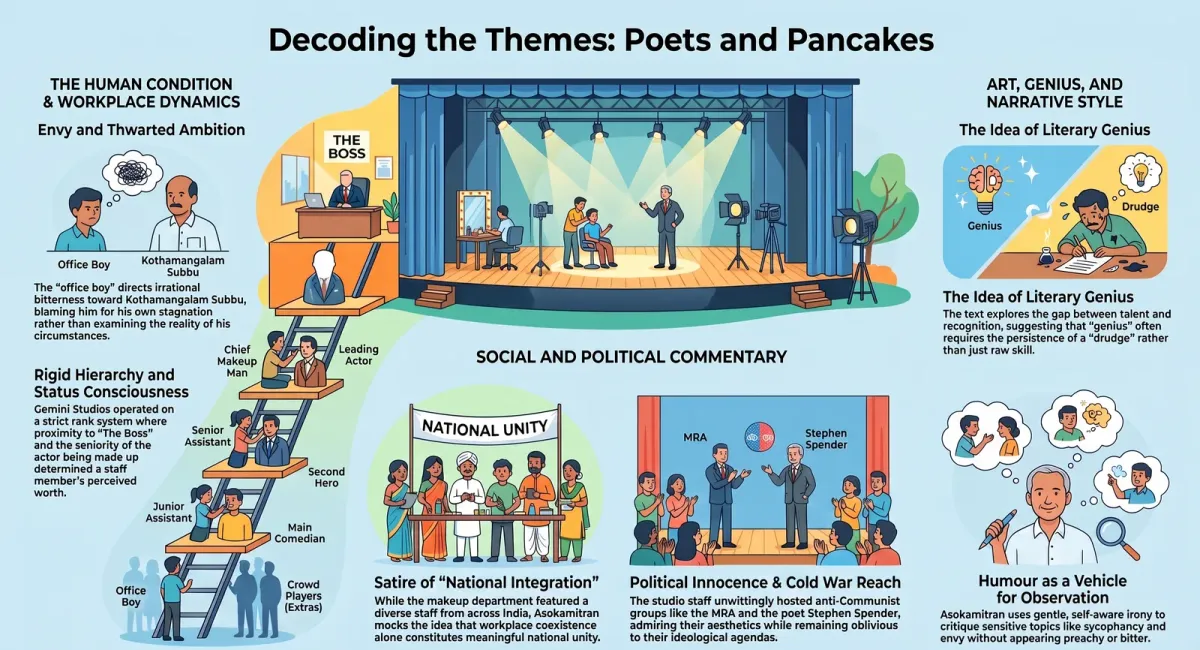
The clearest emotional thread in the chapter is the office boy’s bitterness toward Kothamangalam Subbu. Both men entered the film industry with similar dreams of becoming stars, writers, or directors, yet their paths diverged sharply — Subbu rose to become the studio’s unofficial No. 2, while the office boy remained stuck applying paint to crowd extras. Rather than examining his own circumstances honestly, the office boy directs “all his woes, ignominy and neglect” onto Subbu, treating him as the sole cause of his own stagnation. Asokamitran uses this relationship to make a broader observation about human psychology: “In all instances of frustration, you will always find the anger directed towards a single person openly or covertly.” Envy, the chapter suggests, is rarely rational — it looks for a target rather than a cause.
Rigid Hierarchy and Status Consciousness
Gemini Studios runs on an elaborate, almost absurd system of rank. Within the make-up department alone, status determines who works on whom: the chief make-up man handles the leading actors, his senior assistant handles the “second” hero and heroine, the junior assistant handles the main comedian, and the office boy is left with the crowd players. This mirrors a larger pattern across the studio, where proximity to The Boss determines privilege — Subbu’s closeness to power lets him direct a film despite no obvious qualification, just as it earns him enviers. The narrator’s own job, though genuinely important to the studio’s information-gathering, is dismissed as “doing next to nothing” simply because it lacks visible status. The chapter gently mocks a workplace culture where perceived rank matters more than actual contribution.
Satire of Superficial “National Integration”
When Asokamitran describes the make-up department’s leadership passing through a Bengali, a Maharashtrian, a Dharwar Kannadiga, an Andhra, a Madras Indian Christian, an Anglo-Burmese, and local Tamils, he calls it evidence of “national integration” achieved “long before A.I.R. and Doordarshan began broadcasting programmes” on the subject. The joke works on two levels: it is genuinely true that people of many backgrounds worked side by side at Gemini Studios, but reducing this diversity to a punch line about a make-up department also gently mocks the idea that mere coexistence in a workplace amounts to meaningful integration. The theme extends to the poets themselves, who “wore khadi and worshipped Gandhiji” yet had “not the faintest appreciation for political thought of any kind” — a comment on performative rather than genuine political consciousness.
Poetry, Prose, and the Idea of Genius
Asokamitran repeatedly circles back to questions about literary value. The office boy insists that “great literary talent was being allowed to go waste” in the make-up department, revealing his own inflated self-image. Subbu, by contrast, is a genuine poet who “deliberately chose to address his poetry to the masses” rather than pursue more complex, prestigious forms — a choice some critics felt “overshadowed and dwarfed” his literary achievements. The narrator himself, half-seriously, declares that “prose-writing is not and cannot be the true pursuit of a genius,” reserving that status for “the patient, persistent, persevering drudge” who endures endless rejection. This self-mocking claim, coming from a prose writer describing his own attempts to publish, adds irony to the theme: genius and recognition, the chapter suggests, rarely align with either talent or effort alone.
Political Innocence and the Reach of the Cold War
Perhaps the chapter’s most significant theme only becomes visible in its final pages. The poets and staff at Gemini Studios are shown as politically naive — vaguely suspicious of “Communism” as something “godless” and violent, without any real understanding of the term. This naivety makes them easy hosts for Frank Buchman’s Moral Re-Armament troupe, an anti-Communist movement whose plays they admire purely for their staging and “sunrise and sunset” aesthetics, unaware of the ideological agenda behind the visit. The mysterious English “poet” who arrives soon after — later revealed as Stephen Spender — receives an equally grand, equally uncomprehending welcome. Only years later does the narrator connect the dots through The God That Failed, realising that Spender’s reputation as a former Communist turned strong critic of Communism, not his poetry, explains The Boss’s enthusiasm. The theme here is quietly powerful: global Cold War politics shaped behaviour even in a provincial film studio whose staff barely grasped what was happening around them.
Humour as a Vehicle for Social Observation
Running through every theme above is Asokamitran’s use of gentle, self-aware humour rather than harsh criticism. He mocks the office boy’s self-pity, Subbu’s sycophantic critics, the lawyer’s ill-fitting formality, and his own “insignificant function” with equal affection. This consistent comic tone allows the chapter to make sharp observations about envy, hierarchy, and political blindness without ever feeling preachy or bitter — the humour becomes the very method through which serious themes are delivered to the reader.
Related Reading
-
Poets and Pancakes Summary and Analysis – CBSE Class 12 English Flamingo Chapter 6
-
Poets and Pancakes Character Sketch – Subbu, the Lawyer & More (CBSE Class 12 Flamingo)
-
Poets and Pancakes Literary Devices and Narrative Style – CBSE Class 12 Flamingo
-
Poets and Pancakes NCERT Solutions – CBSE Class 12 English Flamingo Chapter 6
Start Learning with ChampionsPrep
Want theme-by-theme breakdowns and practice questions for every Flamingo chapter? It is free to register & pay as you use — explore ChampionsPrep for CBSE Class 12 English resources built around exactly what your board exam expects.
Test Your Knowledge
Poets and Pancakes Themes Explained – CBSE Class 12 English Flamingo Chapter 6
Frequently Asked Questions
What is the central theme of "Poets and Pancakes"? +
The chapter primarily explores envy and thwarted ambition, workplace hierarchy, and how larger Cold War politics quietly shaped even a small film studio's behaviour.
How does the chapter treat the idea of "national integration"? +
It satirises the idea by showing that a make-up department staffed by people of different regions was jokingly called "national integration," questioning whether such coexistence reflects genuine integration.
What does the chapter suggest about envy and frustration? +
It suggests that frustration usually seeks a single target to blame, as seen when the office boy directs all his resentment at Kothamangalam Subbu rather than examining his own circumstances.
How is the theme of political innocence developed in the chapter? +
Through the studio staff's vague, uninformed suspicion of Communism and their enthusiastic but uncomprehending welcome of both the MRA troupe and Stephen Spender.
Why is humour important to the chapter's themes? +
Because Asokamitran uses gentle humour, rather than direct criticism, to explore envy, hierarchy, and political naivety, making the chapter entertaining while still conveying serious observations.
AI-powered practice — free to start