
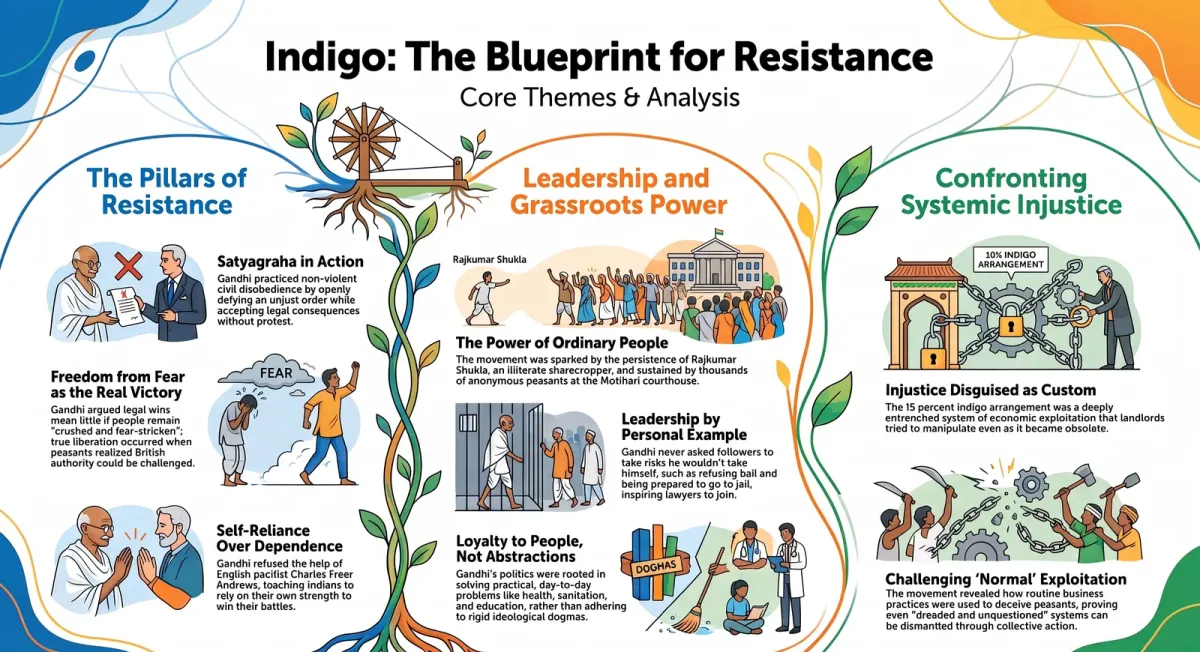
Beyond its historical narrative, “Indigo” is a chapter built around ideas that shaped India’s entire freedom movement. CBSE Class 12 English exams often ask students to discuss these themes directly, especially through the “Talking about the Text” discussion prompts. This post breaks down the chapter’s core themes with textual support, giving students the vocabulary and examples needed for strong, analytical answers.
Satyagraha and Non-Violent Civil Disobedience
The Champaran episode is presented as an early, defining instance of satyagraha in action. Gandhi does not resist the notice to quit Champaran through force or evasion; instead, he openly signs it while declaring his intent to disobey, then accepts the legal consequences without protest. He pleads guilty in court, refuses bail, and calmly awaits sentencing. This combination — visible defiance paired with total acceptance of consequences — is the essence of the non-violent resistance Gandhi would later apply on a national scale. The peasants’ spontaneous, peaceful gathering outside the Motihari courthouse mirrors this same restraint: a mass show of support with no violence, yet enough moral pressure to unsettle the colonial administration.
Freedom from Fear as the Real Victory
Gandhi’s own words in the chapter make this theme explicit: he tells the Muzzafarpur lawyers that taking cases to law courts does little good for peasants who are “so crushed and fear-stricken,” and that their real relief lies in becoming free from fear. The Champaran movement succeeds less because of the legal settlement itself and more because it teaches frightened sharecroppers that British authority, though “hitherto dreaded and unquestioned,” can be challenged by ordinary Indians. This idea — that psychological liberation matters as much as material justice — is one of the chapter’s most frequently discussed themes and a natural bridge to broader classroom discussion about justice for the poor even after Independence.
Self-Reliance Over Dependence
When Charles Freer Andrews, a sympathetic English pacifist, offers to remain in Champaran and assist the campaign, Gandhi firmly refuses. He argues that seeking support from an Englishman, however well-intentioned, would reveal weakness in a fight the Indians themselves must win. Rajendra Prasad later reflects that this response taught the lawyers an unspoken lesson in self-reliance. The theme extends beyond this single episode: Gandhi consistently pushes Champaran’s peasants, lawyers, and volunteers to solve their own problems rather than depend on outside rescue, reinforcing self-reliance as both a personal virtue and a political strategy.
Loyalty to People, Not Abstractions
Fischer explicitly frames Gandhi’s politics as intertwined with the practical, day-to-day problems of ordinary people rather than loyalty to abstract ideals. Champaran did not begin as a planned act of political defiance; it grew out of a genuine effort to relieve the suffering of poor sharecroppers. This grounding in lived human need — rather than ideology for its own sake — explains why Gandhi moves seamlessly from a legal battle over indigo rents to organising schools, healthcare, and sanitation lessons in Champaran’s villages.
Leadership Rooted in Personal Example
Gandhi never asks anyone to take a risk he is unwilling to take himself. He signs the notice to quit and states his intent to disobey it openly; he pleads guilty rather than seeking a technical escape; he refuses bail. When he later asks the visiting lawyers what they would do if he were imprisoned, their honest answer — that they would return home — forces them to confront their own commitment. Only after real reflection do they choose to stay and risk arrest alongside him, at which point Gandhi declares that the battle of Champaran is won. Leadership, the chapter suggests, works through demonstrated conviction rather than instruction.
The Contribution of Ordinary, Anonymous People
Rajkumar Shukla, an illiterate sharecropper with no political standing, sets the entire Champaran movement in motion simply through persistence. Later, thousands of unnamed peasants gather around the Motihari courthouse, having never even heard of Gandhi’s record in South Africa — they act purely because a “Mahatma” trying to help them was in trouble. This theme deliberately counters the idea that India’s freedom struggle was driven only by famous leaders; the chapter insists that ordinary, often powerless individuals were essential to its success.
Injustice Disguised as Custom
The ancient sharecropping arrangement forcing tenants to plant 15 per cent of their land with indigo and surrender the entire harvest as rent is presented as a system so deeply entrenched it had come to seem normal. When landlords learn that synthetic indigo has made natural indigo less profitable, they manipulate peasants into signing away their compensation rights before the truth becomes known — revealing how economic exploitation persists by disguising itself as routine business practice until challenged directly.
Why These Themes Matter for CBSE Exams
Examiners consistently reward answers that connect specific incidents to broader ideas rather than restating the plot. Linking Gandhi’s guilty plea to satyagraha, his refusal of Andrews’s help to self-reliance, or the courthouse gathering to freedom from fear demonstrates exactly the kind of textual analysis Class 12 English answers require.
Start Learning Smarter with ChampionsPrep
Want theme-by-theme breakdowns and discussion-ready notes for every Flamingo chapter? ChampionsPrep supports CBSE and Maharashtra Board Class XI–XII students preparing for boards and entrance exams like CUET, IPMAT, NPAT, and SET with structured, exam-focused content. It is free to register & pay as you use — explore ChampionsPrep today.
Test Your Knowledge

Themes in Indigo: Satyagraha, Self-Reliance and Freedom from Fear – CBSE Class 12
Frequently Asked Questions
What is satyagraha as depicted in the chapter Indigo? +
It is non-violent resistance in which Gandhi openly disobeys an unjust order, such as the notice to quit Champaran, while fully accepting the legal consequences of his defiance.
Why does Gandhi say freedom from fear matters more than legal justice? +
Because peasants who remain psychologically dominated by authority cannot benefit from legal wins alone; genuine liberation requires them to lose their fear of the powerful.
How does the theme of self-reliance appear in the chapter? +
Gandhi refuses help from his English friend Charles Freer Andrews, insisting Indians must rely on their own efforts to win an unequal fight.
What does the chapter suggest about ordinary people's role in the freedom movement? +
Figures like Rajkumar Shukla and the anonymous Champaran peasants show that persistence and courage from ordinary, powerless individuals were vital to the movement's success.
How is leadership portrayed as a theme in Indigo? +
Gandhi leads by personal example, taking on the same risks he asks of others, which is what ultimately persuades the lawyers to stay and support the cause.
AI-powered practice — free to start