
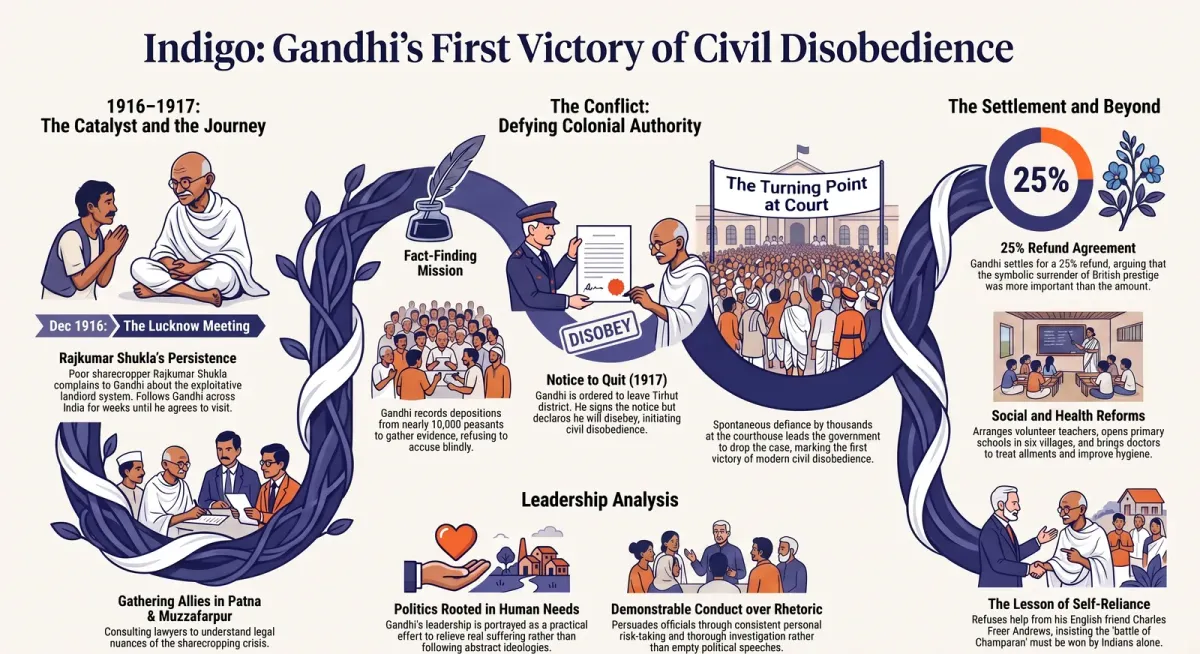
“Indigo” is Chapter 5 of the NCERT Class XII English textbook Flamingo, an excerpt from Louis Fischer’s biography The Life of Mahatma Gandhi. The chapter recounts the 1917 Champaran episode in Bihar, often described as Gandhi’s first major experiment with organised civil disobedience on Indian soil. Through reported conversation and closely observed detail, Fischer shows how a single, persistent meeting changed the course of a mass movement. This post summarises the chapter section by section and unpacks why it remains a cornerstone text for understanding Gandhian leadership.
About the Author: Louis Fischer
Louis Fischer (1896–1970) was an American journalist born in Philadelphia who briefly served with the British Army before building a long career writing for major publications, including assignments across Europe and Asia. He later joined the faculty at Princeton University. His biography of Gandhi, from which this chapter is drawn, has been praised as one of the finest full-length studies of the Mahatma ever written, valued for combining journalistic precision with genuine access to its subject.
Gandhi Meets Rajkumar Shukla
The narrative opens with Gandhi recalling, during a 1942 visit to his Sevagram ashram, how he first resolved to challenge British authority back in 1917. That decision traces to the December 1916 Congress session in Lucknow, attended by thousands of delegates. There, a poor, unlettered sharecropper named Rajkumar Shukla approached Gandhi and insisted he visit Champaran, a district near the Himalayan foothills that Gandhi had never even heard of. Champaran’s peasants worked under a rigid, decades-old sharecropping system tied to indigo cultivation, and Shukla had come to complain about its injustice.
The Long, Patient Journey
Shukla refused to be brushed off. He followed Gandhi from Lucknow, trailed him to his ashram near Ahmedabad, and stayed at his side for weeks, repeatedly begging him to fix a date. Gandhi eventually agreed to meet him later in Calcutta. True to his word, Shukla was waiting when Gandhi arrived, and the two travelled on to Patna and then Muzzafarpur, gathering allies along the way, including Professor J.B. Kripalani and lawyer Rajendra Prasad, who would later become President of India.
Confronting the Authorities in Champaran
Once in Champaran, Gandhi began methodically gathering facts rather than making accusations. British landlords and officials tried to dismiss him as an outsider and ordered him to leave Tirhut. Gandhi refused. When he pressed on to investigate a report of a mistreated peasant, he was formally served notice to quit the district — and he signed the notice while stating plainly that he intended to disobey it.
The Trial and the Turning Point
Summoned to court, Gandhi pleaded guilty rather than contest the charge, explaining that he faced a genuine conflict between respecting lawful authority and answering the deeper call of conscience and humanitarian duty. Thousands of peasants gathered spontaneously outside the courthouse — their first collective act of defiance against colonial power. Rattled and unprepared, the government postponed proceedings and ultimately dropped the case altogether on the Lieutenant-Governor’s orders. It was, as the chapter notes, the first victory of civil disobedience in modern India.
The Official Inquiry and the Settlement
Gandhi and a team of lawyers then conducted an extensive investigation, recording depositions from roughly ten thousand peasants. The Lieutenant-Governor eventually appointed an official commission that included Gandhi as the sole representative of the sharecroppers. When landlords agreed in principle to refund money extorted from peasants, Gandhi asked for only half of it back — and when planters countered with 25 per cent, he accepted immediately, breaking the deadlock. He believed the symbolic surrender of prestige mattered more than the exact sum recovered.
Rebuilding Champaran Beyond Politics
Gandhi’s involvement did not stop at legal victory. He arranged for volunteer teachers, opened primary schools in six villages, brought in a doctor to treat common ailments, and had his wife Kasturbai teach hygiene and sanitation. He also declined an offer of help from his English friend Charles Freer Andrews, insisting that the peasants’ cause had to be won through self-reliance rather than by leaning on a British ally — a moment the chapter treats as a lesson in independence for everyone involved.
Why Champaran Was a Turning Point
Gandhi himself called Champaran a turning point, explaining that what he did was ordinary: he simply declared that the British could not order him about in his own country. The episode did not begin as defiance; it grew from a practical effort to relieve real suffering. That pattern — politics rooted in everyday human problems rather than abstract ideology — defines the Gandhi that Fischer portrays throughout the chapter, and it is a useful lens for the “battle of Champaran is won” moment that closes the movement’s legal struggle.
Analysis: What the Chapter Teaches About Leadership
“Indigo” works as both history and character study. It shows leadership built on patient fact-finding, willingness to accept personal risk, and a refusal to separate large political goals from small, immediate human needs. Gandhi persuades officials, lawyers, and peasants alike not through rhetoric but through consistent, demonstrable conduct. For CBSE Class 12 students, the chapter offers a clear model for exam answers on theme, characterisation, and narrative technique, all of which are explored further in the linked posts below.
Start Learning Smarter with ChampionsPrep
Want chapter-wise summaries, practice questions, and exam-ready notes for every Flamingo chapter in one place? ChampionsPrep gives CBSE and Maharashtra Board Class XI–XII Commerce and English students structured, exam-focused content built for CUET, IPMAT, NPAT, SET, and board exams alike. It is free to register & pay as you use — explore ChampionsPrep today and make revision effortless.
Test Your Knowledge

Indigo Summary and Analysis – CBSE Class 12 English (Flamingo)
Frequently Asked Questions
What is the chapter Indigo about? +
It is an excerpt from Louis Fischer's biography of Gandhi describing the 1917 Champaran movement, where Gandhi helped indigo sharecroppers in Bihar challenge exploitative British landlords through non-violent civil disobedience.
Who was Rajkumar Shukla? +
He was an illiterate but determined Champaran sharecropper who persuaded Gandhi to visit the district and investigate the injustices faced by indigo farmers.
Why is Champaran called a turning point in Gandhi's life? +
Because it was his first successful large-scale civil disobedience campaign in India, proving that ordinary people, organised peacefully, could challenge unquestioned colonial authority.
What percentage refund did Gandhi accept from the planters? +
Although he could have demanded full repayment, Gandhi settled for a 25 per cent refund, valuing the landlords' loss of prestige over the exact amount recovered.
What is the significance of the title Indigo? +
Indigo was the forced cash crop at the centre of the exploitative sharecropping system; the title anchors the whole chapter in the specific economic injustice Gandhi set out to correct.
AI-powered practice — free to start