
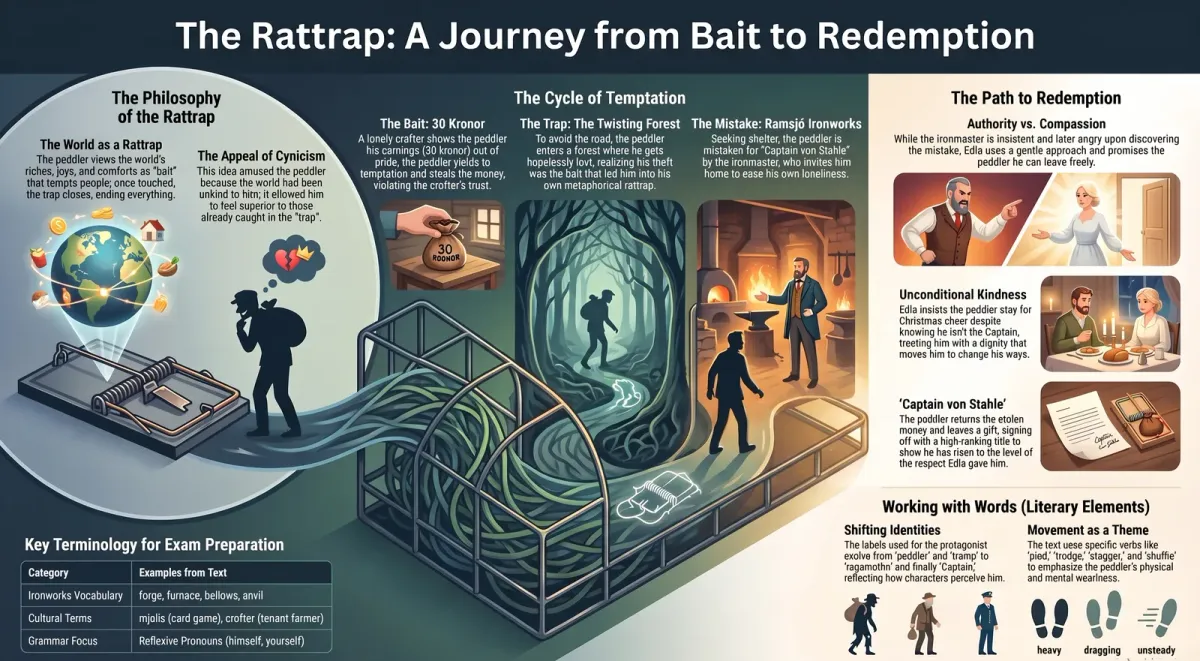
This post walks through the exercise sections that follow The Rattrap in your CBSE Class 12 English Flamingo textbook, with model answers written in simple, exam-ready language. Questions are paraphrased in each heading for clarity — always frame your own answers in your own words during the exam.
Understanding the Text
1. Where did the peddler’s idea about the world being a rattrap come from? It grew out of his own trade. Thinking about the small wire traps he made and sold, he suddenly connected them to the wider world, realising that riches, comfort and shelter work exactly like bait — tempting, and dangerous, to anyone who reaches for them.
2. Why did this idea amuse him? Because the world had never been kind to him, imagining it as a trap that catches other people too gave him a strange, private satisfaction. It let him feel superior to those who had been “caught,” rather than bitter about his own poverty.
3. Did the peddler expect the kind of welcome he received from the crofter? No. He was used to sour, suspicious reactions from strangers, so the crofter’s warm hospitality — food, tobacco, and a card game — came as a genuine, pleasant surprise.
4. Why was the crofter so talkative and friendly with the peddler? The crofter lived alone with no wife or child, and years of isolation had left him hungry for company. A visitor, even a ragged stranger, was a rare chance to talk and be listened to.
5. Why did the crofter show the peddler his thirty kronor? He was proud of his cow’s earnings and wanted to prove, since his guest seemed doubtful, that his claim of prosperity was genuine — an innocent boast that ultimately cost him dearly.
6. Did the peddler respect the trust the crofter placed in him? No. Despite the crofter’s genuine kindness, the peddler returned within the half hour to break in and steal the money, showing no regard for the confidence shown in him.
More Understanding the Text Questions
7. What convinced the peddler that he had truly fallen into a rattrap? Getting hopelessly lost in the dark, twisting forest after stealing the money made him recall his own metaphor — he realised he had let himself be tempted by bait and was now, quite literally, trapped.
8. Why did the ironmaster speak kindly to the peddler, and why did the peddler decline going home with him? Genuine warmth and loneliness — his wife had died and his sons were abroad — made the ironmaster mistake the stranger for an old comrade and invite him home. The peddler refused, fearing the truth about his identity and the stolen money would come out at the manor house.
9. What made the peddler finally accept Edla’s invitation, and when did the ironmaster realise his mistake? Edla’s gentle approach and her promise that he could leave freely reassured him where her father’s insistence had not. The ironmaster only realised his error the next morning, once his guest was bathed, groomed and dressed, and clearly did not resemble his old comrade.
10. How did the peddler defend himself, and why did Edla still want him to stay? He admitted the truth honestly, insisting he had only ever claimed to be a poor trader and offering to leave quietly. Edla felt it would be wrong to turn away someone promised Christmas cheer, and wanted him to have one peaceful day regardless of who he really was.
11. What finally made the peddler change his ways? Edla’s sustained, unconditional kindness — treating him with dignity even as a suspected thief — moved him in a way that fear of the sheriff never could.
12. How does the rattrap metaphor illuminate the human condition, and how does humour shape the story’s tone? It shows how easily anyone can be lured by material temptation, while suggesting trust and generosity offer a way out. The peddler’s witty, self-aware remarks lighten this serious theme and build reader sympathy for him.
Talking About the Text
These are discussion-based prompts best explored in groups, but for exam purposes, remember the core positions: readers sympathise with the peddler because his poverty and mistreatment are shown before his dishonesty, and this sympathy is largely justified by his eventual change. The story also highlights human loneliness as a force driving nearly every character’s actions. If asked for a personal example of kindness changing someone’s outlook, use a genuine, brief real-life illustration. Finally, remember that the story works on two levels at once — as an entertaining tale and as a philosophical statement on greed and goodness.
Working with Words
The peddler is called by several labels across the story — “peddler,” “stranger,” “tramp,” “vagabond,” “ragamuffin,” and finally “Captain von Stahle.” Each shift reflects how differently characters see him at that moment, from suspicion to eventual respect. Words like plod, trudge and stagger, describing tired, heavy movement, appear throughout; similar words include shuffle, trundle, lumber, and drag oneself.
Noticing Form and Thinking About Language
Reflexive pronouns (himself, yourself) appear throughout the text, sometimes for emphasis and sometimes simply to show the subject acting on itself — track a few examples as you reread. The story also uses vocabulary specific to ironworks (forge, furnace, bellows, anvil) worth noting for the “Thinking about Language” section, along with mjolis, a Swedish card game, and crofter, a term for a small tenant farmer with regional equivalents worth researching in your own language.
Related Reading
-
The Rattrap Summary and Analysis – CBSE Class 12 English Flamingo Chapter 4
-
The Rattrap Character Sketch: Peddler, Crofter, Ironmaster and Edla – CBSE Class 12
-
Themes in The Rattrap: Materialism, Loneliness and Redemption Explained
-
The Rattrap Exam Tips: Important Questions and Revision Checklist
Prepare Smarter with ChampionsPrep
Get chapter-wise practice questions and instant answer feedback for every Flamingo chapter, including The Rattrap. It is free to register & pay as you use — so you only spend on the practice you actually need, whenever you need it.
Test Your Knowledge

The Rattrap NCERT Solutions – Understanding the Text, Working with Words & More
Frequently Asked Questions
What is the best way to answer Understanding the Text questions for The Rattrap? +
Keep answers factual and specific to the story's events, using your own words rather than memorised textbook lines.
Why did the peddler not correct the ironmaster's mistaken identity? +
He hoped being mistaken for an old comrade might earn him money, so he let the misunderstanding continue.
What should I focus on for the Working with Words section? +
Notice how different labels for the peddler reflect shifting attitudes, and build a list of synonyms for tired, weary movement.
Are the NCERT questions on The Rattrap mostly factual or analytical? +
Both — Understanding the Text is largely factual, while Talking About the Text and the thematic prompts require analytical, opinion-based answers.
How should I prepare Noticing Form and Thinking About Language topics? +
Reread the story specifically looking for reflexive pronouns and ironworks-related vocabulary, and note a few examples of each in your revision notes.
AI-powered practice — free to start