
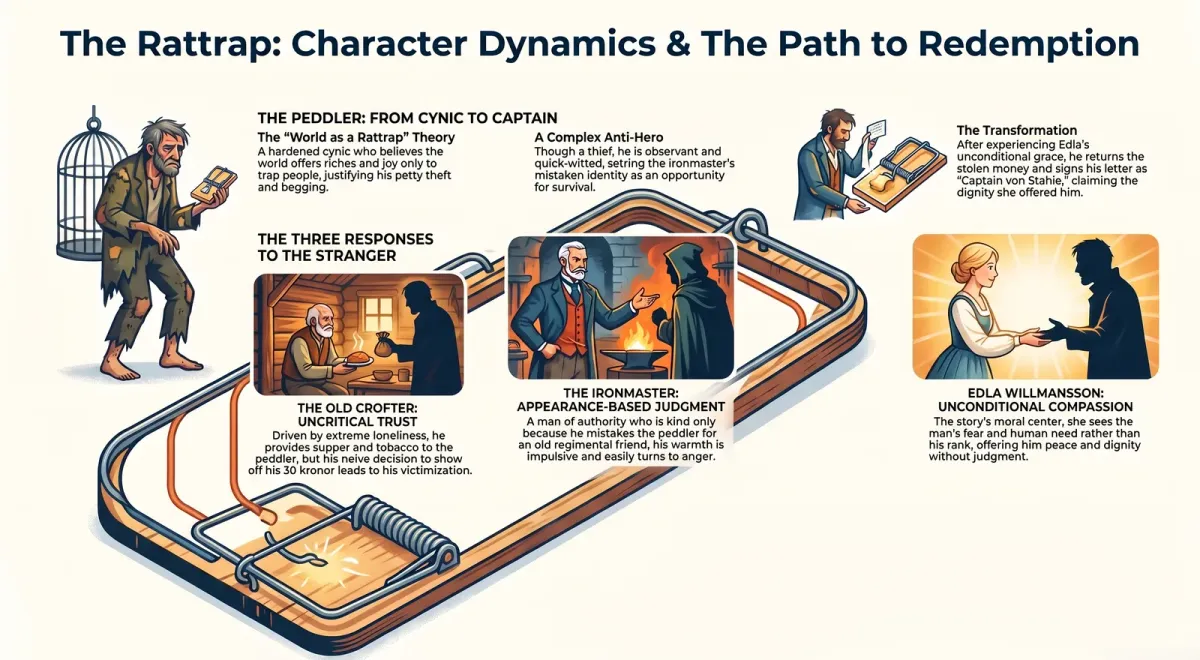
Selma Lagerlöf builds The Rattrap around four contrasting characters, each of whom responds differently to a ragged stranger on a cold winter’s night. Understanding how these characters think and change is central to answering character-based questions in your CBSE Class 12 English exam. This post breaks down the peddler, the old crofter, the ironmaster, and Edla Willmansson in detail.
The Peddler (later “Captain von Stahle”)
The peddler is the story’s central character, and also its most complex. When we first meet him he is a hardened cynic: poor, hungry, and reduced to begging and petty theft to survive. His invented theory — that the whole world is a giant rattrap baiting people with riches and comfort — reveals a man who has made peace with his own dishonesty by convincing himself that everyone, given the chance, would behave the same way.
Yet the peddler is never portrayed as purely villainous. He is quick-witted, capable of dry humour, and observant enough to seize the ironmaster’s mistaken identity to his own advantage. What makes him genuinely interesting is his capacity to change. Getting lost in the forest after stealing the crofter’s money forces him to literally live out his own metaphor, and Edla’s unconditional kindness at the manor house does what fear of the sheriff never could: it makes him feel ashamed of his dishonesty and gives him the will to make amends. By the end of the story, in returning the money and signing himself “Captain von Stahle,” he has claimed the dignity Edla extended to him and tried to live up to it.
The Old Crofter
The old crofter is a minor but important character who sets the story’s central irony in motion. A former worker at the Ramsjö Ironworks, he now lives alone, supported only by his cow’s milk. His defining trait is loneliness: he is so starved for company that a passing stranger’s presence is worth a free supper, shared tobacco, and a game of cards. His openness — going so far as to show off his thirty kronor savings — is entirely well-meaning, but it is also naive, and it is this same trusting nature that the peddler exploits. The crofter represents ordinary, undeserved victimhood in the story: unlike the ironmaster or Edla, he has no power to protect himself, and his loss is quietly set right only because of Edla’s compassion, not his own actions.
The Ironmaster
The ironmaster who owns the Ramsjö Ironworks is a study in contrasts. He is a man of authority and ambition, watching over his mill “night and day” to see that its iron reaches the market in the best condition. At first glance he seems proud and somewhat blind to appearances — he mistakes a ragged vagrant for an old regimental friend simply because of a resemblance in the firelight, and later reacts with anger and suspicion once he realises his error.
But the ironmaster is not simply harsh. His initial warmth toward the “captain” comes from real loneliness of his own: his wife Elizabeth is dead, his sons are abroad, and he openly admits he and his daughter wanted company for Christmas. Even after learning the truth, he chooses humour over punishment, calling the peddler’s rattrap speech “not so badly said” and letting him go without involving the sheriff. His character shows that behind his stern authority lies a fundamentally decent, if impulsive and appearance-driven, man — someone who reacts strongly in the moment but is capable of both mercy and self-correction.
Edla Willmansson
Edla, the ironmaster’s daughter, is the true moral centre of the story. Where her father judges by appearance and first assumes the stranger is a disgraced old comrade, Edla looks past both identity and suspicion to the man’s basic human need for dignity and rest. She notices his fear, quietly guesses that he may have “stolen something” or “escaped from jail,” and yet chooses compassion anyway, promising he is free to leave as he came.
Her insistence that he stay for Christmas Eve — “I don’t want him to go” — is not naivety but a deliberate act of grace: she wants to give one lonely wanderer a single day of peace in a year that otherwise offers him none. It is this consistency, treating the peddler with the same warmth whether he is a captain or a common thief, that ultimately earns his trust and transforms him. Edla embodies the theme Lagerlöf places at the heart of the story: that understanding and love, not judgment, are what awaken goodness in people.
How the Characters Work Together
Lagerlöf arranges these four characters so that each highlights a different response to the same stranger: the crofter’s uncritical trust, the ironmaster’s appearance-based judgment, and Edla’s unconditional compassion. Placed side by side, they trace the peddler’s journey from cynicism to redemption, making the character dynamics as important to the story’s meaning as its plot.
Related Reading
-
The Rattrap Summary and Analysis – CBSE Class 12 English Flamingo Chapter 4
-
Themes in The Rattrap: Materialism, Loneliness and Redemption Explained
-
Literary Devices in The Rattrap: Symbolism, Irony and Narrative Style
-
The Rattrap NCERT Solutions – Understanding the Text, Working with Words & More
Prepare Smarter with ChampionsPrep
Master character-based questions on Flamingo chapters like The Rattrap with structured notes and practice sets built for CBSE Class 12 English. It is free to register & pay as you use — so you only spend on the practice you actually need, whenever you need it.
Test Your Knowledge

The Rattrap Character Sketch: Peddler, Crofter, Ironmaster and Edla – CBSE Class 12
Frequently Asked Questions
What kind of person is the peddler at the start of The Rattrap? +
He is a poor, cynical vagrant who survives through begging and petty theft, and who has convinced himself that the world only exists to trap and exploit people.
Why is the old crofter important to the story despite his small role? +
He represents innocent trust and hospitality; his loneliness leads him to confide in a stranger, and his resulting loss sets the entire plot in motion.
How does the ironmaster's character change over the story? +
He moves from proud assumption and later anger at being deceived to amused forgiveness, showing a man capable of both authority and mercy.
What makes Edla Willmansson different from her father? +
Edla treats the peddler with consistent kindness regardless of his true identity or suspected dishonesty, while her father's warmth depends on mistaken assumptions.
Why does the peddler finally return the stolen money? +
Edla's unconditional respect and compassion make him feel genuinely valued for the first time, giving him the motivation to act honourably in return.
AI-powered practice — free to start