
The NCERT textbook itself draws attention to the distinctive style of “Poets and Pancakes,” asking students to notice its “chatty, rambling style” in which “one thought leads to another which is then dwelt upon at length.” Understanding how Asokamitran builds his humour and irony through specific literary techniques is essential for CBSE Class 12 exam answers on style and technique. Here is a detailed look at the chapter’s key literary devices and narrative choices.
First-Person Memoir Narration
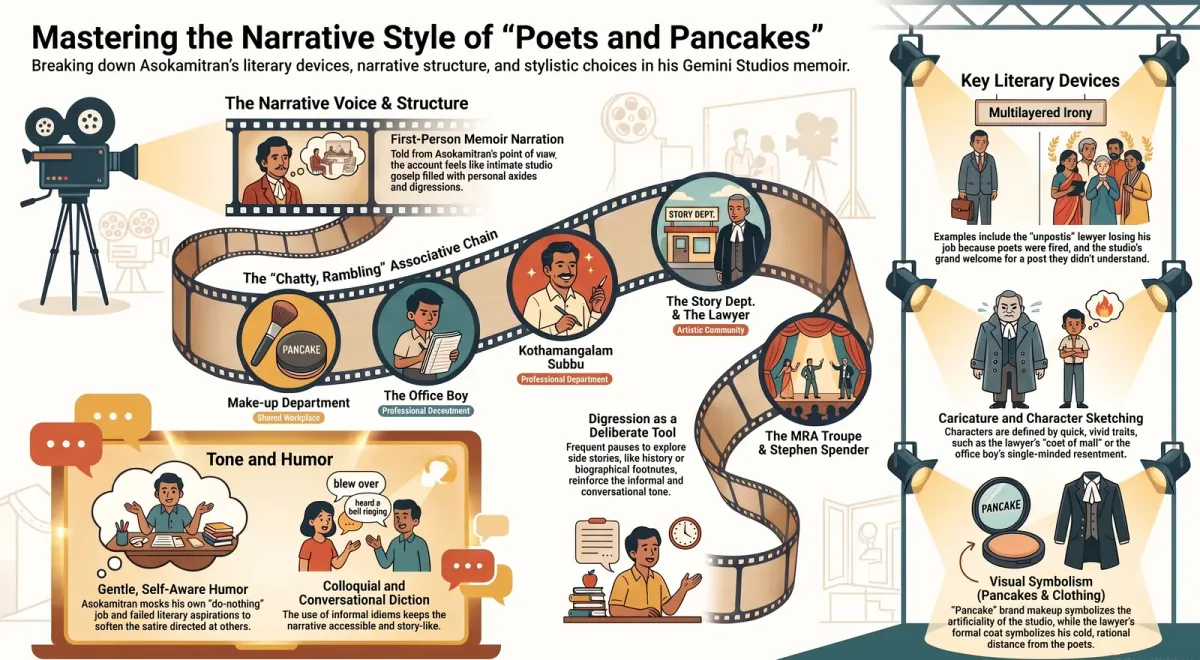
The chapter is told entirely from Asokamitran’s own point of view, drawing on his real experiences at Gemini Studios. This first-person memoir style gives the account an intimate, conversational quality — the narrator addresses the reader almost as a friend being told studio gossip, complete with asides, digressions, and personal opinions (“my conviction grows stronger day after day that prose-writing is not… the true pursuit of a genius”). Because the narrator is also a character within the events he describes, readers get both an outside view of the studio’s oddities and an inside sense of what it felt like to be dismissed as someone “doing next to nothing.”
The Chatty, Rambling Structure
Rather than following a single clear plot, the essay moves associatively: the make-up department leads to the office boy, the office boy’s resentment leads to Subbu, Subbu’s position leads to the Story Department and the lawyer, the poets of the Story Department lead to the MRA troupe, and the MRA episode leads naturally into the visit of the mysterious English poet. Each transition happens through a shared idea or person rather than strict chronology. The NCERT textbook’s own “Noticing Transitions” exercise asks students to trace exactly this chain — Make-up department, Office-boy, Subbu — reflecting how deliberately Asokamitran uses loose, associative links to hold a wide-ranging set of anecdotes together under one theme.
Gentle, Self-Aware Humour
Unlike satire that mocks its targets harshly, Asokamitran’s humour is warm and inclusive — he directs it at himself as readily as at others. He describes his own newspaper-cutting job with wry understatement, admits that “most people thought I was doing next to nothing,” and later mocks his own aspirations as a prose writer by praising, half-seriously, the “shrunken heart” of the rejected author who keeps submitting manuscripts anyway. This self-directed humour softens the chapter’s satire of others, such as the office boy’s inflated sense of wasted genius or the studio staff’s confused reverence for an English visitor nobody understands.
Irony
Irony operates throughout the chapter at multiple levels. There is situational irony in the lawyer losing his job specifically because the poets were let go, even though he was the least “poetic” member of the department. There is irony in the office boy resenting Subbu’s success while failing to see that his own bitterness, not lack of opportunity, keeps him stuck. And there is dramatic irony in the studio’s grand reception for Stephen Spender: the reader senses, well before the narrator explains it years later, that the staff’s total ignorance of who he actually is makes their elaborate welcome faintly absurd. The final revelation — that Spender was celebrated not for his poetry but for his anti-Communist credentials — recontextualises the entire episode retrospectively.
Caricature and Character Sketching
Asokamitran draws his characters in quick, vivid strokes rather than extended psychological analysis. The office boy is captured almost entirely through his obsessive lectures and his single-minded resentment of Subbu. The lawyer is defined by his clothing — pants, tie, and a coat “that looked like a coat of mail” — which visually separates him from the khadi-wearing poets around him. The Boss is sketched through the vague, uninformed speech he delivers to welcome Spender. This technique of caricature, sketching a person through one or two sharply chosen details, allows the essay to introduce many characters efficiently while still making each memorable.
Digression as a Deliberate Technique
The chapter repeatedly pauses its main narrative to explore side stories — the history of Robert Clive’s stables, footnoted biographical details about Greta Garbo and Vyjayantimala, and an extended reflection on why “prose-writing… cannot be the true pursuit of a genius.” Far from being careless, these digressions mirror the chatty, conversational voice the narrator adopts throughout, reinforcing the sense that this is an informal, personal recollection rather than a tightly plotted short story.
Colloquial and Conversational Diction
The chapter’s language stays deliberately informal and accessible, using idiomatic expressions like “blew over,” “catapulted into,” “played into their hands,” and “heard a bell ringing” — phrases the NCERT textbook specifically highlights for students to interpret from context. This colloquial diction supports the memoir’s conversational tone and makes even its more serious observations, about politics or ambition, feel like something told rather than formally argued.
Symbolism
Small details carry larger meaning. “Pancake,” the make-up brand, symbolises the artificiality the studio applies not just to actors’ faces but to its own workings — turning “decent-looking” people into “hideous crimson hued monster[s]” before they can appear presentable on screen. The lawyer’s coat “like a coat of mail” symbolises his defensive, rational distance from the more emotional, dreamy poets around him.
Related Reading
-
Poets and Pancakes Summary and Analysis – CBSE Class 12 English Flamingo Chapter 6
-
Poets and Pancakes Character Sketch – Subbu, the Lawyer & More (CBSE Class 12 Flamingo)
-
Poets and Pancakes Themes Explained – CBSE Class 12 English Flamingo Chapter 6
-
Poets and Pancakes NCERT Solutions – CBSE Class 12 English Flamingo Chapter 6
Start Learning with ChampionsPrep
Want to master literary devices across every Flamingo and Vistas chapter with structured practice? It is free to register & pay as you use — explore ChampionsPrep for CBSE Class 12 English resources built around exactly what your board exam expects.
Test Your Knowledge
Poets and Pancakes Literary Devices and Narrative Style – CBSE Class 12 Flamingo
Frequently Asked Questions
What narrative style does Asokamitran use in "Poets and Pancakes"? +
A first-person, chatty, and rambling memoir style in which one thought leads associatively to the next, as the NCERT textbook itself points out.
How does the author use humour in the chapter? +
Through gentle, self-aware humour that he directs at himself as often as at others, softening his satire of workplace envy and political naivety.
What are some examples of irony in the chapter? +
The lawyer losing his job because the poets were sent home, and the studio's grand but uninformed welcome for Stephen Spender, whose real significance only becomes clear years later.
How does the chapter use caricature to introduce characters? +
By sketching each character through one or two sharply chosen details, such as the lawyer's formal clothing or the office boy's obsessive lectures, rather than lengthy psychological description.
Why does the chapter include so many digressions? +
Because digressions match its conversational, memoir-like voice, mirroring how personal recollections naturally wander from one connected idea to another.
AI-powered practice — free to start