
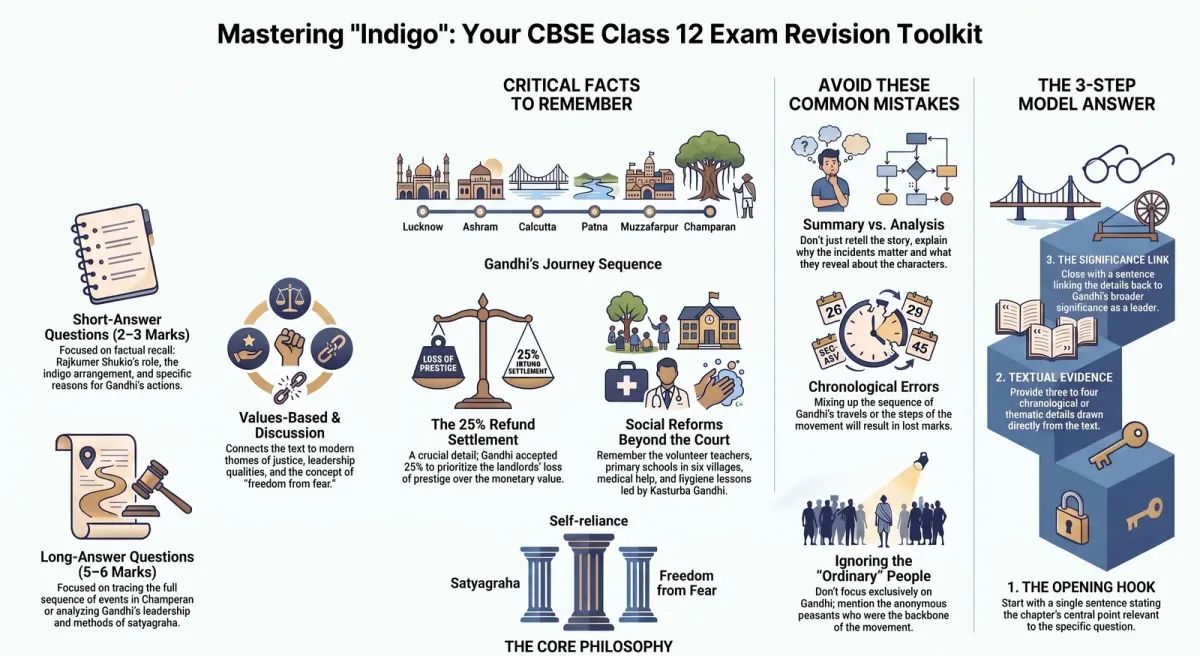
With board exams rewarding precise, example-backed answers, “Indigo” is a chapter where scoring well depends on recalling specific incidents, not just the general storyline. This post rounds out the ChampionsPrep series on the chapter with a focused set of likely exam questions, common mistakes to avoid, and a quick revision checklist.
How Indigo Is Usually Tested
CBSE Class 12 English papers typically draw on chapters like “Indigo” for short-answer questions (2–3 marks), long-answer questions (5–6 marks), and occasionally a values-based or discussion-style question connecting the text to real-world justice or leadership themes. Questions tend to cluster around four areas: the sequence of events in Champaran, Gandhi’s methods and character, the chapter’s central themes, and the significance of specific incidents like the courtroom scene or the Andrews episode.
Important Short-Answer Questions
Students should be ready to answer questions such as: Who was Rajkumar Shukla, and how did he convince Gandhi to visit Champaran? What was the ancient arrangement that bound Champaran’s sharecroppers to plant indigo? Why did the British landlords change their demands after synthetic indigo was developed? What did Gandhi mean when he said the peasants’ real relief was freedom from fear rather than legal victory? Why did Gandhi refuse Charles Freer Andrews’s offer to help? Each answer should be built from two or three concrete details drawn directly from the chapter’s events rather than vague generalisations.
Important Long-Answer Questions
Longer answers usually ask students to trace and interpret a full sequence of events, such as describing how the Champaran movement unfolded from Gandhi’s first meeting with Shukla to the final settlement, or explaining how the chapter illustrates Gandhi’s methods of satyagraha and non-violent resistance. Another common prompt asks students to discuss Gandhi as a leader, drawing on his fact-finding approach, his courtroom conduct, and his post-settlement social work in Champaran’s schools and health programmes. A strong answer moves chronologically, cites specific incidents, and closes by connecting those incidents back to the question’s central idea.
Values-Based and Discussion Questions
Examiners sometimes ask students to reflect on whether the poor remain free from fear even after Independence, or to discuss the qualities that make someone a good leader based on Gandhi’s conduct in the chapter. These questions reward original thinking supported by textual evidence — for instance, connecting Gandhi’s practical, ground-level reforms in Champaran to the idea that effective leadership addresses immediate human needs, not just abstract political goals.
Common Mistakes Students Make
A frequent error is treating “Indigo” as pure narrative and summarising events without analysing why they matter — examiners look for interpretation, not just retelling. Another common slip is confusing the sequence of Gandhi’s journey (Lucknow to his ashram, then Calcutta, Patna, and Muzzafarpur before Champaran), which costs marks on sequencing questions. Students also sometimes forget that Gandhi accepted only a 25 per cent refund rather than full repayment, a detail examiners frequently test because it reveals his priorities. Finally, many students overlook the chapter’s supporting theme — those anonymous, ordinary peasants — focusing exclusively on Gandhi and missing marks on questions about the freedom movement’s broader participants.
Quick Revision Checklist
Before an exam, students should be able to confirm they can: state who Rajkumar Shukla was and why his persistence mattered; list the key locations in Gandhi’s journey to Champaran in correct order; explain the old indigo sharecropping arrangement and why it changed; summarise what happened at Gandhi’s trial and why the case was eventually dropped; describe the 25 per cent settlement and why Gandhi accepted it; name at least three social reforms Gandhi initiated in Champaran beyond the legal case; explain why Gandhi refused Andrews’s help; and connect at least two chapter incidents to the ideas of satyagraha, self-reliance, and freedom from fear.
A Quick Model Answer Structure
For any long-answer question on this chapter, a reliable structure is: begin with one sentence stating the chapter’s central point relevant to the question, follow with three to four chronological or thematic details drawn from the text, and close with a one-sentence link back to Gandhi’s broader significance as a leader. This structure keeps answers focused, avoids unnecessary repetition, and demonstrates the kind of analytical thinking examiners reward at the Class 12 level.
Final Revision Tip
Rather than re-reading the entire chapter the night before an exam, students get more value from reviewing the sequence of events, the key quotations examiners commonly reference (such as Gandhi’s remarks on freedom from fear or self-reliance), and two or three practised long-answer responses. Pairing this with the character, theme, and literary-device breakdowns in the earlier posts of this series should cover the chapter comprehensively for board preparation.
Start Learning Smarter with ChampionsPrep
Want practice questions, revision checklists, and exam-ready notes for every Flamingo chapter, all in one place? ChampionsPrep helps CBSE and Maharashtra Board Class XI–XII students prepare for boards and entrance exams like CUET, IPMAT, NPAT, and SET with structured, exam-focused content. It is free to register & pay as you use — explore ChampionsPrep today.
Test Your Knowledge

Indigo Exam Tips, Important Questions and Revision Checklist – CBSE Class 12
Frequently Asked Questions
What kind of questions are most commonly asked from Indigo in CBSE exams? +
Short-answer questions on plot details and character, long-answer questions tracing the Champaran movement or analysing Gandhi's leadership, and occasional values-based discussion questions.
What is a common mistake students make when answering questions on this chapter? +
Summarising events without analysis, or getting the sequence of Gandhi's journey to Champaran out of order, both of which cost marks in exams.
What specific detail about the settlement should students remember for exams? +
Gandhi accepted a 25 per cent refund rather than demanding full repayment, prioritising the landlords' loss of prestige over the exact amount recovered.
How should students structure a long-answer response on Indigo? +
Start with a topic sentence answering the question directly, support it with three to four specific chapter details in order, and end by linking the details back to Gandhi's broader significance.
What social reforms did Gandhi undertake in Champaran beyond the legal case? +
He arranged for volunteer teachers and opened primary schools in six villages, brought in a doctor for basic healthcare, and had his wife teach hygiene and sanitation.
AI-powered practice — free to start