
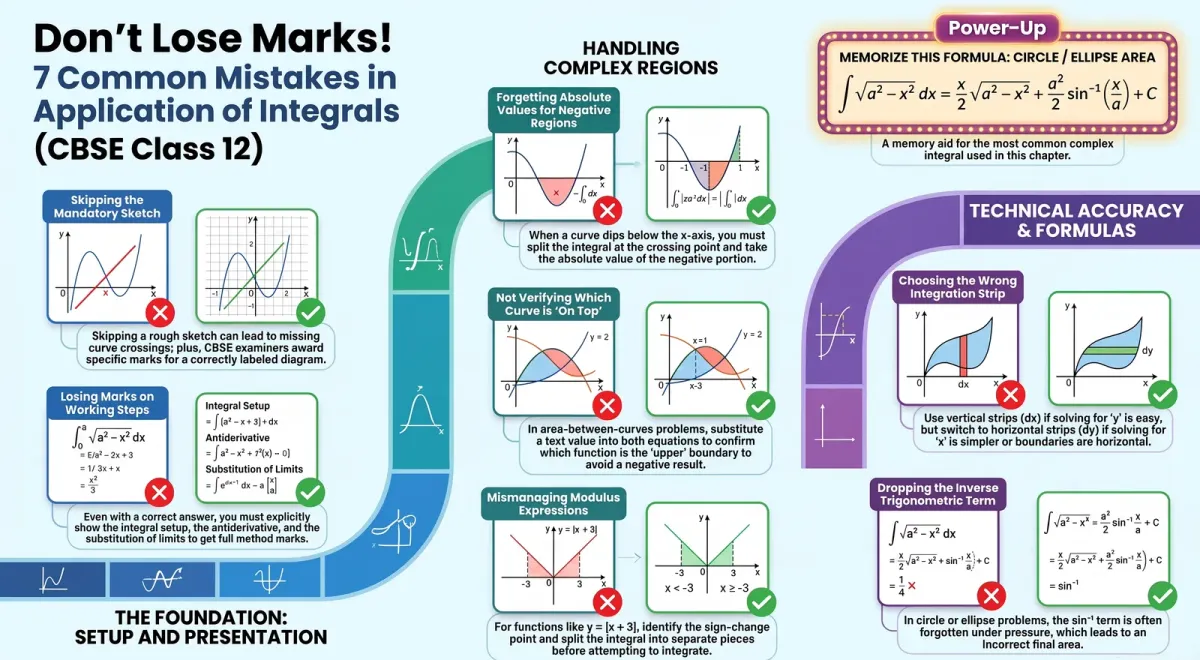
Application of Integrals is a chapter where students often understand the theory perfectly well but still lose marks — not because they don’t know the method, but because of small, repeatable errors under exam pressure. This post walks through the mistakes examiners see most often, and exactly how to avoid each one.
Mistake 1: Skipping the Sketch
It’s tempting to jump straight into integration, especially when you’re confident about the formula. But without a rough sketch, it’s easy to miss whether a curve dips below the x-axis, where two curves cross, or which curve lies “on top” in a shared region. A 30-second sketch often prevents a completely wrong final answer, and CBSE examiners specifically award marks for a correctly labeled diagram — so skipping it costs you twice.
Fix: Before writing a single integral, sketch the curve(s) and shade the region you’re finding the area of. Mark the x-axis crossings and intersection points clearly.
Mistake 2: Forgetting the Absolute Value for Negative Regions
When a curve lies below the x-axis, its definite integral over that portion comes out negative. Many students either report this negative number as the final answer, or worse, add it directly to a positive portion without correcting the sign first.
Fix: Whenever a curve crosses the x-axis within your interval, split the integral at the crossing point. Evaluate each piece separately, take the absolute value of any negative piece, and then add the magnitudes together.
Mistake 3: Mixing Up Vertical and Horizontal Strips
Some problems are far easier to solve using y = f(x) and vertical strips (dx), while others are much cleaner using x = g(y) and horizontal strips (dy). Students who default to one method regardless of the problem often end up with unnecessarily messy algebra — or get stuck entirely.
Fix: Look at the given equation. If solving for y is straightforward, use vertical strips. If x is easier to isolate, or if the boundaries are given as horizontal lines (y = c, y = d), switch to horizontal strips instead.
Mistake 4: Forgetting the Inverse Trigonometric Term in Circle/Ellipse Integrals
The standard result ∫√(a² − x²) dx = (x/2)√(a² − x²) + (a²/2) sin⁻¹(x/a) + C has two parts. Under time pressure, it’s common to write only the algebraic part and drop the sin⁻¹ term entirely — which silently produces a wrong final answer, since the sin⁻¹ term is exactly what contributes at the upper limit.
Fix: Write out this standard integral result from memory before you need it, as a quick warm-up at the start of any circle or ellipse question, so it’s fresh and complete when you use it.
Mistake 5: Not Verifying Which Curve Is “On Top”
In area-between-two-curves problems, assuming which curve is larger — rather than checking — is a frequent source of a negative (and therefore clearly wrong) final answer.
Fix: After finding the points of intersection, substitute a test value from inside the interval into both equations. Whichever gives the larger y-value (or x-value, for horizontal strips) is the “upper” curve for that interval.
Mistake 6: Incorrectly Simplifying Piecewise or Modulus Expressions
Expressions involving |x|, such as y = x|x| or y = |x + 3|, behave differently depending on the sign of x (or x + 3). Treating them as a single smooth function across the whole interval — without splitting at the sign-change point — is a very common and easily avoidable error.
Fix: Identify exactly where the expression inside the modulus changes sign, split your integral there, and rewrite the function separately for each piece before integrating.
Mistake 7: Losing Marks on Presentation, Not Just Calculation
Even a correct numerical answer can lose marks if the working doesn’t clearly show the setup: the equation used, the limits of integration, and the final substitution step. CBSE awards marks for method, not just the final number.
Fix: Write your integral setup explicitly before evaluating it — don’t skip straight from the sketch to the final numeric answer. Show the antiderivative and the substitution of both limits as separate, visible steps.
A Quick Pre-Exam Self-Check
Before your board exam, test yourself on these questions: Can you state the standard integral for √(a² − x²) from memory, including the sin⁻¹ term? Can you correctly identify where a cubic or trigonometric curve changes sign within a typical interval? Can you decide, at a glance, whether vertical or horizontal strips will be easier for a given curve? If you can answer “yes” to all three confidently, you’ve addressed the most common sources of lost marks in this chapter.
Related Reading
-
Area Between Two Curves: Class 12 Integration Methods Explained
-
Top Solved Examples & Important Questions: Application of Integrals Class 12
-
Area of a Circle Using Integration: Step-by-Step Derivation (πr²)
Ready to Practice?
Knowing these mistakes is the first step — catching them in your own work under timed conditions is what actually moves your score. Get instant, step-by-step doubt resolution on ChampionsPrep for just ₹10 per use, so every mistake gets corrected before your exam, not during it. Practice on ChampionsPrep →
Test Your Knowledge
Common Mistakes to Avoid in Application of Integrals (CBSE Class 12 Exam Tips)
Frequently Asked Questions
What is the most common mistake students make in Application of Integrals? +
Forgetting to take the absolute value when a curve lies below the x-axis, which leads to an incorrect, often negative, final answer.
Why does skipping the sketch cost marks even if the final answer is correct? +
CBSE examiners specifically award marks for a correctly labeled diagram of the bounded region, separate from the marks for the calculation itself.
How do I know whether to use vertical or horizontal strips? +
Choose whichever variable, x or y, is easier to isolate in the given curve equation, or match the direction of the given boundary lines.
What should I memorize before the exam for circle and ellipse questions? +
The standard integral ∫√(a² − x²) dx = (x/2)√(a² − x²) + (a²/2) sin⁻¹(x/a) + C, including the inverse trigonometric term, which students often forget.
How can I avoid errors with modulus functions like x|x|? +
Identify where the expression inside the modulus changes sign, split the integral at that point, and rewrite the function separately for each piece before integrating.
AI-powered practice — free to start