
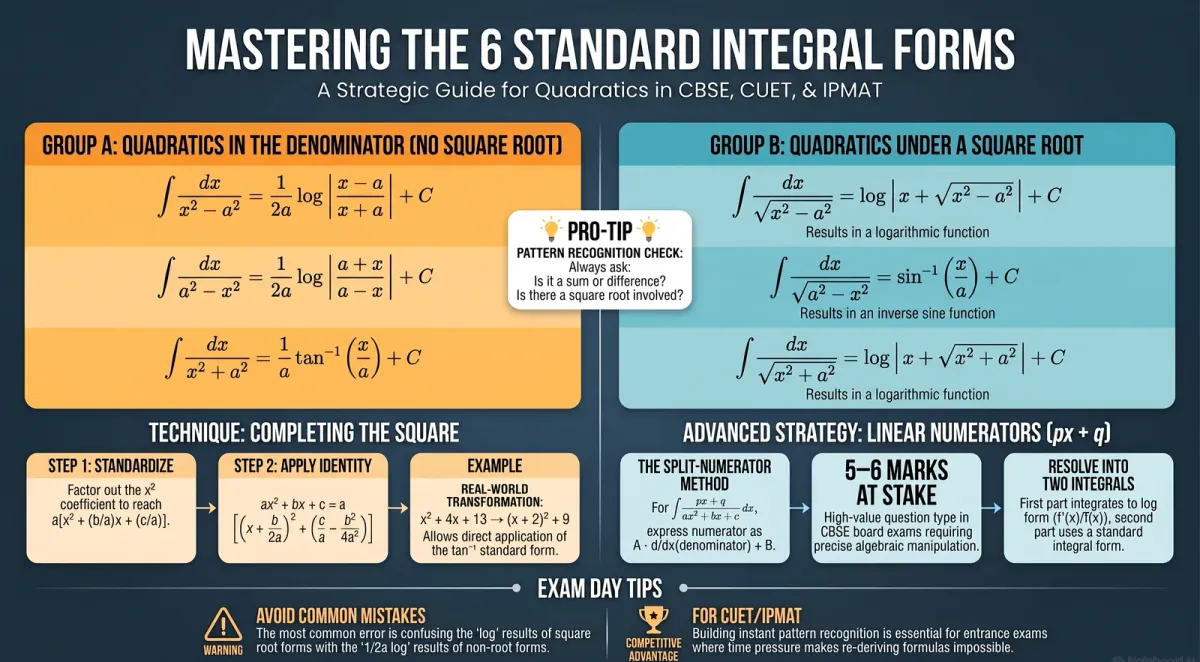
Some integrals show up so frequently in Class 12 board exams — and in the tougher problems involving quadratic expressions under a square root or in a denominator — that CBSE treats them as standard results to be memorized outright, rather than derived from scratch each time. This guide covers all six standard forms, shows you exactly how “completing the square” extends their reach to virtually any quadratic expression, and walks through solved examples of increasing difficulty.
The Six Standard Integral Results
These results, each provable using substitution or partial fractions, should be committed to memory:
-
∫dx/(x²−a²) = (1/2a) log|(x−a)/(x+a)| + C
-
∫dx/(a²−x²) = (1/2a) log|(a+x)/(a−x)| + C
-
∫dx/(x²+a²) = (1/a) tan⁻¹(x/a) + C
-
∫dx/√(x²−a²) = log|x + √(x²−a²)| + C
-
∫dx/√(a²−x²) = sin⁻¹(x/a) + C
-
∫dx/√(x²+a²) = log|x + √(x²+a²)| + C
Notice the pattern: forms 1–3 involve a quadratic in the denominator (leading to logarithms or inverse tangent), while forms 4–6 involve a square root (leading to logarithms of a different type or inverse sine). Confusing these six is one of the most common errors students make — always double-check whether you’re dealing with a sum or difference, and whether there’s a square root involved.
Direct Application: When the Quadratic Is Already Perfect
Example 1: Evaluate ∫dx/(x²−16)
Here a = 4, matching form 1 directly:
= (1/8) log|(x−4)/(x+4)| + C
Example 2: Evaluate ∫dx/√(25−x²)
Here a = 5, matching form 5:
= sin⁻¹(x/5) + C
These direct applications are the easiest marks in this topic — as long as you correctly identify which of the six forms applies.
Completing the Square: Extending the Formulas
Most exam questions don’t hand you a “clean” x² − a² expression. Instead, you’ll see something like x² + 4x + 13, which needs to be rewritten in the form (x + p)² ± q² before any standard formula applies. This technique is called completing the square, and it’s essential for this entire topic.
General approach for ax² + bx + c:
ax² + bx + c = a[(x + b/2a)² + (c/a − b²/4a²)]
Once rewritten this way, substitute t = x + b/2a (so dt = dx), and the integral reduces to one of the six standard forms in terms of t.
Example 3: Evaluate ∫dx/(x² + 4x + 13)
Complete the square: x² + 4x + 13 = (x + 2)² + 9
This matches form 3 with a = 3, and t = x + 2:
= (1/3) tan⁻¹[(x + 2)/3] + C
Example 4: Evaluate ∫dx/√(4x − x²)
Complete the square: 4x − x² = −(x² − 4x) = −[(x − 2)² − 4] = 4 − (x − 2)²
This matches form 5 with a = 2, and t = x − 2:
= sin⁻¹[(x − 2)/2] + C
Handling a Linear Numerator: (px + q) Forms
A step up in difficulty involves integrals of the form ∫(px + q)/(ax² + bx + c) dx. The strategy is to express the numerator as a combination of the derivative of the denominator plus a constant:
px + q = A · d/dx(ax² + bx + c) + B = A(2ax + b) + B
Comparing coefficients gives you the values of A and B, after which the integral splits into two parts: one that integrates to a logarithm (since it’s of the form f′(x)/f(x)), and one that reduces to a standard form.
Example 5: Evaluate ∫(x + 2)/(2x² + 6x + 5) dx
Write x + 2 = A(4x + 6) + B. Comparing coefficients: 4A = 1 and 6A + B = 2, giving A = 1/4 and B = 1/2.
= (1/4)∫(4x+6)/(2x²+6x+5) dx + (1/2)∫dx/(2x²+6x+5)
The first part integrates to (1/4)log|2x²+6x+5|. For the second part, complete the square inside 2x²+6x+5 = 2[(x+3/2)² + 1/4], leading to a tan⁻¹ term. The full working typically appears as a 5–6 mark board question, so practicing this exact pattern is high-value exam prep.
Why This Topic Matters for CUET and Competitive Exams
Beyond CBSE boards, quadratic-based integrals frequently appear in CUET’s Mathematics/Applied Mathematics domain paper and in quantitative sections of IPMAT and similar entrance tests. Since these problems often require you to recognize the correct standard form quickly under time pressure, building instant pattern recognition — rather than re-deriving from scratch each time — is a genuine competitive advantage.
Ready to Master Quadratic Integrals?
Completing the square and matching the correct standard form takes deliberate, repeated practice — not just formula memorization. ChampionsPrep’s AI-powered doubt resolution and topic-wise practice sets, available at ₹10 per use, let you drill exactly this skill until it’s automatic. Practice Standard Integral Forms on ChampionsPrep →
Test Your Knowledge
Standard Integral Forms: x²±a² Formulas for Class 12 Maths
Frequently Asked Questions
How do I remember which of the six standard integral forms to use? +
Check two things: whether the a-squared and x-squared term is a sum or a difference, and whether there is a square root involved. These two checks narrow it down to exactly one of the six formulas every time.
What if the coefficient of x squared isn't 1? +
Factor out the leading coefficient first, then complete the square inside the brackets before applying the standard formula.
Do I always need to complete the square? +
Only when the quadratic expression is not already in the form x squared plus or minus a squared. If it is already a perfect difference or sum of squares, apply the standard formula directly.
How is the linear-numerator form different from the basic six formulas? +
It has a linear numerator, so it requires splitting the numerator into a multiple of the denominator's derivative plus a constant, creating two separate integrals rather than one direct formula application.
Are these standard forms used in definite integrals too? +
Yes. Once you find the indefinite integral using these standard forms, you substitute the upper and lower limits to evaluate any corresponding definite integral.
AI-powered practice — free to start