
The Konigsberg Bridge Problem: How Euler Invented Graph Theory
Some of the most powerful branches of mathematics were born from puzzles that seemed like nothing more than curious games. The Konigsberg Bridge Problem is one of the best examples of this — a simple walking puzzle from an 18th-century town that led Swiss mathematician Leonhard Euler to invent an entirely new way of representing problems: the network. This idea, explained in the CBSE Class 11 NCERT Appendix on Mathematical Modelling, marked the beginning of what we now call graph theory.
The Setting: A Town Divided by a River
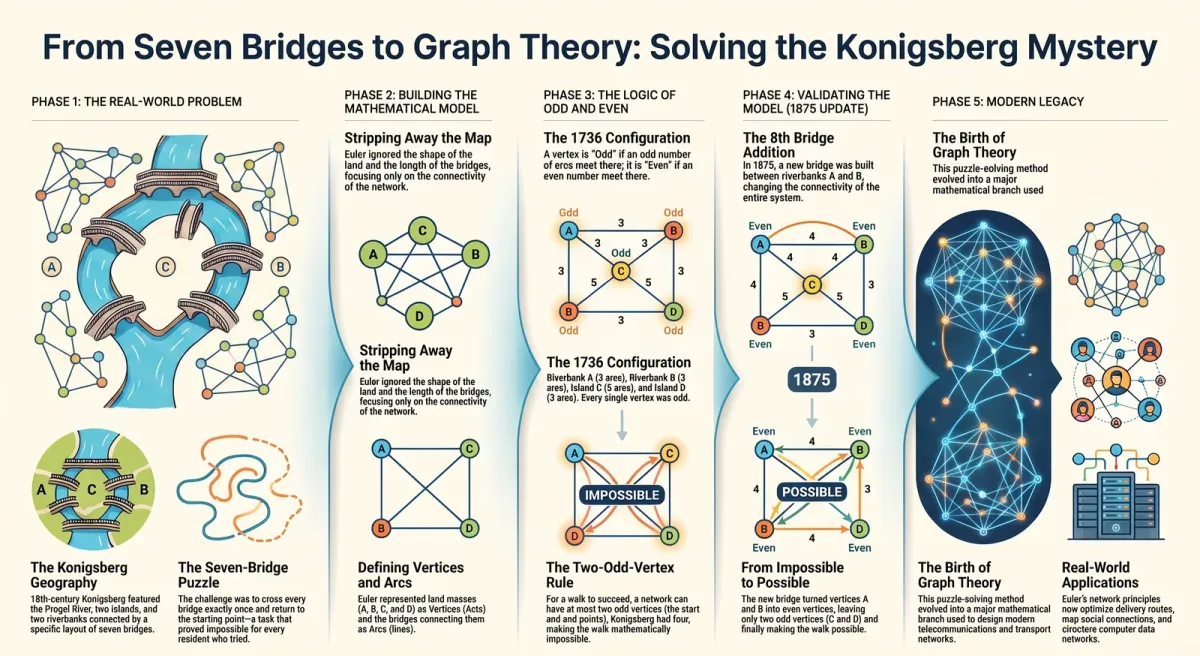
Konigsberg was a town on the Pregel River, a German town in the 18th century that is now part of Russia. Within the town were two river islands connected to the two riverbanks by seven bridges in total. Naturally, people began wondering whether it was possible to take a walk around the town that crossed each of the seven bridges exactly once and returned to the starting point. Despite many attempts, no one could find such a route, and it became known as a genuinely difficult problem.
Euler’s Insight: Turning a Map into a Network
In 1736, Leonhard Euler — who was working in the service of the Russian empire under Catherine the Great — heard about the Konigsberg puzzle and proved that the walk was impossible. What made his proof revolutionary was not just the conclusion, but the method: Euler stripped away every irrelevant geographic detail and represented the problem using a diagram called a network, made up of two basic elements:
-
Vertices — dots representing the places where lines meet (here, the two riverbanks and the two islands)
-
Arcs — lines connecting the vertices (here, the seven bridges)
Euler used four vertices, labelled A and B for the two riverbanks and C and D for the two islands. The seven arcs represented the seven bridges. Crucially, Euler realised that the exact shape of the land masses did not matter for this problem — only how many bridges connected each landmass to the others.
Counting the Connections
When Euler counted the arcs meeting at each vertex, he found:
-
3 bridges connect to riverbank A
-
3 bridges connect to riverbank B
-
5 bridges connect to island C
-
3 bridges connect to island D
Every single vertex has an odd number of arcs attached to it. Euler called such a vertex an odd vertex, in contrast to an even vertex, which would have an even number of arcs joining it.
Why an Odd Number of Bridges Breaks the Walk
The goal was to travel around the town crossing each bridge exactly once — in network terms, tracing over every arc exactly once while visiting every vertex. Euler proved this could not be done in Konigsberg because of a key rule about odd vertices.
If a vertex is odd, any walk that passes through it (entering by one arc and leaving by another) uses up its arcs two at a time. An odd vertex, having an odd number of arcs, can therefore never be fully “used up” by passing through — one arc will always be left over unless the walker either begins or ends their journey exactly at that vertex.
Since a single walk has only one beginning and one end, at most two vertices in the entire network can be odd if the walk is to succeed. But the Konigsberg bridge network has four odd vertices — A, B, C, and D. With four odd vertices and only two possible “special” endpoints (the start and the end of the walk), the journey is mathematically impossible. This elegant argument, built entirely from counting, settled a question that had stumped ordinary trial and error.
A New Bridge, A New Answer
The story does not end there. In 1875, more than a century after Euler’s proof, an extra bridge was built in Konigsberg, directly joining the land areas of riverbanks A and B. This single addition changed the entire structure of the network.
After the new bridge was added, vertices A and B each gained one more arc, turning both of them into even vertices. However, vertices C and D still had an odd number of arcs each. With exactly two odd vertices remaining (C and D), the walk becomes possible — provided the traveller starts at one of the odd vertices and ends at the other. So, after 1875, it was possible for the people of Konigsberg to walk around their city crossing each bridge exactly once.
From a Puzzle to a Mathematical Discipline
Euler’s network idea did far more than solve one town’s walking puzzle. It launched an entirely new branch of mathematics called graph theory, which today is used to plan and map railway networks, design computer and telecommunication networks, model social connections, and optimise delivery routes. The Konigsberg Bridge Problem remains one of the clearest illustrations in the NCERT curriculum of how mathematical modelling works: a messy real-world situation is simplified into vertices and arcs, a general rule is proved about that simplified structure, and the rule is then applied back to answer the original question decisively.
Keep Learning
-
What Is Mathematical Modelling? Meaning, Need & Real-Life Examples
-
The Four Steps of Mathematical Modelling Explained with the Simple Pendulum
-
Exponential Growth Models: How Mathematics Predicts Population Growth
Start Practising with ChampionsPrep
Curious problems like Konigsberg’s bridges show how mathematics turns real-world puzzles into elegant proofs. Build the same problem-solving instinct with ChampionsPrep’s AI-powered practice platform for CBSE and Maharashtra Board Class 11–12 Commerce students. Registration is free, and you only pay as you use — no hidden fees.
Test Your Knowledge

The Konigsberg Bridge Problem: How Euler Invented Graph Theory (Class 11 Maths)
Frequently Asked Questions
What is the Konigsberg Bridge Problem? +
It is a classic puzzle asking whether a person could walk around the 18th-century town of Konigsberg, crossing each of its seven bridges exactly once. Leonhard Euler proved in 1736 that this was impossible.
What is an odd vertex in graph theory? +
An odd vertex is a point in a network where an odd number of arcs (lines) meet. Konigsberg's original bridge network had four odd vertices, which is why the walk could not be completed.
How many odd vertices can a network have for a walk to be possible? +
A network can have at most two odd vertices for a walk that crosses every arc exactly once to be possible — and in that case, the walk must start at one odd vertex and end at the other.
Why did the extra bridge built in 1875 make the walk possible? +
The new bridge connected riverbanks A and B directly, giving both of them one additional arc and turning them into even vertices. This left only two odd vertices (C and D), satisfying the condition for a successful walk.
What branch of mathematics did the Konigsberg Bridge Problem lead to? +
It led to the development of graph theory, a field that uses vertices and arcs to model and solve problems in areas like railway networks, computer networks, and route planning.
AI-powered practice — free to start