
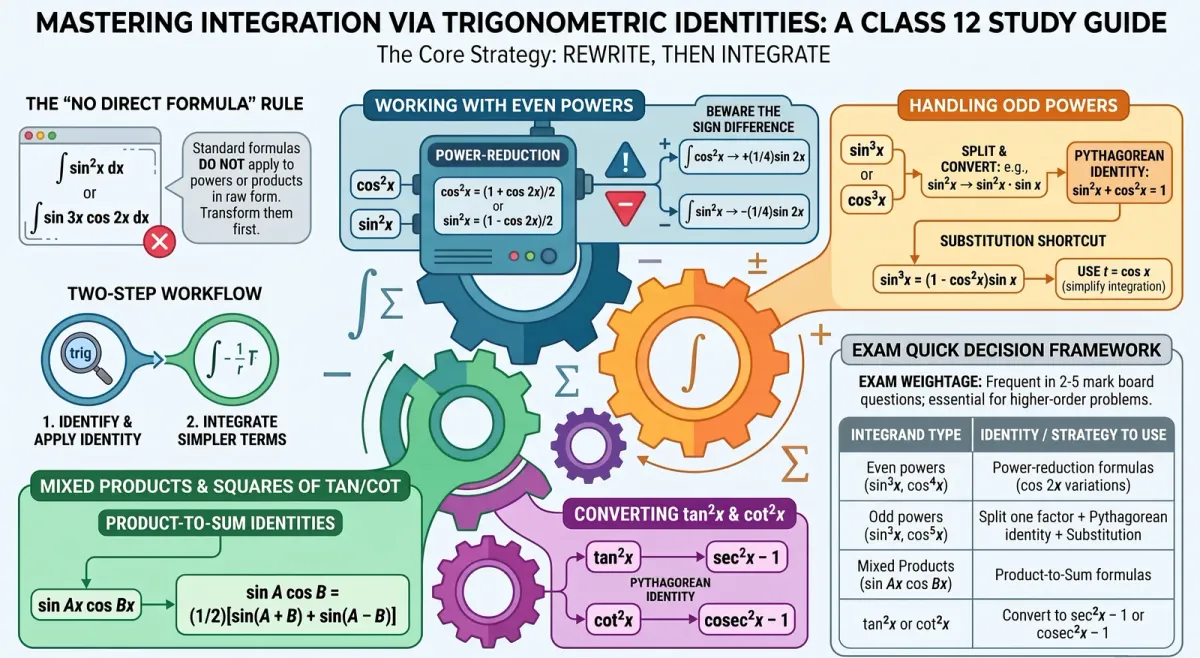
Trigonometric integrands like sin²x, cos³x, or sin 3x cos 2x can’t be integrated directly using standard formulas — none of the basic rules apply to powers or products of trigonometric functions in their raw form. The solution is to first rewrite the expression using a trigonometric identity, converting it into a form that standard formulas can handle. This is one of the most exam-favorite techniques in CBSE Class 12 Maths Chapter 7, and mastering it will save you significant time in both board exams and competitive tests like CUET.
Why We Need Identities Before Integrating
There is no direct formula for ∫sin²x dx or ∫cos³x dx in their original form. However, using identities like the power-reduction formulas or product-to-sum rules, these expressions can be rewritten as sums of simpler terms — each of which matches a standard integral. This “rewrite, then integrate” approach is the core strategy for this entire topic.
Power-Reduction Identities for sin²x and cos²x
Two identities you’ll use constantly:
-
cos 2x = 2cos²x − 1 ⟹ cos²x = (1 + cos 2x)/2
-
cos 2x = 1 − 2sin²x ⟹ sin²x = (1 − cos 2x)/2
Example 1: Evaluate ∫cos²x dx
Using the identity: ∫(1 + cos 2x)/2 dx = (1/2)∫dx + (1/2)∫cos 2x dx = x/2 + (1/4)sin 2x + C
Example 2: Evaluate ∫sin²x dx
= (1/2)∫(1 − cos 2x)dx = x/2 − (1/4)sin 2x + C
Notice the sign difference between the two results — a common point of confusion that examiners test directly.
Integrating Odd Powers: sin³x and cos³x
For odd powers, a different strategy works better: split off one factor and convert the rest using the Pythagorean identity sin²x + cos²x = 1.
Example 3: Evaluate ∫sin³x dx
Using sin 3x = 3 sin x − 4 sin³x, we can write sin³x = (3 sin x − sin 3x)/4. Then:
= (3/4)∫sin x dx − (1/4)∫sin 3x dx = −(3/4)cos x + (1/12)cos 3x + C
Alternatively, this can be solved using substitution: write sin³x = sin²x · sin x = (1 − cos²x) sin x, let t = cos x, and integrate −∫(1 − t²)dt. Both methods give equivalent answers (though they may look different due to different constants of integration), and it’s worth practicing both to see how they connect.
Product-to-Sum Formulas for Mixed Products
When the integrand is a product of sines and cosines with different arguments (like sin 2x cos 3x), direct integration is impossible. Instead, use the product-to-sum identity:
sin A cos B = (1/2)[sin(A+B) + sin(A−B)]
Example 4: Evaluate ∫sin 4x cos 3x dx
Using the identity: sin 4x cos 3x = (1/2)[sin 7x + sin x]
= (1/2)∫sin 7x dx + (1/2)∫sin x dx = −(1/14)cos 7x − (1/2)cos x + C
Similar identities exist for cos A cos B and sin A sin B — always check which pair of angles is involved before choosing the identity.
Integrating tan²x and cot²x
These use the Pythagorean identities sec²x − tan²x = 1 and cosec²x − cot²x = 1:
-
tan²x = sec²x − 1, so ∫tan²x dx = tan x − x + C
-
cot²x = cosec²x − 1, so ∫cot²x dx = −cot x − x + C
These conversions are quick but frequently forgotten under exam pressure — practice them until they’re automatic.
A Combined Example: Higher Powers with Multiple Steps
Example 5: Evaluate ∫sin³x cos²x dx
Write sin³x = sin x (1 − cos²x), so the integrand becomes sin x (1 − cos²x) cos²x. Let t = cos x, dt = −sin x dx:
= −∫(1 − t²)t² dt = −∫(t² − t⁴)dt = −t³/3 + t⁵/5 + C = −(1/3)cos³x + (1/5)cos⁵x + C
This combines the “split an odd power” strategy with substitution — a pattern that appears often in 5-mark board questions.
Choosing the Right Identity: A Quick Decision Framework
-
Even powers of sin/cos alone (like sin²x, cos⁴x) → use power-reduction formulas
-
Odd powers of sin/cos alone → split one factor, use Pythagorean identity, then substitute
-
Products of sin/cos with different arguments → use product-to-sum formulas
-
tan²x or cot²x → convert using sec²x or cosec²x identities
Keeping this framework in mind during your revision will help you instantly recognize which identity a given problem requires — a skill that directly translates into faster, more accurate answers in timed exams.
Ready to Practice Trigonometric Integration?
Recognizing the right identity under exam pressure takes repeated practice, not just formula memorization. ChampionsPrep offers AI-powered doubt resolution and topic-wise practice questions at ₹10 per use, so you can drill this exact skill until it becomes second nature. Practice Trigonometric Integrals on ChampionsPrep →
Test Your Knowledge
Integration Using Trigonometric Identities: Class 12 Maths Guide
Frequently Asked Questions
Why can't I integrate sin squared x directly using a standard formula? +
Because there is no basic formula for powers of trigonometric functions. You must first rewrite it using a power-reduction identity, which converts it into terms that do have standard integrals.
What is the difference between the strategy for even and odd powers? +
Even powers use power-reduction identities to convert into constants and cosine multiples. Odd powers are better handled by splitting off one factor and applying substitution.
How do I know which product-to-sum formula to use? +
It depends on whether you have a product of sine and cosine, two sines, or two cosines. Match the pattern in your integrand to the correct identity.
Are there different-looking correct answers for the same integral? +
Yes. Two valid methods can produce answers that look different but are actually the same family of functions, differing only in how the constant of integration is expressed.
How important is this topic for CBSE board exams? +
Very. Trigonometric integration appears in nearly every board paper and frequently combines with substitution or integration by parts in longer problems.
AI-powered practice — free to start