
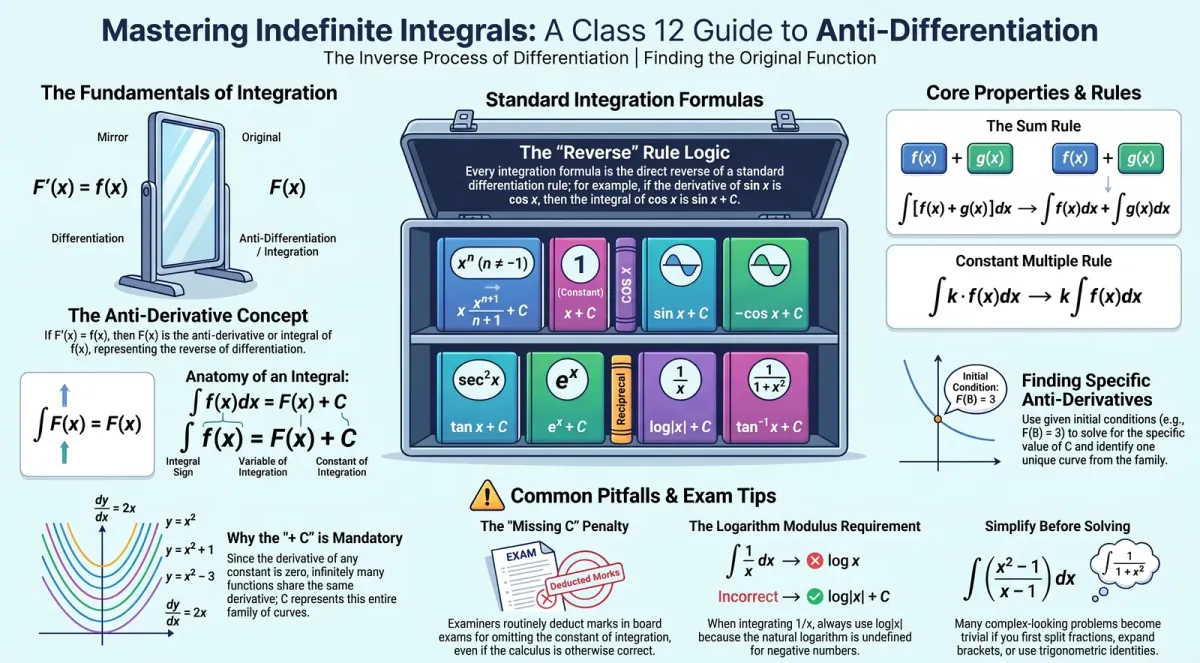
If differentiation asks “what is the rate of change of this function?”, integration asks the opposite: “given the rate of change, what was the original function?” This reverse process is called anti-differentiation, and it forms the foundation of Chapter 7 (Integrals) in CBSE Class 12 Maths. Whether you’re solving board problems or tackling quant sections in CUET, IPMAT, or NPAT, a solid grip on indefinite integrals is non-negotiable. This guide breaks down the formulas, properties, and techniques you need — with worked examples.
What Is an Indefinite Integral?
An indefinite integral represents the entire family of anti-derivatives of a function. If F(x) is a function such that F′(x) = f(x), then F(x) is called an anti-derivative (or integral) of f(x). Since the derivative of any constant is zero, F(x) + C is also a valid anti-derivative for any real number C.
We write this as:
∫f(x) dx = F(x) + C
Here, f(x) is the integrand, x is the variable of integration, and C is the constant of integration. The ∫ symbol connects indefinite integrals to definite integrals and area calculations later in the chapter.
Why Do We Always Add ”+ C”?
This is one of the most commonly misunderstood ideas in the chapter. Since differentiating a constant always gives zero, infinitely many functions share the same derivative — they just differ by a constant. For example, sin x + 1, sin x + 5, and sin x − 3 all have the same derivative, cos x. So when we integrate cos x, we can’t pin down one specific function; instead, we represent the entire family using sin x + C.
This is more than a technicality — examiners routinely deduct marks for a missing ”+ C” in board exams, so make it a habit from day one.
Standard Integration Formulas You Must Memorize
These formulas are derived directly from standard derivative results, and they form the backbone of every integration problem you’ll face:
| Function | Integral |
|---|---|
| xⁿ (n ≠ −1) | xⁿ⁺¹/(n+1) + C |
| 1 | x + C |
| cos x | sin x + C |
| sin x | −cos x + C |
| sec²x | tan x + C |
| cosec²x | −cot x + C |
| sec x tan x | sec x + C |
| cosec x cot x | −cosec x + C |
| 1/√(1−x²) | sin⁻¹x + C |
| 1/(1+x²) | tan⁻¹x + C |
| eˣ | eˣ + C |
| aˣ | aˣ/log a + C |
| 1/x | log|x| + C |
Notice the pattern: each formula is simply the reverse of a familiar differentiation rule. Instead of memorizing them as isolated facts, try deriving each one from its corresponding derivative — it sticks better and helps during revision.
Key Properties of Indefinite Integrals
Beyond the standard formulas, five core properties let you break complicated integrals into manageable pieces:
-
Differentiation and integration are inverse processes: d/dx[∫f(x)dx] = f(x), and ∫f′(x)dx = f(x) + C.
-
Two integrals with the same derivative are equivalent — they belong to the same family of curves, differing only by a constant.
-
Sum rule: ∫[f(x) + g(x)]dx = ∫f(x)dx + ∫g(x)dx
-
Constant multiple rule: ∫k·f(x)dx = k∫f(x)dx, for any real number k
-
These generalize to any finite number of functions and constants.
These let you split a messy expression into simpler standard integrals.
Solved Examples
Example 1: Find ∫(x³ − 1)/x² dx
Split the fraction first: ∫(x − x⁻²) dx = ∫x dx − ∫x⁻² dx = x²/2 − (x⁻¹/−1) + C = x²/2 + 1/x + C
Example 2: Find ∫(sin x + cos x) dx
Using the sum rule directly: ∫sin x dx + ∫cos x dx = −cos x + sin x + C
Example 3: Find the anti-derivative F of f(x) = 4x³ − 6, given F(0) = 3.
First find the general anti-derivative: ∫(4x³ − 6)dx = x⁴ − 6x + C. Substituting F(0) = 3: 0 − 0 + C = 3, so C = 3. Therefore, F(x) = x⁴ − 6x + 3.
This shows a favorite board-exam question type — finding a specific anti-derivative using an initial condition, rather than the general family.
Common Mistakes Students Make
-
Dropping the ”+ C”: examiners deduct marks even if the rest of your working is correct.
-
Misapplying the power rule at n = −1: ∫xⁿdx = xⁿ⁺¹/(n+1)+C fails here; use ∫(1/x)dx = log|x|+C instead.
-
Forgetting the modulus in log|x|: log is undefined for negative numbers.
-
Not simplifying first: many problems (like Example 1) become trivial once split or simplified.
Quick Tips for CBSE Boards & CUET Preparation
CBSE board papers often test formula recall combined with algebraic manipulation — expanding brackets, splitting fractions, or using basic identities before applying a standard formula. For CUET and other entrance exams, speed matters as much as accuracy, so drill formula recall until it’s automatic.
Ready to Master Integration?
Formulas are only half the battle — real exam confidence comes from solving enough varied problems until the patterns become second nature. On ChampionsPrep, you get AI-powered doubt resolution and topic-wise practice questions for just ₹10 per use, so you can clear every integration doubt the moment it comes up, without waiting for the next tuition class. Start practicing Indefinite Integrals on ChampionsPrep →
Test Your Knowledge
Indefinite Integrals Class 12: Formulas, Rules & Solved Examples
Frequently Asked Questions
What is the difference between a definite and an indefinite integral? +
An indefinite integral gives a general family of functions (with a constant C), while a definite integral is evaluated between two limits and produces a single numerical value.
Why is the constant of integration important in board exams? +
It represents that infinitely many functions share the same derivative. CBSE examiners specifically check for it, and omitting it can cost you marks even if the rest of your solution is correct.
Can every function be integrated using elementary formulas? +
No. Some functions, like e^(-x^2), don't have anti-derivatives expressible in terms of standard functions, even though they are continuous and integrable in principle.
How do I choose which integration formula to apply? +
Look at the structure of the integrand first. If it matches a standard form directly, apply the formula. If not, consider simplifying algebraically, using trigonometric identities, or exploring substitution.
Is the integral of 1/x equal to log x + C? +
Not quite - the correct form is log|x| + C, since the natural logarithm is only defined for positive values, but 1/x is defined for all nonzero x.
AI-powered practice — free to start