
Integration by Substitution: Class 12 Maths Guide with Examples
Not every integral fits neatly into a standard formula. When the integrand looks complicated — a function nested inside another function, or a product where one part is the derivative of the other — the substitution method is usually your best tool. This technique, often called “change of variable,” converts a tricky integral into a simpler one by temporarily replacing part of the expression with a new variable. This guide walks you through the logic, the standard results every CBSE Class 12 student should memorize, and plenty of solved examples.
What Is Integration by Substitution?
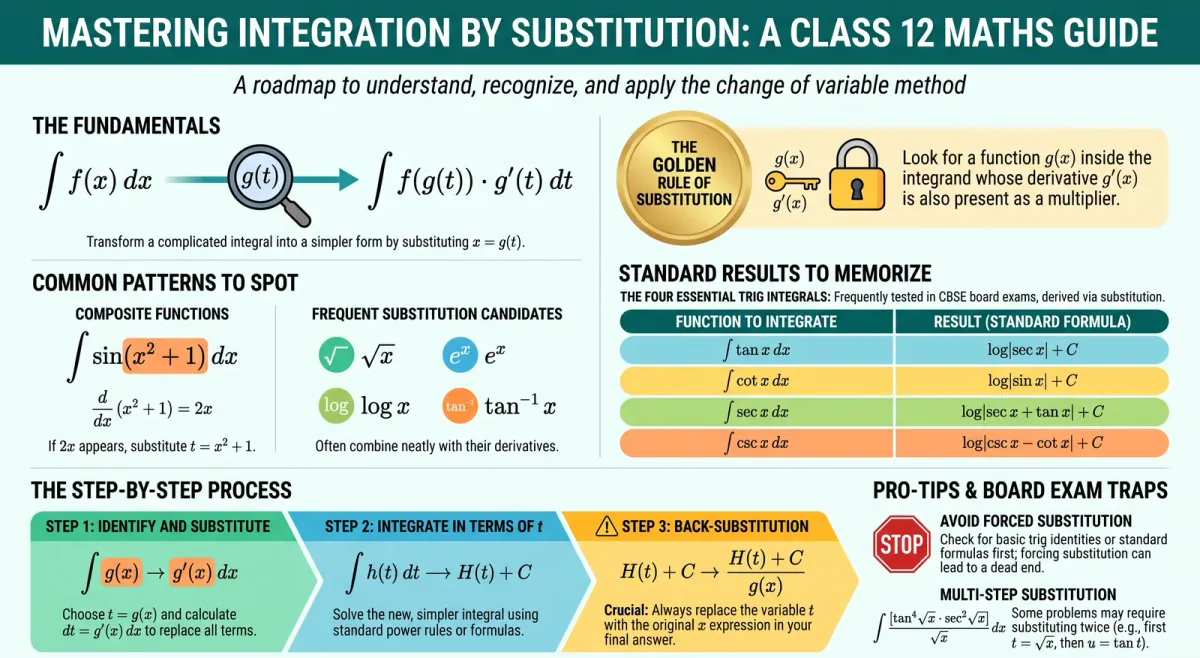
Suppose you want to evaluate I = ∫f(x) dx. If you substitute x = g(t), so that dx = g′(t) dt, the integral transforms into:
I = ∫f(g(t)) · g′(t) dt
The idea is to choose a substitution that turns a complicated function into one you can integrate directly using standard formulas. Once you integrate with respect to t, you substitute back to express the final answer in terms of x.
How to Spot the Right Substitution
The golden rule: look for a function whose derivative also appears (or almost appears) somewhere in the integrand. A few common patterns:
-
If you see g(x) inside another function and g′(x) multiplying it, substitute t = g(x).
-
If the integrand involves a composite function like sin(x² + 1), notice that the derivative of x² + 1 is 2x — so if 2x also appears, substitute t = x² + 1.
-
For expressions involving √x, try t = √x.
-
For expressions involving eˣ, log x, or inverse trig functions, these often combine neatly with their own derivatives.
Solved Examples Using Direct Substitution
Example 1: Evaluate ∫2x sin(x² + 1) dx
The derivative of x² + 1 is 2x, which already appears in the integrand. Let t = x² + 1, so dt = 2x dx.
∫sin t dt = −cos t + C = −cos(x² + 1) + C
Example 2: Evaluate ∫(4x + 2)√(x² + x + 1) dx
Let t = x² + x + 1, so dt = (2x + 1) dx. Rewrite 4x + 2 = 2(2x + 1):
= 2∫√t dt = 2 · (2/3)t^(3/2) + C = (4/3)(x² + x + 1)^(3/2) + C
Example 3: Evaluate ∫sin(tan⁻¹x) / (1 + x²) dx
Let t = tan⁻¹x, so dt = dx/(1 + x²).
= ∫sin t dt = −cos t + C = −cos(tan⁻¹x) + C
Standard Trigonometric Integrals Derived by Substitution
Four important results are derived using substitution and should be memorized for quick recall in exams:
-
∫tan x dx = log|sec x| + C — derived by writing tan x as sin x/cos x and substituting t = cos x
-
∫cot x dx = log|sin x| + C — substitute t = sin x
-
∫sec x dx = log|sec x + tan x| + C — multiply and divide by (sec x + tan x), then substitute t = sec x + tan x
-
∫cosec x dx = log|cosec x − cot x| + C — similarly, substitute t = cosec x + cot x
These four results appear frequently in board exam problems, especially when combined with other techniques like integration by parts.
Substitution with Multiple Steps
Some problems require substituting more than once. Consider:
Example 4: Evaluate ∫[tan⁴√x · sec²√x] / √x dx
First substitute t = √x, so dx/√x = 2dt. This gives 2∫tan⁴t sec²t dt. Now substitute u = tan t, so sec²t dt = du:
= 2∫u⁴ du = (2/5)u⁵ + C = (2/5)tan⁵t + C = (2/5)tan⁵√x + C
This two-step substitution shows why recognizing structure — rather than mechanically applying a rule — is the real skill being tested.
A Common Board Exam Trap: Recognize Before You Substitute
Many students try to force a substitution even when the integrand doesn’t naturally support one. Before substituting, always check whether a standard formula or a trigonometric identity would solve the problem more directly. Substitution is powerful, but only when the derivative relationship genuinely exists in the integrand — forcing it usually leads to a dead end and wasted exam time.
Practice Problem for Self-Assessment
Try evaluating ∫cos x / [(1 + sin x)(2 + sin x)] dx on your own. Hint: substitute t = sin x first, and you’ll need partial fractions afterward — a combination technique that’s common in the trickier CBSE board problems (we cover partial fractions in detail in a separate guide).
Ready to Practice Substitution Problems?
The best way to internalize substitution is repetition with instant feedback — spotting the pattern quickly comes only from solving many varied problems. ChampionsPrep gives you AI-powered, topic-wise practice sets and instant doubt resolution at just ₹10 per use, so you can build real exam speed without expensive tuition fees. Practice Integration by Substitution on ChampionsPrep →
Test Your Knowledge
Integration by Substitution Method: Class 12 Maths Guide
Frequently Asked Questions
When should I use substitution instead of a standard formula? +
Use substitution when the integrand is a composite function and its inner derivative also appears in the expression, directly or after minor algebraic adjustment.
Can I use more than one substitution in a single problem? +
Yes. Some integrals, especially those combining trigonometric and algebraic structures, require two successive substitutions.
Do I need to convert back to the original variable at the end? +
Always. The final answer must be expressed in terms of the original variable, unless you are evaluating a definite integral where the limits have also been converted.
Why do the integrals of tan x and cot x involve logarithms? +
Because both reduce, after substitution, to the standard form of the integral of 1/t, whose result is log of the absolute value of t plus a constant.
Is substitution the same as integration by parts? +
No. Substitution changes the variable to simplify a single composite expression, while integration by parts is used for products of two different types of functions.
AI-powered practice — free to start