
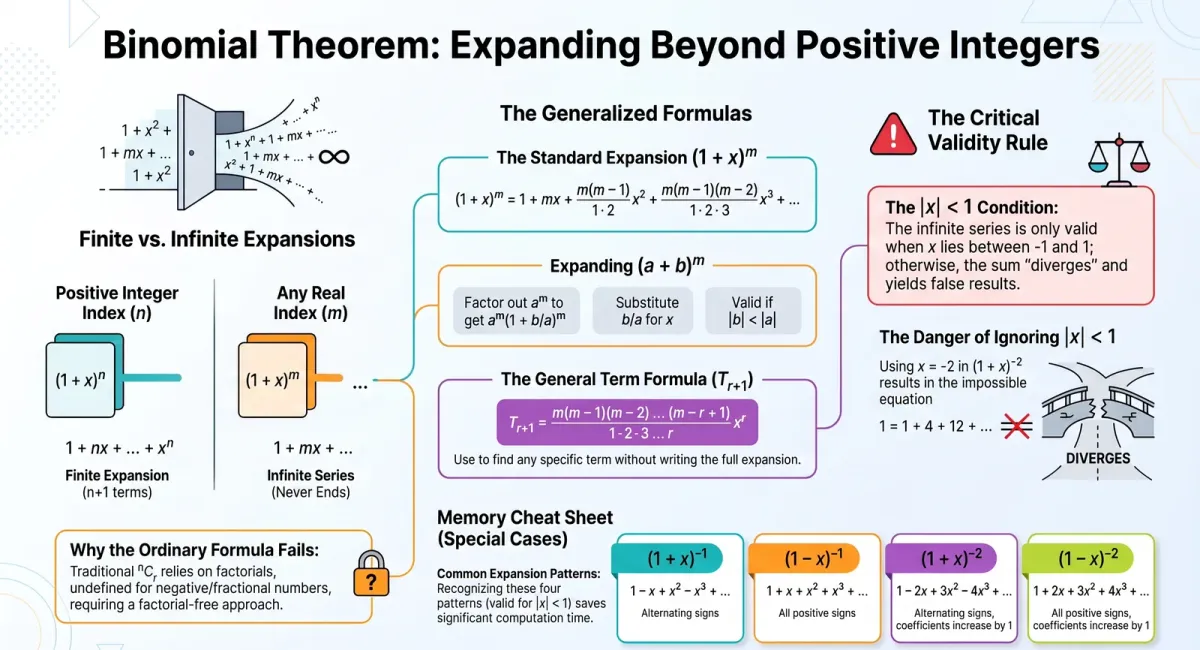
Chapter 8 covers the Binomial Theorem for a positive integer index — a finite expansion of (1 + x)ⁿ using combinations ⁿCᵣ. But what happens when the index is negative, or a fraction like 1/2? Section A.1.2 of Appendix 1 answers this, introducing the Binomial Theorem for any index, which produces an infinite series called the Binomial Series. This post covers the formula, why it needs a specific condition, its key special cases, and a worked example.
Why the Ordinary Binomial Theorem Breaks Down
The familiar formula from Chapter 8 states:
(1 + x)ⁿ = ⁿC₀ + ⁿC₁x + ⁿC₂x² + … + ⁿCₙxⁿ
This works when n is a non-negative integer, because ⁿCᵣ = n! / [r!(n-r)!] is well-defined for every r from 0 to n, and the expansion has exactly n + 1 terms. The trouble starts the moment n is replaced by a negative integer or a fraction: the factorial n! does not make sense for such values, so ⁿCᵣ becomes meaningless. A completely different, factorial-free approach is needed.
The Binomial Theorem for Any Index
NCERT states this generalised theorem without proof. For any real number m (negative, fractional, or a positive integer), the formula
(1 + x)ᵐ = 1 + mx + [m(m-1)/1.2]x² + [m(m-1)(m-2)/1.2.3]x³ + …
holds true whenever |x| < 1. Unlike the finite expansion for a positive integer index, this expansion goes on forever — it is a genuine infinite series, which is exactly why it belongs in this appendix on infinite series rather than in Chapter 8.
Why the Condition |x| < 1 Cannot Be Ignored
The restriction |x| < 1 (that is, -1 < x < 1) is not a technicality — it is essential whenever m is a negative integer or a fraction. NCERT illustrates this with a striking counterexample: take x = -2 and m = -2. Substituting into the formula gives
(1 - 2)⁻² = 1 + (-2)(-2) + [(-2)(-3)/1.2](-2)² + …
which simplifies to 1 = 1 + 4 + 12 + …, an equation that is obviously false. The left-hand side, (-1)⁻² = 1, is a fixed finite number, but the right-hand side diverges (grows without bound) because |x| = 2 is not less than 1. This confirms that the binomial series for a negative or fractional index is only valid inside the interval -1 < x < 1; outside this range, the formula gives meaningless results.
The General Term and the (a + b)ᵐ Version
Since (1 + x)ᵐ produces infinitely many terms when m is negative or a fraction, it is useful to have a formula for the general term — the term corresponding to any particular power of x. From the pattern above, the general term (the (r+1)-th term) is:
[m(m-1)(m-2)…(m-r+1) / 1.2.3…r] xʳ
NCERT also derives a version for expanding (a + b)ᵐ rather than just (1 + x)ᵐ. Writing (a + b)ᵐ = aᵐ(1 + b/a)ᵐ and substituting b/a for x in the binomial series gives:
(a + b)ᵐ = aᵐ + maᵐ⁻¹b + [m(m-1)/1.2]aᵐ⁻²b² + …
This expansion is valid whenever |b/a| < 1, or equivalently, whenever |b| < |a|. Its general term is:
[m(m-1)(m-2)…(m-r+1) / 1.2.3…r] aᵐ⁻ʳbʳ
This general-term formula is the single most practical tool from this section — it lets you find any specific term of a binomial expansion (say, the coefficient of x⁵) without writing out every earlier term first.
Four Special Cases Worth Memorising
NCERT lists four particular expansions (valid for |x| < 1) that appear repeatedly in problems and are worth committing to memory:
-
(1 + x)⁻¹ = 1 - x + x² - x³ + …
-
(1 - x)⁻¹ = 1 + x + x² + x³ + …
-
(1 + x)⁻² = 1 - 2x + 3x² - 4x³ + …
-
(1 - x)⁻² = 1 + 2x + 3x² + 4x³ + …
Notice the pattern: cases 1 and 2 are mirror images of each other with alternating signs flipped, and the same is true for cases 3 and 4. These four series are frequently reused as building blocks when expanding more complicated expressions, so recognising them on sight saves significant computation time.
Worked Example: Expanding (1 - x/2)⁻¹ᐟ²
Example. Expand (1 - x/2)⁻¹ᐟ², when |x| < 2.
Solution. Here m = -1/2, and we replace x in the general formula with (-x/2). Applying the binomial series:
(1 - x/2)⁻¹ᐟ² = 1 + [(-1/2)/1](-x/2) + {[(-1/2)(-3/2)]/1.2}(-x/2)² + …
Simplifying term by term: the first term after 1 is (-1/2)(-x/2) = x/4. The second term is (3/4)/2 multiplied by x²/4, which works out to 3x²/32. So:
(1 - x/2)⁻¹ᐟ² = 1 + x/4 + 3x²/32 + …
This example demonstrates the general method clearly: identify m and the “x” being substituted (here, -x/2), then apply the general term formula systematically rather than trying to guess the pattern.
Keep Learning: Related Reading
-
Infinite Series in Maths: Definition, Sequences & Sigma Notation Explained
-
Infinite Geometric Series: Sum to Infinity Formula & Solved Examples (Class 11 Maths)
-
Exponential Series & Euler’s Number e: Formula, Derivation & Examples (Class 11 Maths)
Practise Binomial Series Problems With ChampionsPrep
The Binomial Theorem for any index is a favourite topic in CBSE board exams and entrance tests like CUET and IPMAT, precisely because it tests whether students understand the validity condition, not just the formula. ChampionsPrep gives CBSE Class XI–XII Commerce students structured, NCERT-aligned practice on topics exactly like this one. Registration is completely free, and you only pay as you use the platform — start solving binomial series problems today.
Test Your Knowledge

Binomial Theorem for Any Index: Formula, Conditions & Special Cases (Class 11 Maths)
Frequently Asked Questions
What is the Binomial Theorem for any index? +
It is a generalisation of the ordinary Binomial Theorem that allows the index m in (1 + x)ᵐ to be any real number — negative, fractional, or a positive integer — producing an infinite series expansion valid whenever |x| < 1.
Why doesn't the ordinary Binomial Theorem work for negative or fractional powers? +
The ordinary theorem relies on combinations ⁿCᵣ, which are built from factorials. Factorials are only defined for non-negative integers, so the moment the index becomes negative or fractional, ⁿCᵣ has no meaning and a different, factorial-free formula is required.
Why is the condition |x| < 1 necessary in the binomial series? +
When m is negative or a fraction, the expansion has infinitely many terms. If |x| ≥ 1, these terms do not shrink toward zero, so the series does not settle to a finite sum — leading to contradictions, as shown by the x = -2, m = -2 example in the NCERT text.
What is the general term of the binomial series for (1 + x)ᵐ? +
The (r+1)-th term is [m(m-1)(m-2)...(m-r+1) / 1.2.3...r] xʳ. This formula lets you compute any specific term directly, which is especially useful for finding a particular coefficient without expanding the whole series.
How is (a + b)ᵐ expanded using the binomial series? +
Factor out aᵐ to write (a + b)ᵐ = aᵐ(1 + b/a)ᵐ, then apply the binomial series with b/a in place of x. This gives aᵐ + maᵐ⁻¹b + [m(m-1)/1.2]aᵐ⁻²b² + ..., valid whenever |b| < |a|.
AI-powered practice — free to start