
Not every function follows one smooth formula for every input. Some functions change their rule depending on which region the input falls into, and these piecewise-defined functions — modulus, signum, and greatest integer — are among the most tested topics in Class 11 Maths Chapter 2. Building on the earlier discussion of identity, constant, and polynomial functions , this post explains each special function, its formula, and its distinctive graph.
The Modulus Function
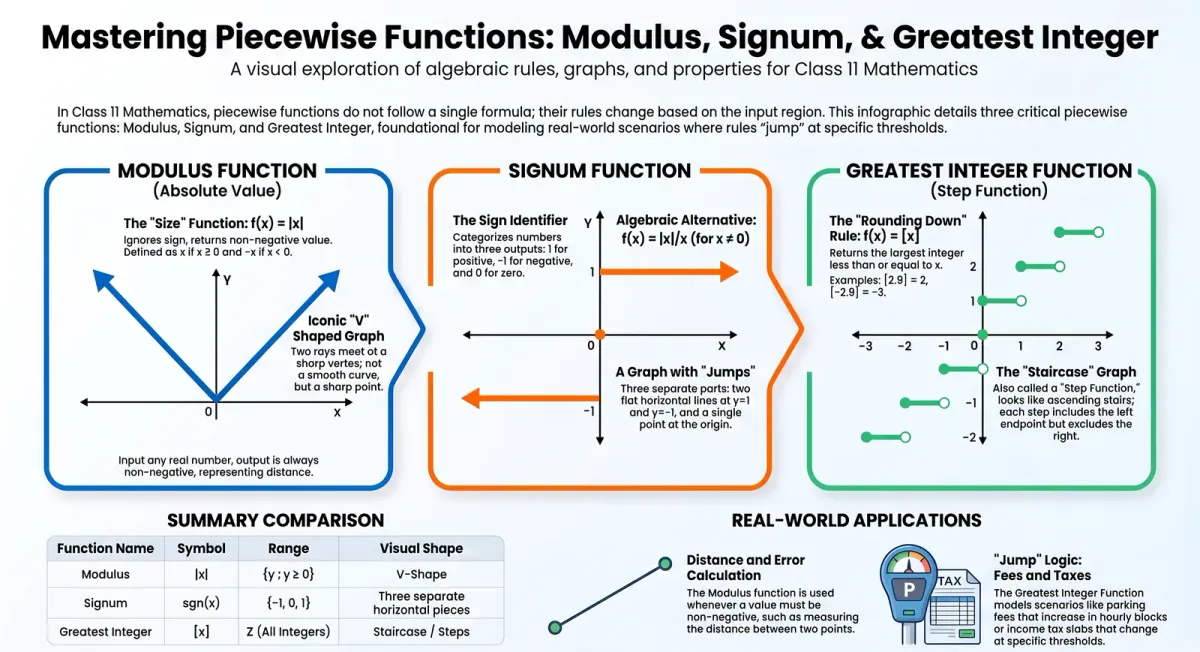
The modulus function, also called the absolute value function, is defined as f: R → R by f(x) = |x| for each x ∈ R. It measures the “size” of a number, completely ignoring its sign.
The rule is defined piecewise:
f(x) = x, when x ≥ 0 f(x) = -x, when x < 0
In other words, for any non-negative input, the modulus function simply returns the same value. For any negative input, it flips the sign to make the output positive. So |5| = 5, and |-5| = 5 as well — both inputs produce the same non-negative output.
Domain, Range, and Graph of the Modulus Function
The domain of the modulus function is all of R, since every real number has an absolute value. The range, however, is restricted to non-negative real numbers, {y : y ≥ 0}, since the output is never negative by definition.
The graph forms a distinctive “V” shape, with its vertex sitting exactly at the origin. For x ≥ 0, the graph follows the line y = x, sloping upward to the right. For x < 0, it follows the line y = -x, sloping upward to the left. The two halves meet symmetrically at (0, 0), creating a sharp point rather than a smooth curve.
The Signum Function
The signum function is designed to answer one simple question about a number: is it positive, negative, or zero? It is defined as f: R → R by:
f(x) = 1, if x > 0 f(x) = 0, if x = 0 f(x) = -1, if x < 0
The domain of the signum function is all of R, but the range collapses to just three possible values: {-1, 0, 1}. No matter how large or small a number is, the signum function only reports its sign category.
Graph of the Signum Function
The graph looks like three separate horizontal pieces. For all positive x, the output sits flat at y = 1. For all negative x, the output sits flat at y = -1. At exactly x = 0, the function takes the single value 0, shown as an isolated point. There is a visible “jump” in the graph as it crosses from negative x to positive x, since the output leaps from -1 straight to 1, skipping every value in between except at the single point x = 0.
An alternative way to describe the signum function algebraically, for non-zero x, is f(x) = |x|/x, since dividing a number by its own absolute value always returns +1 or -1 depending on the sign, with the case x = 0 defined separately as 0.
The Greatest Integer Function
The greatest integer function, sometimes called the floor function, is defined as f: R → R by f(x) = [x], where [x] represents the greatest integer that is less than or equal to x. This function is also informally called a “step function,” because of the shape its graph takes.
To understand this rule, it helps to work through a few intervals:
[x] = -1, for -1 ≤ x < 0 [x] = 0, for 0 ≤ x < 1 [x] = 1, for 1 ≤ x < 2 [x] = 2, for 2 ≤ x < 3
A useful way to think about this: the greatest integer function always “rounds down” to the nearest whole number, never up — even for negative numbers. So [2.9] = 2, but [-2.9] = -3, not -2, because -3 is the greatest integer that is still less than or equal to -2.9.
Graph of the Greatest Integer Function
The graph consists of horizontal line segments, each one unit long, stacked like ascending stairs. Each segment includes its left endpoint (solid dot) but excludes its right endpoint (open circle), since the function jumps to the next integer the instant x reaches the next whole number — the distinctive “staircase” that gives the step function its name.
The domain is all of R. The range is the set of all integers, Z, since the output only ever takes whole-number values.
Why These Functions Matter
Piecewise functions like these appear throughout real-world applications — postal charges that jump at weight thresholds, parking fees that rise in hourly blocks, and income tax slabs that change in steps are all naturally modelled using greatest-integer-style logic. The modulus function, similarly, appears constantly in distance and error calculations, since distances are never negative.
Quick Recap
-
Modulus function: f(x) = |x|; domain R, range {y ≥ 0}; graph is a “V” shape.
-
Signum function: outputs -1, 0, or 1 depending on the sign of x; domain R, range {-1, 0, 1}.
-
Greatest integer function: f(x) = [x], the largest integer ≤ x; domain R, range Z; graph is a staircase.
Related Reading
-
Types of Functions: Identity, Constant, Polynomial & Rational Functions
-
What Is a Function in Maths? Definition, Examples & Function vs Relation
-
Algebra of Real Functions: Domain, Range & Solved Examples
Practice What You’ve Learned
Piecewise functions like these trip up even well-prepared students under exam pressure, simply because the “rule” changes depending on the input. ChampionsPrep offers focused practice sets, step-by-step graph explanations, and mock tests for CBSE and State Board Class 11–12 Commerce students and competitive exam aspirants. Registration is free, and you only pay as you use the platform.
Test Your Knowledge
Modulus, Signum & Greatest Integer Functions Explained | Class 11 Maths
Frequently Asked Questions
What is the value of the modulus function at x = 0? +
The modulus function gives |0| = 0, since 0 satisfies the condition x ≥ 0 in its piecewise definition.
What is the range of the signum function? +
The range is the set {-1, 0, 1}, since the signum function only ever reports whether a number is negative, zero, or positive.
What is [−2.9] equal to? +
[−2.9] = −3, because the greatest integer function always rounds down to the nearest integer that is less than or equal to the given number, even for negative values.
Why is the greatest integer function called a step function? +
Because its graph consists of a series of flat horizontal segments that jump abruptly to a new level at every integer, resembling a staircase.
Is the modulus function's graph smooth at the origin? +
No. The graph forms a sharp "V" shape at the origin, since the two linear pieces (y = x and y = -x) meet at a point rather than blending smoothly.
AI-powered practice — free to start