
Once you know what a function is , the next step is meeting the specific “named” functions that appear again and again in higher mathematics. Four of the most fundamental types — identity, constant, polynomial, and rational functions — are introduced in this chapter, each with its own shape, domain, and range. Recognising these on sight saves time in exams and builds intuition for every function-related chapter that follows.
The Identity Function
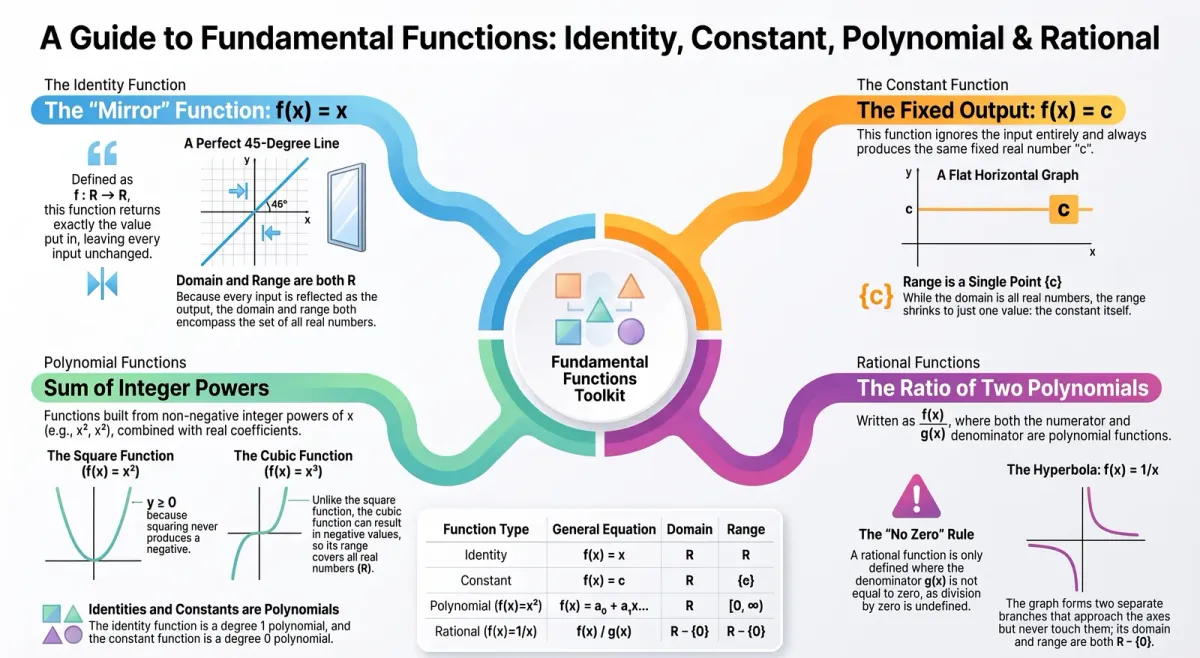
The identity function is the simplest possible function: it returns exactly the value put in. Defined as f: R → R by f(x) = x for every x ∈ R, it leaves every input unchanged.
Both domain and range are R, the set of all real numbers. Its graph is a straight line through the origin, rising at 45 degrees, since output always equals input. At x = 3, the corresponding y-value is also 3, and the same holds for every real number.
The Constant Function
A constant function ignores its input entirely and always produces the same fixed output: f: R → R by f(x) = c, where c is some fixed real number, for every x ∈ R.
The domain is still all of R, but the range shrinks to a single value: {c}. Graphically, this is a horizontal line parallel to the x-axis, at height c. For example, f(x) = 3 produces a flat horizontal line through y = 3, regardless of x.
Polynomial Functions
A function f: R → R is a polynomial function if, for every x in R, it can be written as y = f(x) = a₀ + a₁x + a₂x² + … + aₙxⁿ, where n is a non-negative integer and a₀, a₁, …, aₙ are real numbers.
In simple terms, a polynomial function is any expression built from non-negative integer powers of x, combined with real coefficients. Functions like f(x) = x³ - x² + 2 and g(x) = x⁴ + √2·x qualify. But h(x) = x^(2/3) + 2x is not a polynomial function, since it involves a fractional power of x.
Special Cases Within Polynomial Functions
The identity function and constant function are both special cases of polynomial functions — identity is the polynomial f(x) = x (degree 1), and constant is a polynomial of degree 0. A linear function, f(x) = mx + c, is another commonly used polynomial, where m and c are fixed constants and the graph is always a straight line.
Graphing a Polynomial Function
Consider f(x) = x². Plotting values — f(-2) = 4, f(-1) = 1, f(0) = 0, f(1) = 1, f(2) = 4 — reveals a curve dipping to a minimum at the origin and rising symmetrically, forming a parabola. The domain is all of R, while the range is restricted to {y : y ≥ 0}, since squaring never produces a negative result.
A cubic polynomial like f(x) = x³ behaves differently — negative for negative x, positive for positive x — and both its domain and range cover all of R.
Rational Functions
A rational function is formed by dividing one polynomial function by another, written as f(x)/g(x), where both f(x) and g(x) are polynomial functions of x, and the function is only defined wherever g(x) ≠ 0.
The most well-known example is f(x) = 1/x, defined for every real number except 0. This restriction exists because division by zero is undefined in mathematics. The domain of this function is R - {0}, and interestingly, the range is also R - {0}, since 1/x can equal any real number except zero, no matter how large or small x becomes.
The graph of f(x) = 1/x is a smooth curve called a hyperbola, split into two separate branches — one in the region where x is positive and y is positive, and another where x is negative and y is negative. As x approaches 0, the curve shoots off toward infinity, and as x grows very large in either direction, the curve flattens and approaches the x-axis without ever touching it.
Why These Function Types Matter
These four function families are not just abstract definitions — they form the toolkit used throughout Class 11 and 12 to model everything from straight-line motion (linear/identity functions), fixed costs in business mathematics (constant functions), area and volume relationships (polynomial functions), and rates or ratios that break down at specific values (rational functions). Recognising the shape of a function immediately from its equation is a skill that pays off well beyond this chapter.
Quick Recap
-
Identity function: f(x) = x; domain = range = R; graph is a straight line through the origin.
-
Constant function: f(x) = c; domain = R; range = {c}; graph is a horizontal line.
-
Polynomial function: sum of non-negative integer powers of x with real coefficients.
-
Rational function: f(x)/g(x), defined only where g(x) ≠ 0.
Related Reading
-
What Is a Function in Maths? Definition, Examples & Function vs Relation
-
Modulus, Signum & Greatest Integer Functions Explained
-
Algebra of Real Functions: Domain, Range & Solved Examples
Practice What You’ve Learned
Identifying a function’s type at a glance, and sketching its graph correctly, is a skill examiners test repeatedly across CBSE boards and entrance exams like CUET and IPMAT. ChampionsPrep offers structured question banks, worked solutions, and mock tests for Class 11–12 Commerce students and competitive exam aspirants. Registration is free, and you only pay as you use the platform.
Test Your Knowledge
Types of Functions: Identity, Constant, Polynomial & Rational
Frequently Asked Questions
Is the identity function a type of polynomial function? +
Yes. The identity function f(x) = x is a polynomial function of degree 1, where the coefficient of x is 1 and all other coefficients are zero.
What is the range of a constant function? +
The range of a constant function f(x) = c is always the single-element set {c}, regardless of the input, while the domain remains all of R.
Why is h(x) = x^(2/3) + 2x not a polynomial function? +
Because it contains a fractional power of x. Polynomial functions require every power of x to be a non-negative integer, so a term with a fractional exponent disqualifies it.
Why is 0 excluded from the domain of f(x) = 1/x? +
Because division by zero is undefined in mathematics. Since g(x) = x becomes zero at x = 0, the rational function f(x)/g(x) cannot be evaluated there.
What does the graph of f(x) = x² look like? +
It is a parabola that touches its minimum point at the origin (0, 0) and opens upward symmetrically on both sides, since squaring any real number always gives a non-negative result.
AI-powered practice — free to start