
Every time you look up a seat number like C-14 in a cinema hall, or a point (3, 5) on a graph, you are using an idea from Class 11 Maths without realising it — the ordered pair. This concept, along with the Cartesian product of sets, forms the foundation of Chapter 2, Relations and Functions. Before understanding what a relation or function is, you need to be comfortable with how two sets combine to create pairs.
What Is an Ordered Pair?
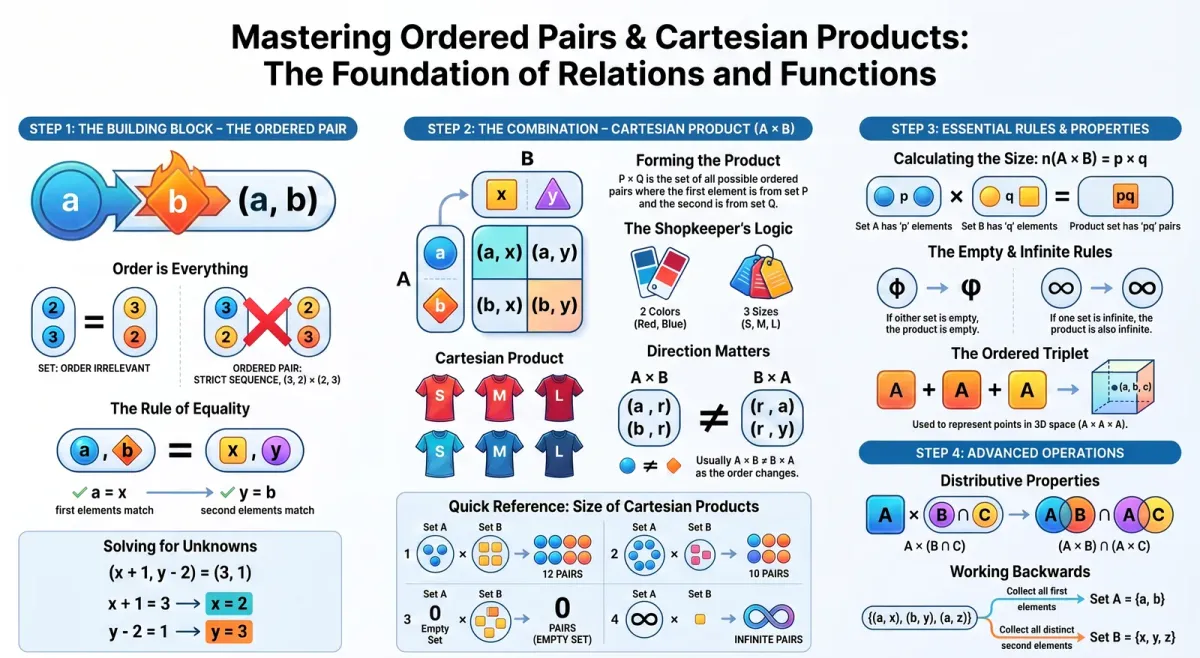
An ordered pair is two elements written together in a fixed sequence, enclosed in brackets, such as (p, q). The word “ordered” is key — the sequence matters. This differs from how we think about sets, where {2, 3} and {3, 2} mean the same thing. In an ordered pair, (2, 3) and (3, 2) are treated as different pairs.
Think of coordinates on a graph. The point (2, 5) is not the same location as (5, 2). Or think of a roll number and marks written as (12, 87) — swapping the numbers changes the meaning entirely. This is why ordered pairs follow a strict rule of equality.
When Are Two Ordered Pairs Equal?
Two ordered pairs (a, b) and (x, y) are equal only when the first elements match and the second elements match separately. In other words, (a, b) = (x, y) if and only if a = x and b = y. This single rule is used repeatedly to solve equations involving unknowns hidden inside ordered pairs — a very common exam question type in this chapter.
For example, if (x + 1, y - 2) = (3, 1), you simply equate the corresponding parts: x + 1 = 3 and y - 2 = 1, giving x = 2 and y = 3.
Understanding the Cartesian Product of Sets
Once ordered pairs are clear, the Cartesian product is a natural next step. Given two non-empty sets P and Q, the Cartesian product P × Q is the set of all possible ordered pairs where the first element comes from P and the second comes from Q, written in set-builder form as P × Q = {(p, q) : p ∈ P, q ∈ Q}.
A Simple Real-Life Example
Suppose a shop sells 2 colours of a bag — red and blue — in 3 sizes: small (s), medium (m), large (l). To list every possible order combination, you are building the Cartesian product of the colour set and the size set. Pairing each colour with each size gives 6 distinct combinations: (red, s), (red, m), (red, l), (blue, s), (blue, m), (blue, l). The order in which the sets are multiplied decides the order of elements inside each pair.
Why Order Matters in P × Q
Because ordered pairs are direction-sensitive, P × Q is generally not the same as Q × P. If P = {a, b, c} and Q = {r}, then P × Q = {(a, r), (b, r), (c, r)}, while Q × P = {(r, a), (r, b), (r, c)} — different sets, since (a, r) ≠ (r, a).
Key Rules and Properties to Remember
-
If set A has p elements and set B has q elements, A × B has exactly pq ordered pairs: n(A × B) = pq.
-
If either A or B is the empty set, then A × B is also empty: A × φ = φ.
-
If A or B is an infinite set (both non-empty), then A × B is also infinite.
-
A × B ≠ B × A in general, unless A = B.
-
The product extends to three sets as A × A × A = {(a, b, c) : a, b, c ∈ A}, called an ordered triplet — useful for describing points in three-dimensional space.
Cartesian Product With Intersections and Unions
Interactive Cartesian Product & Venn Cardinality Simulator
Adjust the cardinality of sets A and B and their common elements to see the Cartesian product size n(A × B) and set relations update dynamically.
Venn Operations
Difference Sets
Visual Venn Diagram
Syllabus Checkpoints & Exam Watch-Outs
- Cartesian Rule: n(A × B) = n(A) × n(B). Cardinality of the product depends purely on the count of elements in each set.
A frequently tested idea is how the Cartesian product interacts with intersection and union. For sets A, B, and C, the property A × (B ∩ C) = (A × B) ∩ (A × C) always holds, and so does A × (B ∪ C) = (A × B) ∪ (A × C). Verifying these with a small numeric example is a common exercise, and it builds the logical foundation needed for relations in the next topic.
Working Backwards: Finding Sets From a Given Product
Exam questions often reverse the process — instead of A and B, they give you the product and ask for the original sets. Since the Cartesian product pairs every first-set element with every second-set element, the set of all first elements gives you A, and the set of all distinct second elements gives you B. For instance, if A × B = {(p, q), (p, r), (m, q), (m, r)}, then A = {p, m} and B = {q, r}.
Quick Recap
-
An ordered pair (a, b) has a fixed sequence; (a, b) ≠ (b, a) unless a = b.
-
Two ordered pairs are equal only when corresponding elements match.
-
A × B is the set of all pairs (a, b) with a ∈ A, b ∈ B; n(A × B) = n(A) × n(B).
-
A × B ≠ B × A in general; A × φ = φ.
Practice What You’ve Learned
Reading the theory is only half the job — Cartesian products show up again in relations, functions, and coordinate geometry, so practise until the idea feels automatic. ChampionsPrep offers chapter-wise practice questions, step-by-step solutions, and mock tests for CBSE and State Board Class 11–12 Commerce students, plus CUET, IPMAT, NPAT, and SET aspirants. Registration is free, and you only pay as you use the platform.
Test Your Knowledge
Ordered Pairs and Cartesian Product of Sets Explained | Class 11 Maths
Frequently Asked Questions
What is the difference between a set and an ordered pair? +
A set like {2, 3} does not care about order, so {2, 3} = {3, 2}. An ordered pair (2, 3) does, so (2, 3) ≠ (3, 2) unless the elements are identical.
Is A × B always equal to B × A? +
No. They are equal only in special cases, such as A = B or when one set is empty. Otherwise the two products have the same size but different pairs.
How many elements does A × B have if A has 3 elements and B has 4 elements? +
It has 3 × 4 = 12 ordered pairs, since n(A × B) = n(A) × n(B).
Can the Cartesian product of two sets be infinite? +
Yes. If either set is infinite, and both are non-empty, the resulting product is also infinite.
What is an ordered triplet? +
An element of A × A × A, written (a, b, c), where a, b, c ∈ A — used to represent points in three-dimensional space.
AI-powered practice — free to start