
If you have just started Chapter 9 of your Class 12 Maths syllabus, differential equations can feel like a new language after a year of limits, derivatives, and integrals. The good news is that the chapter builds directly on what you already know about differentiation. Once you understand what a differential equation represents, finding its order and degree becomes a quick, mechanical skill. This guide breaks the basics down step by step, with solved examples similar to what you will see in your CBSE board exam and in CUET Maths papers.
What Is a Differential Equation?
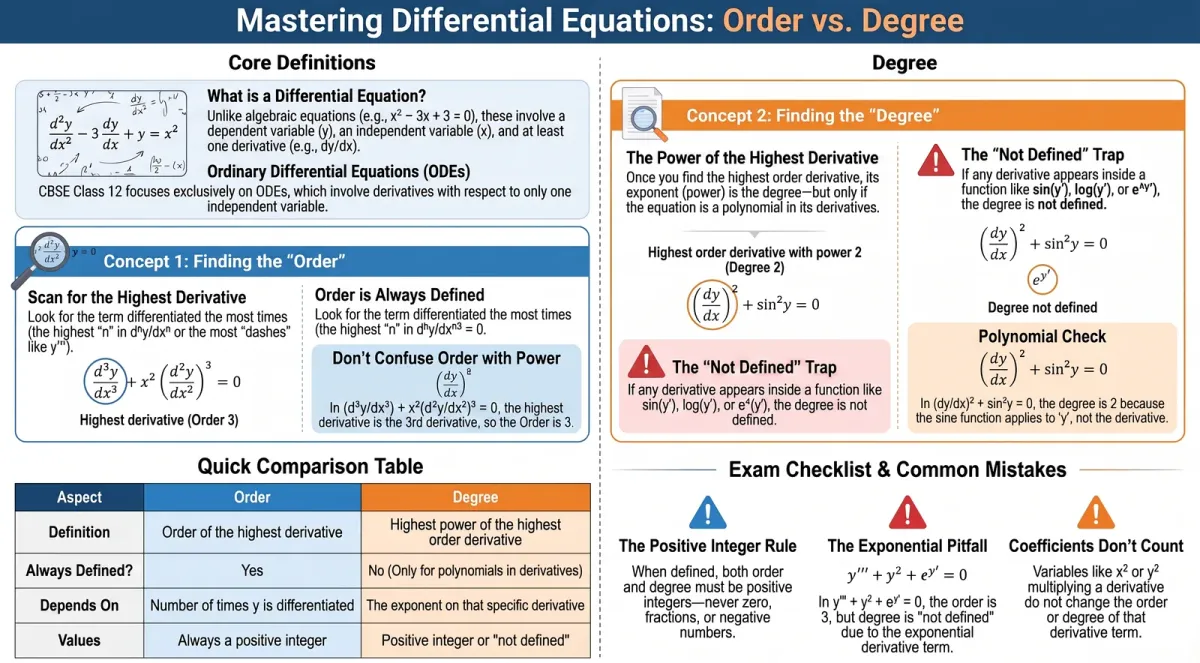
An equation that involves an unknown function along with its derivatives is called a differential equation. Ordinary equations like x² – 3x + 3 = 0 only involve variables, but an equation such as x(dy/dx) + y = 0 involves both the variable and the derivative of the dependent variable y with respect to the independent variable x. That extra ingredient — a derivative — is what makes it a differential equation rather than an ordinary algebraic equation. Such equations show up constantly outside the classroom too, in population growth models, interest calculations, and rate-of-change problems across Physics and Economics.
Ordinary vs Partial Differential Equations
When a differential equation involves derivatives with respect to only one independent variable, it is called an ordinary differential equation (ODE). If it involves derivatives with respect to more than one independent variable, it is a partial differential equation. Class 12 CBSE Maths deals exclusively with ODEs, so “differential equation” here always means ODE.
Order of a Differential Equation
The order of a differential equation is defined as the order of the highest derivative of the dependent variable present in the equation. This is the easiest concept in the chapter, and most students get it right immediately once they see a few examples.
Consider these three equations:
-
dy/dx = eˣ — the highest derivative is the first derivative, so the order is 1.
-
d²y/dx² + y = 0 — the highest derivative is the second derivative, so the order is 2.
-
(d³y/dx³) + x²(d²y/dx²)³ = 0 — the highest derivative is the third derivative, so the order is 3.
How to Find the Order Quickly
Scan the equation for the derivative with the highest number of “dashes,” or the highest power in the d-notation’s denominator (d²y/dx², d³y/dx³, and so on). Whichever derivative has the highest order present decides the order of the whole equation. Do not confuse “order” with “power” — a term like (dy/dx)⁵ still has order 1, because the derivative itself is a first derivative, only raised to the fifth power.
Degree of a Differential Equation
The degree is trickier and is a common source of lost marks in board exams. It is the highest power (a positive integer) of the highest order derivative, provided the equation is a polynomial equation in its derivatives.
That last condition is critical. Before deciding the degree, make sure the equation is a polynomial in y′, y″, y′″, and so on. A removable radical does not block the degree: √(dy/dx) = x can be squared to dy/dx = x², whose degree is 1. The degree is not defined only when a derivative sits inside an expression that cannot be eliminated — a trigonometric function, a logarithm, an exponential, or the like.
When Is Degree Not Defined?
Look at dy/dx + sin(dy/dx) = 0. Here, dy/dx appears inside a sine function. Since sin(dy/dx) cannot be expanded as a finite polynomial in dy/dx, the equation is not a polynomial in its derivative — so its degree is not defined, though its order is 1.
Compare this with (dy/dx)² + (dy/dx) – sin²y = 0. Here, the sine term applies to y, not to the derivative, so the equation is still a polynomial in dy/dx. The highest power of the highest order derivative is 2, so the degree is 2.
Order vs Degree: Key Differences
| Aspect | Order | Degree |
|---|---|---|
| Definition | Order of the highest derivative | Highest power of the highest order derivative |
| Always defined? | Yes | No — only when the equation is polynomial in derivatives |
| Depends on | Number of times y is differentiated | The exponent on that derivative term |
| Values | Always a positive integer | Positive integer, or "not defined" |
Solved Examples on Order and Degree
Example 1: Find the order and degree of xy(d²y/dx²) + x(dy/dx)² – y(dy/dx) = 0. The highest order derivative is d²y/dx², with power 1, in a polynomial equation. Order = 2, Degree = 1.
Example 2: Find the order and degree of y′″ + y² + eʸ′ = 0. The highest order derivative is y′″ (order 3), but eʸ′ places a derivative inside an exponential, which is non-polynomial. Order = 3, Degree = not defined.
Example 3: Find the order and degree of (d²y/dx²)³ + (dy/dx)² + sin(dy/dx) = 0. The highest order derivative is d²y/dx² (order 2), but sin(dy/dx) makes it non-polynomial. Order = 2, Degree = not defined.
Common Mistakes Students Make
Students often lose easy marks by confusing the number of terms with the order, or by assigning a degree even when it is not defined. Remember: order and degree, when defined, are always positive integers — never zero, a fraction, or negative. Also, a coefficient like x² or y² multiplying a derivative does not change that derivative term’s own order or power.
Related Reading
-
Area Between Two Curves: Class 12 Integration Methods Explained
-
Top Solved Examples & Important Questions: Application of Integrals Class 12
Ready to Practice?
Reading theory is only the first step — real command over order and degree comes from solving varied problems under exam conditions. On ChampionsPrep , get AI-powered, pay-per-use practice sessions at just ₹10 each, built for CBSE and Maharashtra Board Class 11–12 Commerce students, plus CUET, IPMAT, JIPMAT, NPAT, and SET aspirants. Start a Differential Equations practice session today.
Test Your Knowledge
Differential Equations Class 12: Order, Degree and Basic Concepts Explained
Frequently Asked Questions
What is the order of a differential equation? +
The order of the highest derivative of the dependent variable present in the equation. For example, in d²y/dx² + y = 0, the order is 2.
What is the degree of a differential equation? +
The highest power of the highest order derivative — but only when the equation is a polynomial in all its derivatives. Otherwise, the degree is not defined.
Can the degree of a differential equation be a fraction or negative number? +
No. When defined, order and degree are always positive integers.
How do I know if the degree is not defined? +
First try to make the equation polynomial in its derivatives. A removable radical does not block the degree — squaring √(dy/dx) = x gives dy/dx = x², degree 1. The degree is not defined only when a derivative cannot be freed from a trigonometric, logarithmic, exponential or similar expression.
Is order always higher than degree? +
No. There is no fixed relationship — an equation can have order 1 and degree 5, or order 3 and degree 1. Each is determined independently.
AI-powered practice — free to start