
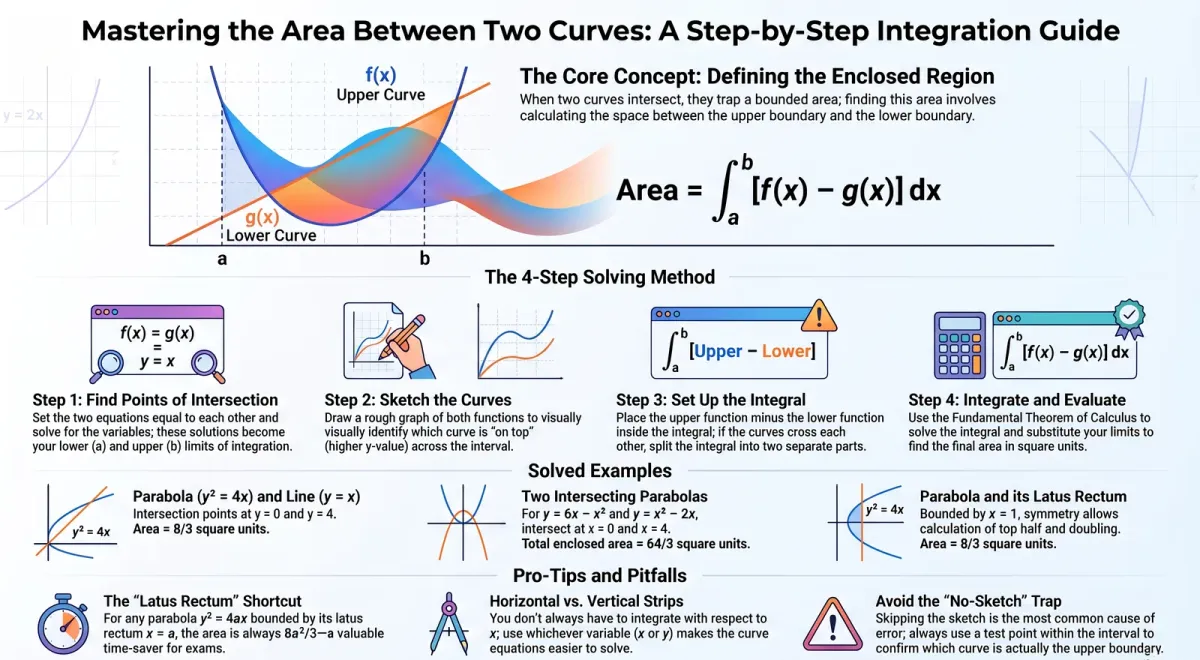
Finding the area under a single curve is a warm-up. The real test in Application of Integrals is finding the area between two curves — a region enclosed above by one curve and below by another. This is one of the highest-value topics in the chapter for CBSE board exams, and this guide breaks it down into a method you can apply to almost any pair of curves.
What Does “Area Between Two Curves” Mean?
When two curves intersect, they enclose a bounded region between their points of intersection. Rather than finding the area under each curve separately and subtracting, there’s a more direct approach: integrate the difference between the upper curve and the lower curve across the shared interval.
The Step-by-Step Method
Step 1: Find the Points of Intersection
Set the two curve equations equal to each other and solve. These intersection points become your limits of integration — this step is almost always the starting point of the entire problem.
Step 2: Sketch Both Curves
Draw a rough sketch showing both curves and shade the enclosed region. This tells you immediately which curve is “on top” (has the larger y-value) across the interval — a detail you cannot afford to get wrong.
Step 3: Set Up the Integral
If f(x) is the upper curve and g(x) is the lower curve between x = a and x = b:
Area = ∫ₐᵇ [f(x) − g(x)] dx
If the upper and lower curves swap partway through the interval, split the integral at the point where they cross and handle each piece separately.
Step 4: Integrate and Simplify
Evaluate the integral using the Fundamental Theorem of Calculus, substituting the intersection points found in Step 1.
Worked Example 1: Parabola and a Line
Find the area enclosed between the parabola y² = 4x and the line y = x.
Step 1: Express both in terms of y, since the parabola is naturally x = y²/4. The line gives x = y. Setting them equal:
y²/4 = y → y² − 4y = 0 → y = 0 or y = 4
Step 2: Between y = 0 and y = 4, the line x = y lies to the right of the parabola x = y²/4 (check with a test point, such as y = 2: line gives x = 2, parabola gives x = 1).
Step 3: Set up the integral using horizontal strips:
Area = ∫₀⁴ [y − y²/4] dy = [y²/2 − y³/12]₀⁴ = (8 − 64/12) = 8 − 16/3 = 8/3 square units
Worked Example 2: Two Parabolas
Find the area enclosed between y = 6x − x² and y = x² − 2x.
Step 1: Set the equations equal: 6x − x² = x² − 2x → 8x = 2x² → x² − 4x = 0 → x = 0 or x = 4
Step 2: Test x = 2: first curve gives y = 8, second gives y = 0, so the first curve is on top throughout the interval.
Step 3: Area = ∫₀⁴ [(6x − x²) − (x² − 2x)] dx = ∫₀⁴ (8x − 2x²) dx = [4x² − 2x³/3]₀⁴ = 64 − 128/3 = 64/3 square units
Worked Example 3: Parabola and Latus Rectum
Find the area bounded by the parabola y² = 4x and its latus rectum x = 1.
Since the parabola is symmetric about the x-axis, find the area of the upper half and double it:
Area = 2∫₀¹ √(4x) dx = 2 × 2∫₀¹ √x dx = 4 × [(2/3)x^(3/2)]₀¹ = 4 × 2/3 = 8/3 square units
This “8a²/3” pattern for a parabola y² = 4ax bounded by its latus rectum (x = a) is worth memorizing as a shortcut, since it appears often in board papers.
Common Mistakes to Avoid
The single biggest error is skipping the sketch and guessing which curve is on top — always verify with a test point inside the interval rather than assuming. A close second is forgetting that the upper and lower curves can swap positions partway through the interval, which requires splitting the integral into two parts. Finally, students sometimes integrate f(x) − g(x) using the wrong variable (x instead of y, or vice versa) when the curves are more naturally expressed the other way — check which variable makes the algebra simplest before starting.
Related Reading
-
Area of an Ellipse Using Integration: Formula, Derivation & Solved Examples
-
How to Find Area Under a Simple Curve Using Integration – Class 12 Maths
Ready to Practice?
Area-between-curves questions carry some of the highest marks in this chapter — and the highest risk of sign errors. Get instant doubt resolution and topic-wise practice on ChampionsPrep for just ₹10 per use. Practice on ChampionsPrep →
Test Your Knowledge
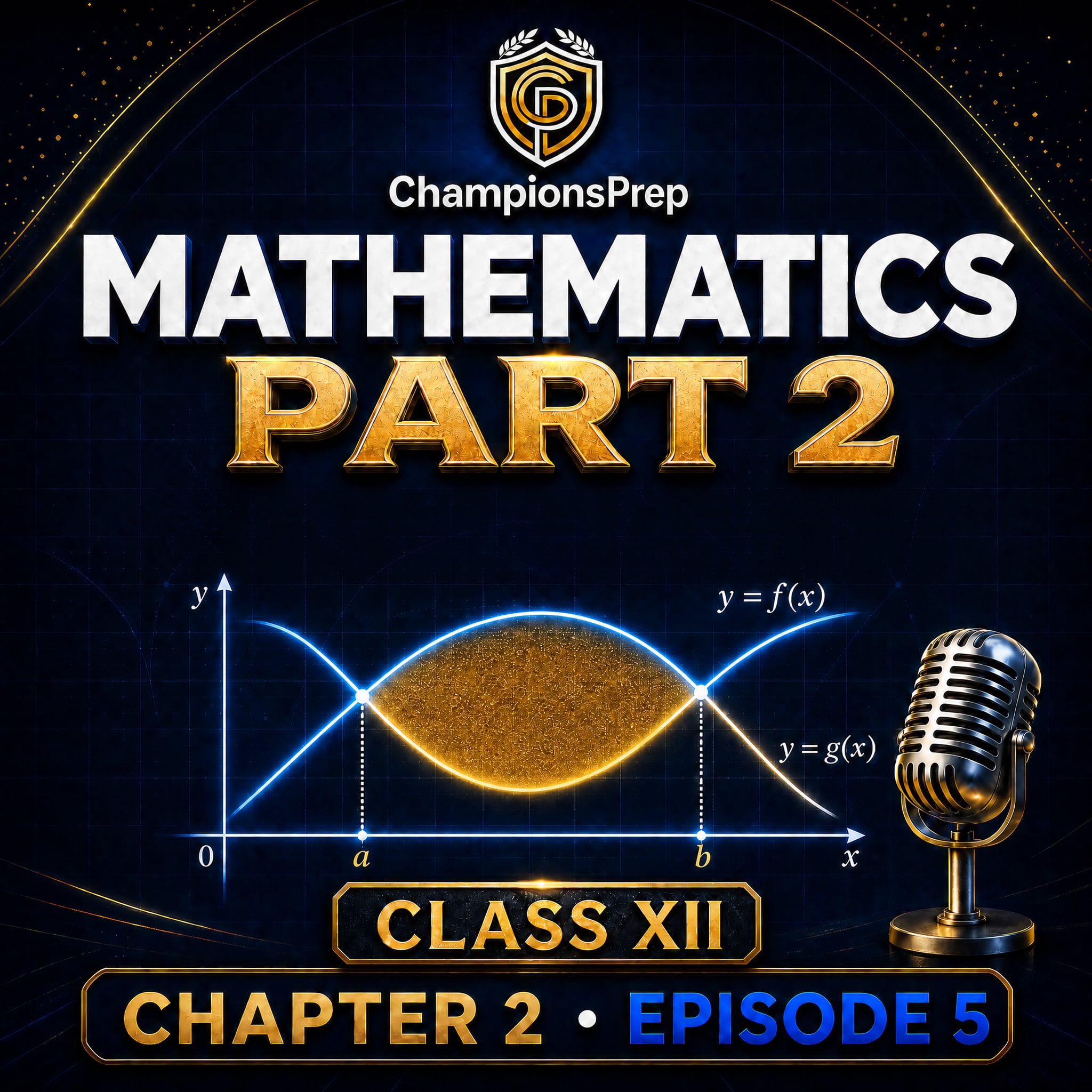
Area Between Two Curves: Class 12 Integration Methods Explained
Frequently Asked Questions
What is the formula for the area between two curves? +
Area = ∫ₐᵇ [f(x) − g(x)] dx, where f(x) is the upper curve, g(x) is the lower curve, and a, b are their points of intersection.
How do I find the limits of integration for two curves? +
Set the two curve equations equal to each other and solve for the intersection points — these become your integration limits.
What if I can't tell which curve is on top? +
Substitute a test value from inside the interval into both equations and compare the resulting y-values (or x-values, for horizontal strips) — the larger one is on top.
What is the shortcut formula for a parabola bounded by its latus rectum? +
For y² = 4ax bounded by the latus rectum x = a, the enclosed area is 8a²/3 — a useful pattern to recognize instantly in exams.
Do I always use vertical strips for area between two curves? +
No — use whichever variable (x or y) makes both curve equations easiest to work with; horizontal strips are often simpler when curves are naturally expressed as x = g(y).
AI-powered practice — free to start