
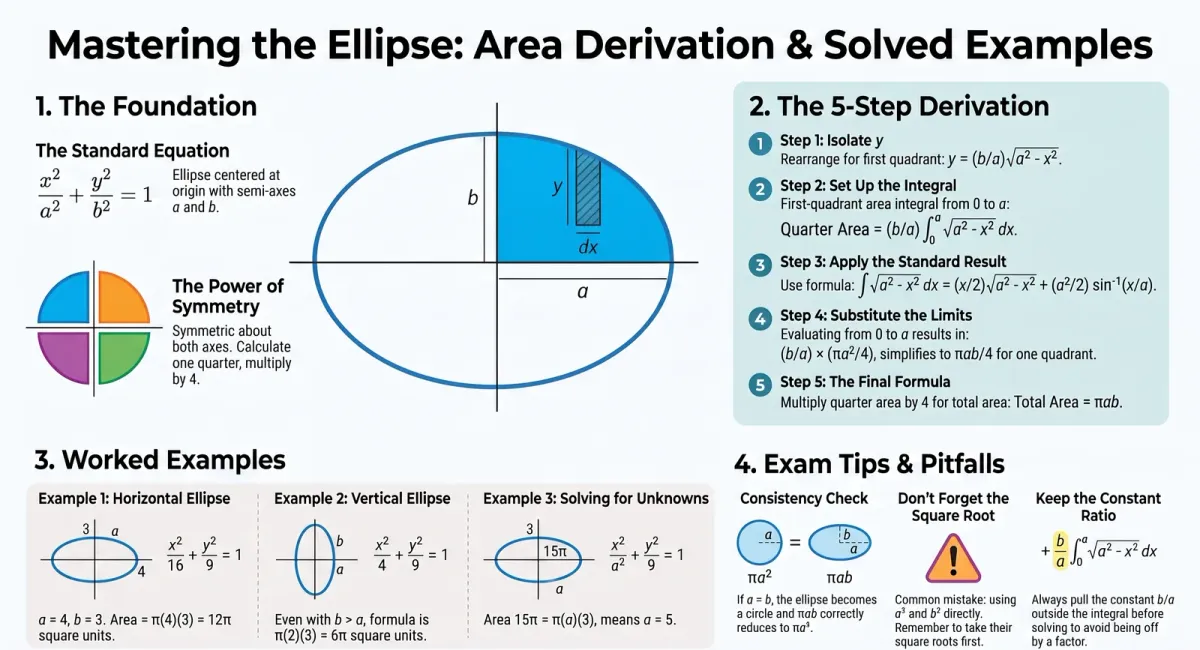
If you’ve already worked through the circle-area derivation in this chapter, the ellipse is a natural next step — the method is almost identical, with just one extra ratio to track. This post derives the area formula πab from scratch and works through several solved examples, the kind you’ll see repeatedly in CBSE Class 12 and Maharashtra Board Commerce papers.
The Equation of an Ellipse
An ellipse centered at the origin, with semi-axes a (along the x-axis) and b (along the y-axis), is written as:
x²/a² + y²/b² = 1
Like a circle, this shape is symmetric about both the x-axis and the y-axis. That symmetry is what makes the integration manageable — you only need to compute the area of one quarter and multiply by 4.
Step-by-Step Derivation
Step 1: Isolate y
Rearranging the ellipse equation for y:
y² = b²(1 − x²/a²) → y = ±(b/a)√(a² − x²)
Since we want the region in the first quadrant (above the x-axis), take the positive root:
y = (b/a)√(a² − x²)
Step 2: Set Up the First-Quadrant Integral
The first-quadrant arc of the ellipse runs from x = 0 to x = a. Using vertical strips:
Quarter Area = ∫₀ᵃ (b/a)√(a² − x²) dx
Since b/a is constant, pull it outside the integral:
Quarter Area = (b/a) ∫₀ᵃ √(a² − x²) dx
Step 3: Apply the Standard Integral
Using the same standard result from the circle derivation:
∫√(a² − x²) dx = (x/2)√(a² − x²) + (a²/2) sin⁻¹(x/a) + C
Step 4: Substitute the Limits
Quarter Area = (b/a) × [(x/2)√(a² − x²) + (a²/2) sin⁻¹(x/a)]₀ᵃ
At x = a: (a/2)(0) + (a²/2) sin⁻¹(1) = (a²/2)(π/2) = πa²/4
At x = 0: both terms vanish.
Quarter Area = (b/a) × (πa²/4) = πab/4
Step 5: Multiply by 4 for the Full Ellipse
Total Area = 4 × (πab/4) = πab
Notice that setting a = b reduces this exactly to πa², the circle formula — a nice consistency check that confirms the derivation is correct.
Alternative Method: Horizontal Strips
Rearranging for x instead: x = (a/b)√(b² − y²)
Quarter Area = (a/b) ∫₀ᵇ √(b² − y²) dy = (a/b) × (πb²/4) = πab/4
Total Area = 4 × πab/4 = πab
Both methods converge to the same answer, as expected from the ellipse’s dual-axis symmetry.
Worked Example 1: Standard Ellipse
Find the area of the region bounded by the ellipse x²/16 + y²/9 = 1.
Here a² = 16 so a = 4, and b² = 9 so b = 3.
Area = πab = π(4)(3) = 12π square units
Worked Example 2: Ellipse With a Larger Vertical Axis
Find the area of the region bounded by the ellipse x²/4 + y²/9 = 1.
Here a = 2 and b = 3 (note that b > a in this case, meaning the major axis lies along the y-axis rather than the x-axis).
Area = πab = π(2)(3) = 6π square units
This example is worth noting carefully: regardless of whether a or b is larger, the area formula πab stays exactly the same — only the shape’s orientation changes.
Worked Example 3: Finding the Semi-Axes From a Given Area
Sometimes a question works backward: if the area of an ellipse x²/a² + y²/9 = 1 is 15π square units, find a.
Using Area = πab with b = 3: 15π = πa(3) → a = 5
This kind of reverse problem tests whether you truly understand the formula’s structure rather than just memorizing it, so it’s worth practicing a few variations where the area or one axis is unknown instead of both being given directly.
Common Mistakes to Avoid
The most frequent error is forgetting to pull the constant ratio b/a (or a/b) out of the integral before applying the standard result — skipping this step usually leads to an answer that’s off by a factor of a or b. Another common mistake is misreading a² and b² directly as a and b without taking the square root first. Finally, students sometimes assume a must always be the “bigger” value; in reality, a and b are simply the denominators under x² and y² respectively, and either one can be larger.
Related Reading
-
Area of a Circle Using Integration: Step-by-Step Derivation (πr²)
-
Application of Integrals Class 12: Complete Guide to Area Under Curves
Ready to Practice?
Once you can derive πab confidently, ellipse questions become quick, reliable marks. Get AI-powered doubt resolution and topic-wise practice on ChampionsPrep for just ₹10 per use. Practice on ChampionsPrep →
Test Your Knowledge
Area of an Ellipse Using Integration: Formula, Derivation & Solved Examples
Frequently Asked Questions
What is the formula for the area of an ellipse? +
Area = πab, where a and b are the semi-axes along the x-axis and y-axis (the square roots of the denominators in the standard equation x²/a² + y²/b² = 1).
How is the ellipse area formula derived using integration? +
By integrating y = (b/a)√(a² − x²) over the first quadrant, applying the standard √(a² − x²) integral, and multiplying the result by 4 using symmetry.
Does it matter if a is larger than b, or vice versa? +
No. The formula πab gives the correct area either way — only the orientation of the ellipse's major axis changes, not the area formula.
How does the ellipse formula relate to the circle formula? +
Setting a = b in πab gives πa², exactly matching the circle-area formula, since a circle is a special case of an ellipse where both axes are equal.
Is the ellipse-area derivation commonly tested in board exams? +
Yes, it appears frequently as a 3–5 mark question in CBSE Class 12, and similar problems are common in Maharashtra Board Commerce Maths as well.
AI-powered practice — free to start