

Integration by Parts: ILATE Rule, Formula & Solved Examples (Class 12)
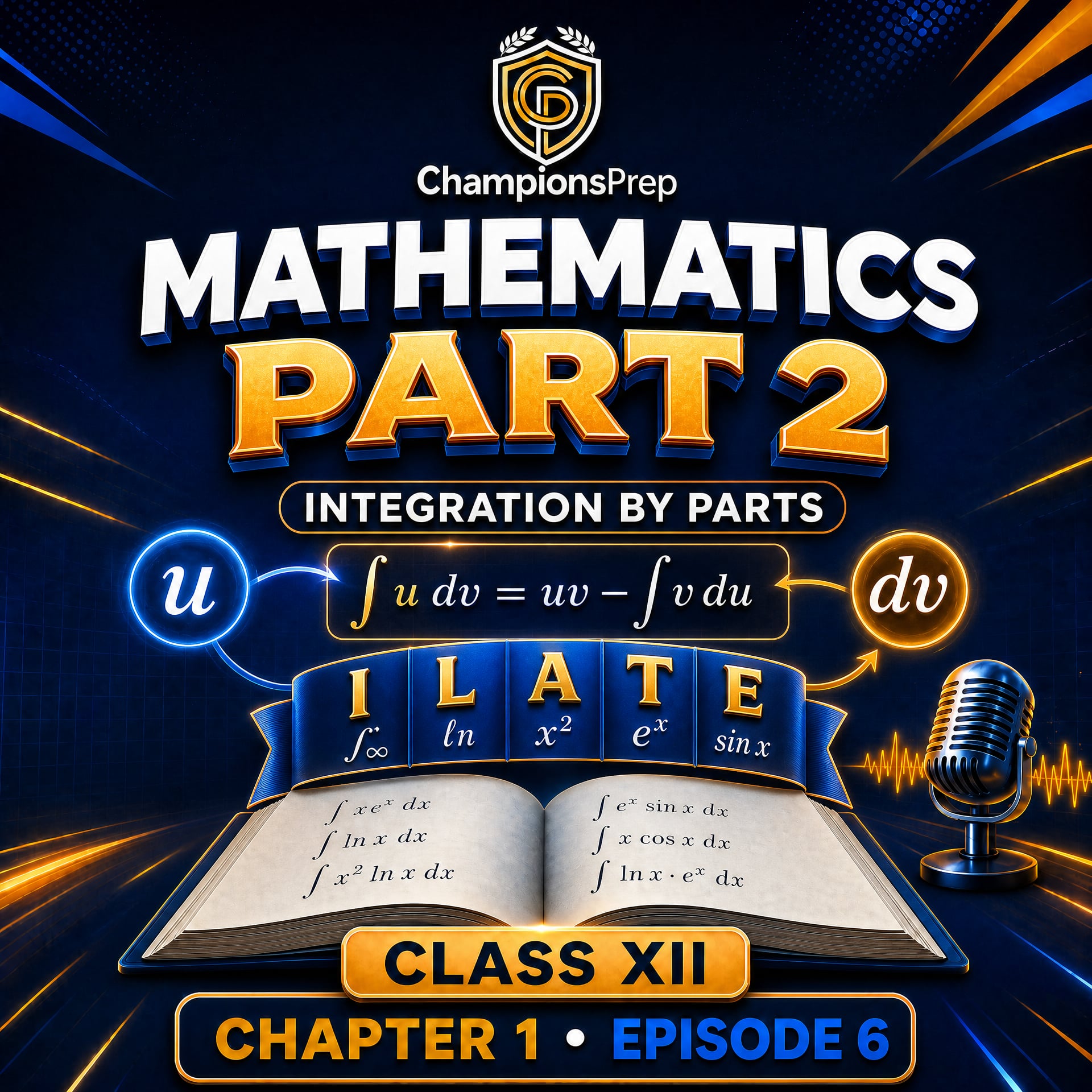
When an integrand is a product of two different types of functions — like x·sin x, x²·eˣ, or log x on its own — no standard formula or simple substitution will crack it directly. This is where integration by parts comes in, a technique built directly on the product rule of differentiation, run in reverse. This guide explains the formula, the ILATE rule for choosing which function to integrate first, and walks through the exact worked examples that appear most often in CBSE Class 12 board exams.
The Integration by Parts Formula
Starting from the product rule of differentiation, d/dx(uv) = u(dv/dx) + v(du/dx), and integrating both sides, we arrive at:
∫u·(dv/dx) dx = uv − ∫v·(du/dx) dx
In words: ∫(first function)(second function) dx = (first function) × ∫(second function)dx − ∫[derivative of first function × ∫(second function)dx] dx
The entire technique hinges on one crucial decision: which of the two functions should be treated as the "first function" (the one you differentiate) and which as the "second function" (the one you integrate)?
The ILATE Rule: Choosing the First Function
ILATE is a memory device that ranks function types in the order they should be chosen as the first function:
- I — Inverse trigonometric functions (sin⁻¹x, tan⁻¹x, etc.)
- L — Logarithmic functions (log x)
- A — Algebraic functions (x, x², polynomials)
- T — Trigonometric functions (sin x, cos x)
- E — Exponential functions (eˣ, aˣ)
Whichever function type appears earliest in this list should be treated as the first function, since it generally becomes simpler when differentiated.
Worked Example: Choosing the Wrong Function First
Example 1: Evaluate ∫x cos x dx
Following ILATE, "algebraic" (x) comes before "trigonometric" (cos x), so x is the first function:
∫x cos x dx = x∫cos x dx − ∫[1·∫cos x dx]dx = x sin x − ∫sin x dx = x sin x + cos x + C
What happens if we choose incorrectly? If we instead pick cos x as the first function, we get x²/2 · cos x + ∫(x²/2)sin x dx — a more complicated integral than we started with, since the power of x increased instead of reducing to a constant. This demonstrates exactly why the ILATE order matters.
Worked Example: Logarithmic Functions
Example 2: Evaluate ∫log x dx
There's no obvious "second function" here, so we treat 1 as the second function (its integral is simply x):
∫(log x · 1) dx = log x · x − ∫(1/x)·x dx = x log x − ∫1 dx = x log x − x + C
Integration by Parts: ILATE Rule, Formula & Solved Examples (Class 12)
Worked Example: Exponential Functions
Example 3: Evaluate ∫x eˣ dx
By ILATE, algebraic (x) comes before exponential (eˣ):
= x·eˣ − ∫1·eˣ dx = xeˣ − eˣ + C = eˣ(x − 1) + C
Worked Example: Inverse Trigonometric Functions
Example 4: Evaluate ∫tan⁻¹x dx
Similar to log x, treat 1 as the second function:
= x tan⁻¹x − ∫x · [1/(1+x²)] dx = x tan⁻¹x − (1/2)log(1+x²) + C
(The remaining integral is solved by substituting t = 1 + x², since its derivative 2x appears in the numerator.)
The Special Shortcut: ∫eˣ[f(x) + f′(x)]dx = eˣf(x) + C
One of the most exam-favorite patterns in this chapter is recognizing when an integrand secretly fits the form eˣ[f(x) + f′(x)]. When it does, the answer is immediately eˣf(x) + C — no lengthy integration by parts required.
Example 5: Evaluate ∫eˣ[1/x − 1/x²] dx
Let f(x) = 1/x, so f′(x) = −1/x². Then f(x) + f′(x) = 1/x − 1/x², which exactly matches the integrand.
= eˣ · (1/x) + C = eˣ/x + C
Spotting this pattern instantly — rather than attempting integration by parts the long way — can save several minutes in a timed exam.
Double Integration by Parts: The e^x sin x Type
Some integrals require applying integration by parts twice, and then solving algebraically for the original integral, since it reappears on both sides of the equation.
Example 6: Evaluate ∫eˣ sin x dx
Let I = ∫eˣ sin x dx. Applying parts once (with sin x as the first function):
I = −eˣ cos x + ∫eˣ cos x dx
Applying parts again to the remaining integral:
∫eˣ cos x dx = eˣ sin x − ∫eˣ sin x dx = eˣ sin x − I
Substituting back: I = −eˣ cos x + eˣ sin x − I, so 2I = eˣ(sin x − cos x), giving:
I = (eˣ/2)(sin x − cos x) + C
This "solve for I" technique is unique to this type of problem and is a favorite 5-mark board question.
Common Mistakes to Avoid
- Ignoring ILATE, which often makes the resulting integral harder, not easier.
- Forgetting to integrate the "second function" correctly before applying the formula.
- Missing the "−∫" sign, leading to an incorrect final answer.
- Not recognizing the eˣ[f(x)+f′(x)] shortcut, wasting time when a one-line answer was possible.
Suggested Internal Links
- Link to: Indefinite Integrals Class 12: Formulas & Solved Examples (for the base formulas used in every parts problem)
- Link to: Integration by Substitution Method (used within the "second function" steps of parts problems)
- Link to: Integration by Partial Fractions (the technique preceding this in most syllabi)
- Link to: Definite Integrals & Fundamental Theorem of Calculus (applying parts with limits)
Ready to Master Integration by Parts?
The ILATE rule is easy to state but takes real practice to apply instinctively under exam pressure. ChampionsPrep's AI-powered doubt resolution and topic-wise practice sets, at just ₹10 per use, let you drill this exact decision-making skill until it becomes second nature. Practice Integration by Parts on ChampionsPrep →
Test Your Knowledge
Frequently Asked Questions
What does ILATE stand for and why does the order matter? +
ILATE stands for Inverse trigonometric, Logarithmic, Algebraic, Trigonometric, and Exponential functions. The order matters because choosing the first function according to this priority generally simplifies the integral with each successive step.
What if neither function in the product integrates easily? +
Try treating the constant function 1 as the second function. This works well for standalone log x and inverse trigonometric functions.
Why do some integrals require applying integration by parts twice? +
Because a single application does not eliminate the product structure. Applying parts a second time and then solving algebraically for the original integral resolves this, as seen with e to the x times sin x.
How do I quickly recognize the e^x times f(x) plus f'(x) pattern? +
Look for two terms combined inside brackets, multiplying e to the x, where one term looks like it could be the derivative of the other.
Is integration by parts tested heavily in CBSE board exams? +
Yes, it is one of the highest-weightage techniques in the Integrals chapter, appearing as both standalone questions and as a component within longer combined problems.
Keep practising Mathematics
AI-powered feedback and structured revision for Mathematics — free to start, at your own pace.
AI-powered practice — free to start