
You’ve known the formula πr² since primary school, but have you ever derived it? Application of Integrals gives you the tools to do exactly that, using nothing more than the equation of a circle and a definite integral. This derivation is one of the most frequently asked long-answer questions in CBSE Class 12 boards, so knowing it cold is genuinely worth the effort.
Setting Up the Problem
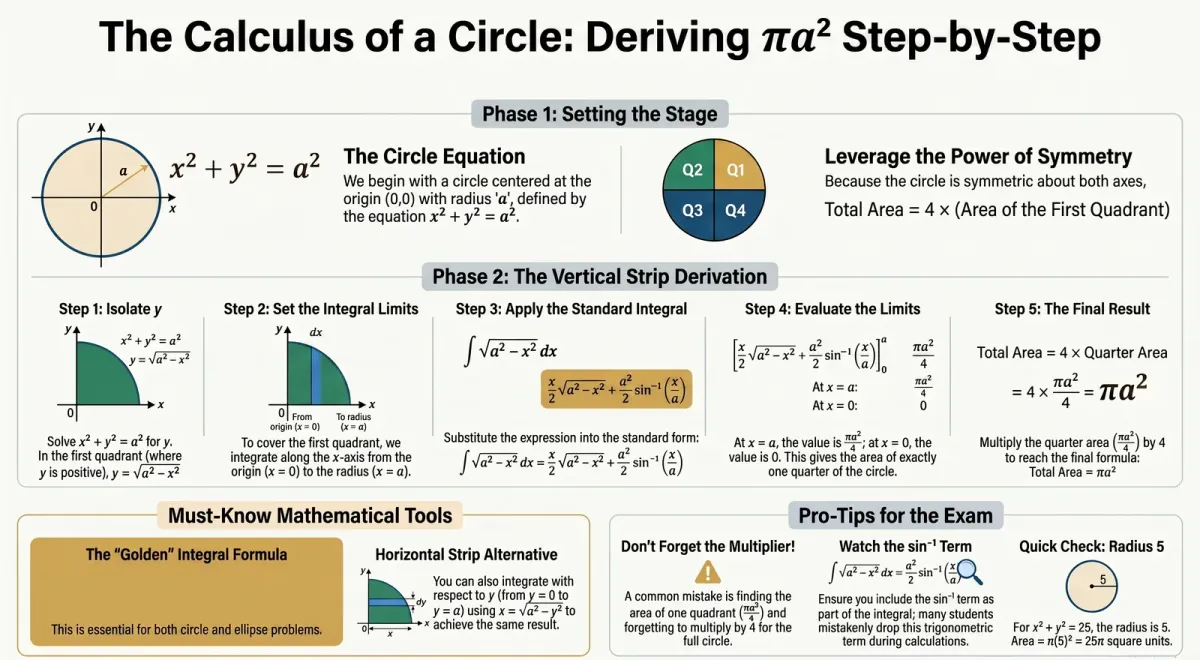
Consider the circle x² + y² = a², centered at the origin with radius a. Our goal is to find the total area enclosed by this circle using integration rather than the standard geometry formula.
The key observation is symmetry: the circle is symmetric about both the x-axis and the y-axis. This means the area in each of the four quadrants is identical. So instead of integrating over the entire circle, you only need to find the area in the first quadrant and multiply the result by 4.
Step-by-Step Derivation (Vertical Strips)
Step 1: Isolate y
From x² + y² = a², solve for y:
y = ±√(a² − x²)
Since the first-quadrant region lies above the x-axis, take the positive root: y = √(a² − x²).
Step 2: Set Up the Integral for One Quadrant
The first-quadrant arc runs from x = 0 to x = a. Using vertical strips, the area of this quarter is:
Quarter Area = ∫₀ᵃ √(a² − x²) dx
Step 3: Apply the Standard Integration Result
This integral has a standard form:
∫√(a² − x²) dx = (x/2)√(a² − x²) + (a²/2) sin⁻¹(x/a) + C
It’s worth memorizing this result exactly, since it appears in nearly every circle and ellipse problem in this chapter.
Step 4: Substitute the Limits
Quarter Area = [(x/2)√(a² − x²) + (a²/2) sin⁻¹(x/a)]₀ᵃ
At x = a: (a/2)(0) + (a²/2) sin⁻¹(1) = (a²/2)(π/2) = πa²/4
At x = 0: both terms vanish.
So Quarter Area = πa²/4.
Step 5: Multiply by 4
Total Area = 4 × (πa²/4) = πa²
This matches the familiar formula exactly, confirming that integration gives the same result as elementary geometry — just derived from first principles.
Alternative Method: Horizontal Strips
You can reach the same answer using horizontal strips instead, which is a useful cross-check and sometimes appears as a follow-up “verify using the other method” question.
From x² + y² = a², solve for x: x = √(a² − y²)
Quarter Area = ∫₀ᵃ √(a² − y²) dy = πa²/4, by the identical reasoning as above (the integral is symmetric in x and y for a circle).
Total Area = 4 × πa²/4 = πa²
The fact that both methods give the same answer isn’t a coincidence — it’s a direct consequence of the circle’s symmetry about both axes.
Worked Example: Circle of Radius 5
Find the area enclosed by the circle x² + y² = 25.
Using the derived formula directly: Area = πa² = π(5)² = 25π square units
Alternatively, showing full working: Area = 4∫₀⁵ √(25 − x²) dx = 4 × (25π/4) = 25π square units — the same result, with all steps shown for full marks.
Related Problem: Quarter-Circle Regions
CBSE often asks for just the area in one quadrant, bounded by specific vertical or horizontal lines rather than the full circle. For example, the area in the first quadrant bounded by x² + y² = 4, x = 0, and x = 2 is simply one quarter of the full circle’s area: (1/4)(π × 4) = π square units. Recognizing this shortcut — rather than re-deriving the integral from scratch — saves valuable time in the exam.
Common Mistakes to Avoid
Forgetting the (a²/2) sin⁻¹(x/a) term is the most common error, since students often remember only the algebraic part of the standard integral and drop the inverse trigonometric part entirely. Another frequent slip is forgetting to multiply the first-quadrant area by 4 for the full circle — always double-check whether the question asks for the full area or just one quadrant. Finally, be careful with the sign when taking the square root; always choose the branch that matches the region you’re integrating over.
Related Reading
-
Application of Integrals Class 12: Complete Guide to Area Under Curves
-
How to Find Area Under a Simple Curve Using Integration – Class 12 Maths
Ready to Practice?
Master this derivation once, and circle-area questions become one of the easiest marks on your paper. Get instant, step-by-step doubt resolution and topic-wise practice on ChampionsPrep for just ₹10 per use. Practice on ChampionsPrep →
Test Your Knowledge
Area of a Circle Using Integration: Step-by-Step Derivation (πr²)
Frequently Asked Questions
How is the area of a circle derived using integration? +
By integrating y = √(a² − x²) from x = 0 to x = a to get the first-quadrant area, then multiplying by 4 using the circle's symmetry about both axes, giving πa².
What is the standard integral used for circle and ellipse problems? +
∫√(a² − x²) dx = (x/2)√(a² − x²) + (a²/2) sin⁻¹(x/a) + C. This result is essential to memorize for this chapter.
Does the horizontal strip method give the same answer as the vertical strip method? +
Yes. Because a circle is symmetric in x and y, both methods produce identical results, which is why examiners sometimes ask you to verify using both approaches.
How do I find the area of just one quadrant of a circle? +
Divide the full circle's area (πa²) by 4, or directly integrate over the relevant quarter using the appropriate limits.
Is the circle-area derivation likely to appear in board exams? +
Yes, it's one of the most commonly repeated long-answer questions in CBSE Class 12 Application of Integrals, often worth 5 marks.
AI-powered practice — free to start