
Application of Integrals Class 12: The Complete Guide to Area Under Curves
If you’ve just finished Definite Integrals and are wondering what they’re actually for, this chapter answers that question. Application of Integrals — Chapter 8 in the CBSE NCERT textbook, and Chapter 7 (Application of Definite Integration) in the Maharashtra State Board Commerce Maths syllabus — teaches you how to use integration to calculate the exact area enclosed by curves, something ordinary geometry formulas can’t do. This guide covers the core idea, the standard shapes you’ll be tested on, and how to approach the chapter for your board exam.
What Is “Application of Integrals” in Class 12 Maths?
Basic geometry gives formulas for triangles, rectangles, and circles, but curves like parabolas, ellipses, and trigonometric graphs don’t fit those templates. Application of Integrals fills that gap, building on the “definite integral as the limit of a sum” idea from the previous chapter and turning it into a practical tool: slicing a region into infinitely thin strips and adding up their areas using integration.
This is more than an abstract exercise. The same logic — breaking an irregular shape into tiny, measurable pieces — underlies real-world applications in physics, engineering, economics, and statistics, wherever you need to measure area, volume, or accumulated quantity under a changing rate.
The Core Formula for Area Under a Curve
Vertical Strips Method (Integrating with Respect to x)
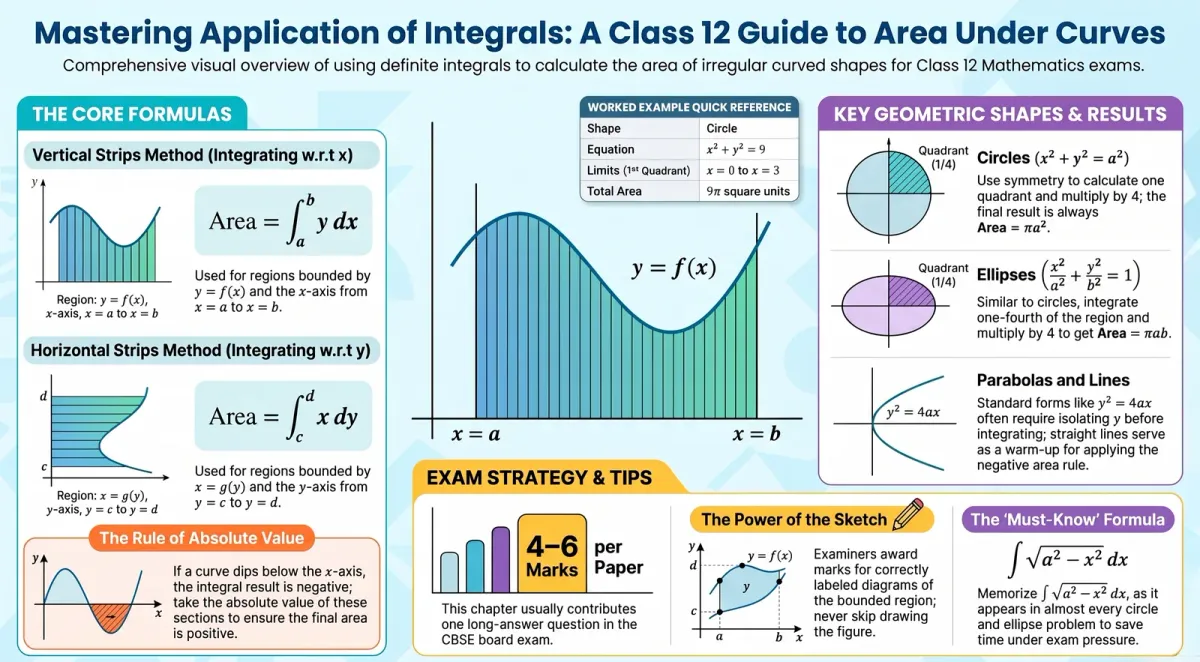
Picture the region enclosed by a curve y = f(x), the x-axis, and two vertical lines x = a and x = b. Slice this region into thin vertical strips of width dx and height y. Each strip has area y·dx, and adding up all these strips from x = a to x = b gives the total area:
Area = ∫ₐᵇ y dx = ∫ₐᵇ f(x) dx
This is the single most important formula in the chapter — almost every problem you solve will start from this line.
Horizontal Strips Method (Integrating with Respect to y)
Sometimes it’s easier to work with the region bounded by a curve x = g(y), the y-axis, and two horizontal lines y = c and y = d. Here, you slice the region into horizontal strips instead:
Area = ∫꜀ᵈ x dy = ∫꜀ᵈ g(y) dy
Choosing between the two methods usually comes down to which variable is easier to isolate — a decision that becomes intuitive with practice.
Why the Area Can Turn Out Negative — And How to Fix It
If a curve dips below the x-axis, the definite integral over that portion comes out negative, even though area itself can never be negative. The fix: take the absolute value of any negative portion before adding it to the rest. When a curve crosses the x-axis multiple times within your interval, split the integral at each crossing point, evaluate each piece separately, and add the absolute values. Skipping this step is a common reason students lose marks in this chapter.
Key Shapes You’ll Be Asked to Find the Area Of
Circles
For a circle x² + y² = a², using symmetry about both axes lets you compute just one quarter and multiply by 4. This consistently leads to the well-known result: Area = πa².
Ellipses
For an ellipse x²/a² + y²/b² = 1, the same symmetry trick applies. Integrating one quarter of the region and multiplying by 4 gives: Area = πab.
Parabolas
Standard parabolas like y² = 4ax show up frequently, especially in problems asking for the area bounded by the curve and its latus rectum. These problems test your ability to isolate y (or x) correctly before integrating.
Straight Lines
Lines are the simplest case and a good warm-up before tackling curves — but watch out for lines that cross the x-axis within your interval, since that’s exactly where the “negative area” rule applies.
A Quick Worked Example
Find the area enclosed by the circle x² + y² = 9.
By symmetry, the total area is 4 times the area in the first quadrant between x = 0 and x = 3:
Area = 4∫₀³ √(9 − x²) dx = 4 × (9π/4) = 9π square units
Notice how the formula √(a² − x²) integrates to a standard expression involving sin⁻¹ — a result worth memorizing, since it appears in nearly every circle and ellipse problem.
How This Chapter Fits Into the CBSE Class 12 Exam
Application of Integrals typically contributes 4–6 marks in the CBSE board paper, often as one long-answer question. It’s also a favourite in CUET and other entrance exams because it combines algebra, integration, and graphical reasoning. Diagrams matter here — examiners award marks for a correctly labeled sketch of the bounded region, so never skip the figure even if the question doesn’t explicitly ask for one.
Study Tips to Master Application of Integrals
Memorize the standard result for ∫√(a² − x²) dx — it saves time under exam pressure. Always sketch the curve before integrating; a rough graph shows immediately which parts lie above or below the axis. Finally, practice a mix of circle, ellipse, parabola, and line problems, since board exams rotate between all of them.
1. What is the main formula used in Application of Integrals?
The area under a curve y = f(x) between x = a and x = b is given by Area = ∫ₐᵇ f(x) dx, using vertical strips, or the equivalent horizontal-strip version for x = g(y).
2. Why do we take the absolute value of the area sometimes?
Because a definite integral is negative when the curve lies below the x-axis, even though physical area cannot be negative. Taking the absolute value corrects this.
3. What is the area enclosed by an ellipse x²/a² + y²/b² = 1?
The area is πab, derived by integrating one quarter of the ellipse in the first quadrant and multiplying the result by 4.
4. How many marks does this chapter carry in CBSE Class 12 boards?
It usually contributes 4–6 marks, frequently as one long-answer question involving a sketch and a definite integral calculation.
5. Is Application of Integrals important for CUET or other entrance exams?
Yes. Because it blends integration, algebra, and graphical reasoning, it is a common topic in CUET Commerce and other undergraduate entrance tests.
Ready to Practice?
Reading the theory is only half the battle — the CBSE board exam rewards speed and accuracy on problems just like the ones above. ChampionsPrep offers AI-powered doubt resolution and topic-wise practice on Application of Integrals for just ₹10 per use — pay only for the help you need. Start practicing →
Test Your Knowledge
Application of Integrals Class 12: Complete Guide to Area Under Curves
Frequently Asked Questions
What is the main formula used in Application of Integrals? +
The area under a curve y = f(x) between x = a and x = b is given by Area = ∫ₐᵇ f(x) dx, using vertical strips, or the equivalent horizontal-strip version for x = g(y).
Why do we take the absolute value of the area sometimes? +
Because a definite integral is negative when the curve lies below the x-axis, even though physical area cannot be negative. Taking the absolute value corrects this.
What is the area enclosed by an ellipse x²/a² + y²/b² = 1? +
The area is πab, derived by integrating one quarter of the ellipse in the first quadrant and multiplying the result by 4.
How many marks does this chapter carry in CBSE Class 12 boards? +
It usually contributes 4–6 marks, frequently as one long-answer question involving a sketch and a definite integral calculation.
Is Application of Integrals important for CUET or other entrance exams? +
Yes. Because it blends integration, algebra, and graphical reasoning, it is a common topic in CUET Commerce and other undergraduate entrance tests.
AI-powered practice — free to start