

Definite Integrals & Fundamental Theorem of Calculus (Class 12 Maths)
So far, indefinite integrals have given us a family of functions, differing by a constant C. Definite integrals take this a step further: instead of a general answer, they produce a single, precise numerical value — typically representing the area under a curve between two specific points. This connection between anti-differentiation and area is formalized by the Fundamental Theorem of Calculus, arguably the single most important result in this entire chapter. This guide explains the concept clearly and shows exactly how to apply it.
What Is a Definite Integral?
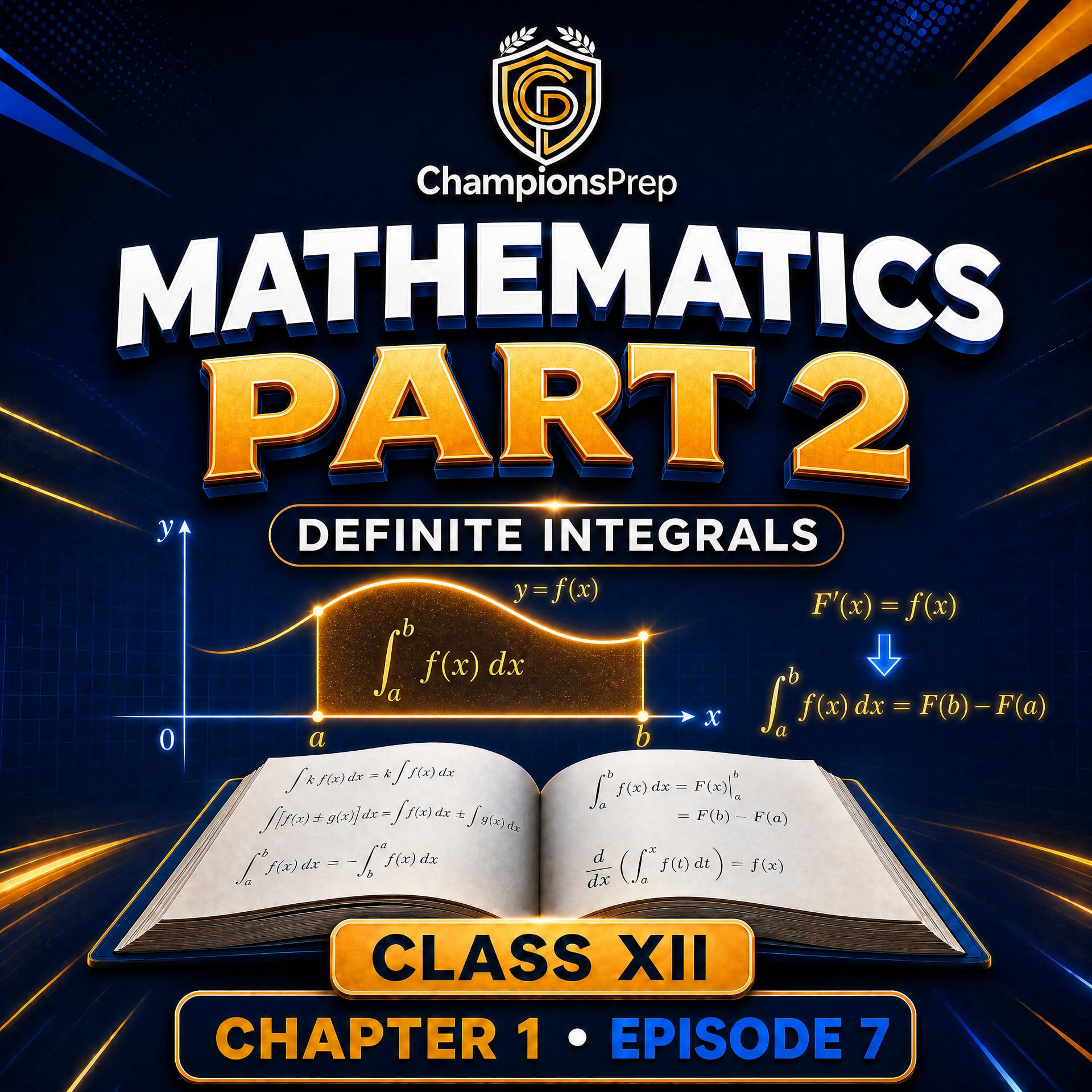
A definite integral is written as ∫ₐᵇ f(x) dx, where a is the lower limit and b is the upper limit of integration. Geometrically, if f(x) ≥ 0 on [a, b], this represents the area of the region bounded by the curve y = f(x), the x-axis, and the vertical lines x = a and x = b.
Unlike an indefinite integral, a definite integral has a single fixed value — there's no "+C" involved, because the constant cancels out when you apply the limits (as we'll see shortly).
The Area Function: Building Intuition
Before stating the Fundamental Theorem formally, it helps to understand the area function A(x) = ∫ₐˣ f(t) dt, which represents the area under the curve from a fixed point a up to a variable point x. As x increases, this area changes — and the rate at which it changes turns out to be exactly f(x) itself. This insight is the seed of the entire theorem.
First Fundamental Theorem of Integral Calculus
If f is continuous on [a, b] and A(x) = ∫ₐˣ f(t) dt is the area function, then A′(x) = f(x) for all x in [a, b].
In plain language: the derivative of the area function is the original function. This confirms, rigorously, that integration and differentiation genuinely are inverse operations — not just informally, but as a provable theorem.
Second Fundamental Theorem of Integral Calculus (The One You'll Use Constantly)
If f is continuous on [a, b] and F is any anti-derivative of f (meaning F′(x) = f(x)), then:
∫ₐᵇ f(x) dx = F(b) − F(a)
This is the practical, computational version of the theorem — and it's what you'll use for nearly every definite integral problem in your syllabus. Notice that any constant of integration added to F(x) cancels out automatically: [F(x) + C]ₐᵇ = [F(b) + C] − [F(a) + C] = F(b) − F(a). This is exactly why you don't need to write "+C" when evaluating a definite integral.
Step-by-Step Process for Evaluating Definite Integrals
- Find the indefinite integral ∫f(x) dx, calling the result F(x) — no need to add C.
- Evaluate F(b), substituting the upper limit.
- Evaluate F(a), substituting the lower limit.
- Subtract: F(b) − F(a) is your final numerical answer.
Definite Integrals & Fundamental Theorem of Calculus (Class 12 Maths)
Solved Examples
Example 1: Evaluate ∫₁² x² dx
F(x) = x³/3. So the answer is F(2) − F(1) = 8/3 − 1/3 = 7/3
Example 2: Evaluate ∫₀^(π/2) cos x dx
F(x) = sin x. So the answer is sin(π/2) − sin(0) = 1 − 0 = 1
Example 3: Evaluate ∫₀^(π/4) tan²x dx
Rewrite tan²x = sec²x − 1, so F(x) = tan x − x. The answer is [tan(π/4) − π/4] − [tan(0) − 0] = 1 − π/4
A Crucial Caution: Continuity Matters
The Second Fundamental Theorem requires that f be well-defined and continuous throughout [a, b]. If the integrand is undefined anywhere within the interval — even at a single point — applying the theorem directly gives a meaningless result. Always check the domain of the integrand across the entire interval before evaluating.
Definite Integrals by Substitution
When evaluating a definite integral using substitution, you have two options: (1) find the indefinite integral first, convert back to the original variable, then apply the limits — or (2) the faster route — convert the limits themselves to match the new variable, and never convert back.
Example 4: Evaluate ∫₀¹ x/(1+x²) dx
Let t = 1 + x², so dt = 2x dx. When x = 0, t = 1; when x = 1, t = 2. So the limits transform directly:
= (1/2)∫₁² dt/t = (1/2)[log t]₁² = (1/2)(log 2 − log 1) = (1/2) log 2
Notice that we never needed to substitute back to x — the transformed limits handled everything, making this the faster and less error-prone approach.
Example 5: Evaluate ∫₀^(π/2) sin x cos x dx
Let t = sin x, so dt = cos x dx. When x = 0, t = 0; when x = π/2, t = 1:
= ∫₀¹ t dt = [t²/2]₀¹ = 1/2
Why Definite Integrals Matter Beyond the Exam
Definite integrals aren't just an abstract exercise — they're the mathematical tool behind computing areas, and by extension, they underpin real-world applications in economics (consumer and producer surplus), physics (displacement from velocity), and statistics (probability distributions). If you're preparing for CUET's Applied Mathematics domain or considering a Commerce-with-quant career path, this connection is worth internalizing, not just memorizing.
Suggested Internal Links
- Link to: Indefinite Integrals Class 12: Formulas & Solved Examples (prerequisite for finding F(x))
- Link to: Integration by Substitution Method (needed for the limit-conversion technique here)
- Link to: Properties of Definite Integrals (the next essential topic for simplifying tricky definite integrals)
- Link to: Integration by Parts – ILATE Rule & Examples (for definite integrals involving products)
Ready to Master Definite Integrals?
Applying the Fundamental Theorem correctly — especially with substitution and limit conversion — takes hands-on practice, not just theory. ChampionsPrep's AI-powered doubt resolution and topic-wise practice questions, at ₹10 per use, help you build genuine exam-day fluency. Practice Definite Integrals on ChampionsPrep →
Test Your Knowledge
Frequently Asked Questions
Why doesn't a definite integral need a constant of integration? +
Because the constant added to any anti-derivative cancels out when you subtract the value at the lower limit from the value at the upper limit.
What is the difference between the First and Second Fundamental Theorems of Calculus? +
The First Theorem establishes that the area function's derivative equals the original function. The Second Theorem is the practical formula used to actually compute definite integrals by subtracting anti-derivative values.
Do I need to convert the limits when using substitution in a definite integral? +
It is the recommended, faster approach. Converting the limits to match the substituted variable lets you complete the evaluation without converting back to the original variable.
What happens if the integrand is undefined somewhere in the interval? +
The Fundamental Theorem does not apply directly in that case, so you must always verify continuity across the full interval before evaluating.
Can a definite integral be negative? +
Yes. If the function is negative over part or all of the interval, the definite integral value will be negative, corresponding to area below the x-axis.
Keep practising Mathematics
AI-powered feedback and structured revision for Mathematics — free to start, at your own pace.
AI-powered practice — free to start