

Properties of Definite Integrals: Class 12 Maths with Examples
Some definite integrals look intimidating at first glance — expressions with x sin x over 1 + cos²x, or log(sin x) with no obvious anti-derivative in sight. Yet many of these become surprisingly manageable once you apply the right property of definite integrals. These properties don't just save time; for several classic CBSE board questions, they're the only practical way to reach a solution. This guide walks through every key property with proofs in brief and fully worked examples.
Why Properties Matter More Here Than in Indefinite Integrals
Indefinite integrals are evaluated purely through anti-differentiation techniques. Definite integrals, however, come with fixed limits — and this opens the door to clever algebraic manipulations (like reversing the direction of integration, or exploiting symmetry) that have no equivalent in indefinite integration. Recognizing when a property applies is often the difference between a two-line solution and an unsolvable mess.
The Core Properties
P1: ∫ₐᵇ f(x) dx = −∫ᵇₐ f(x) dx, and in particular ∫ₐᵃ f(x) dx = 0
Reversing the limits flips the sign of the integral.
P2: ∫ₐᵇ f(x) dx = ∫ₐᶜ f(x) dx + ∫ᶜᵇ f(x) dx
You can split the interval at any intermediate point c and add the two resulting integrals.
P3: ∫ₐᵇ f(x) dx = ∫ₐᵇ f(a+b−x) dx
Replacing x with (a+b−x) leaves the integral's value unchanged — this is one of the most powerful and frequently tested properties.
P4: ∫₀ᵃ f(x) dx = ∫₀ᵃ f(a−x) dx
A special case of P3 when a = 0, extremely common in board exam problems.
P5 & P6: Deal with integrals over [0, 2a], splitting them based on symmetry around x = a. If f(2a−x) = f(x), then ∫₀²ᵃf(x)dx = 2∫₀ᵃf(x)dx; if f(2a−x) = −f(x), the integral equals 0.
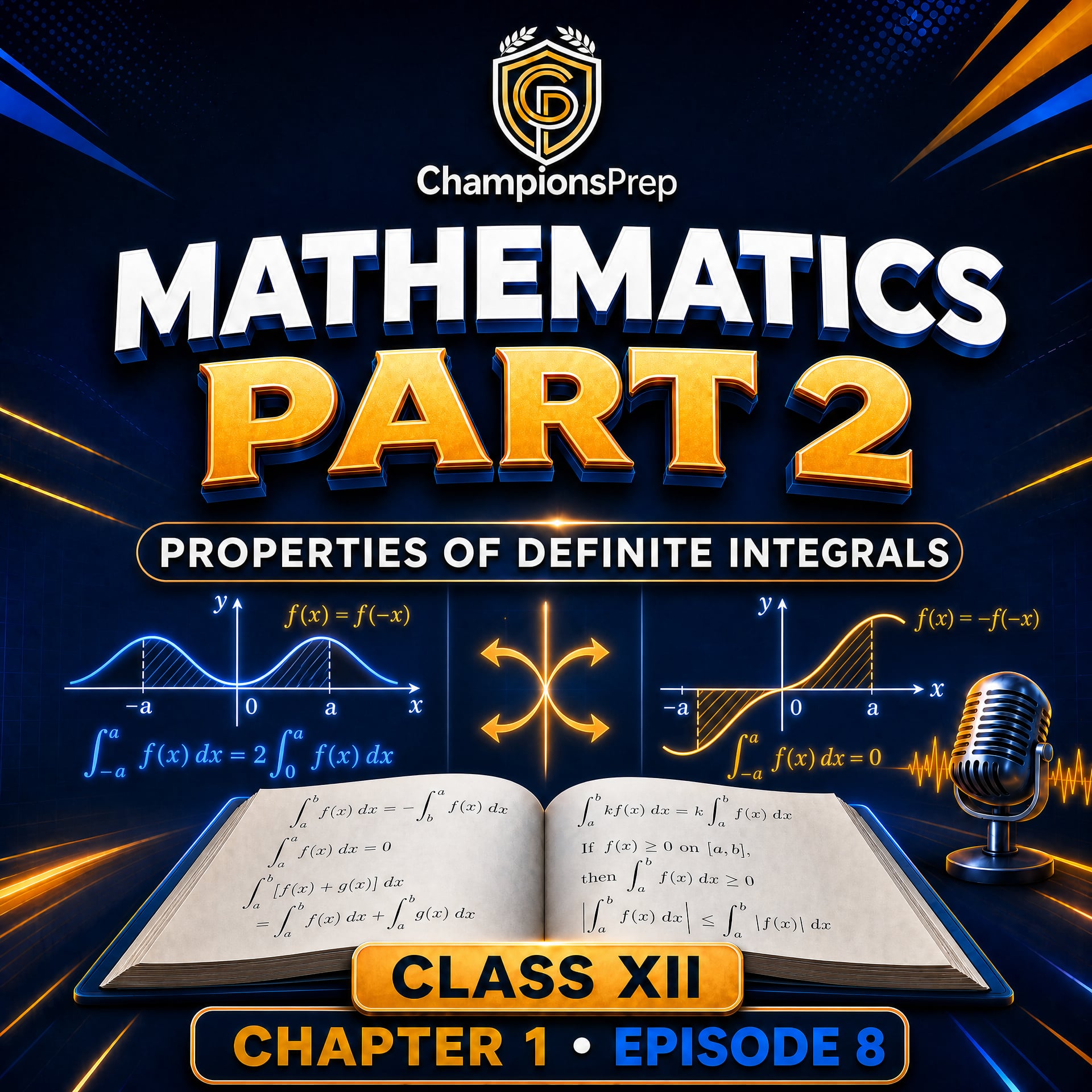
P7: For integrals over a symmetric interval [−a, a]: if f is an even function (f(−x) = f(x)), then ∫₋ₐᵃf(x)dx = 2∫₀ᵃf(x)dx. If f is an odd function (f(−x) = −f(x)), then ∫₋ₐᵃf(x)dx = 0.
Solved Example: Using P7 for Odd Functions
Example 1: Evaluate ∫₋₁¹ x³ dx
Since f(x) = x³ satisfies f(−x) = −x³ = −f(x), it's an odd function. By P7, the integral over the symmetric interval [−1, 1] equals 0 — no calculation needed at all.
Properties of Definite Integrals: Class 12 Maths with Examples
Solved Example: Using P4 to Solve an "Impossible-Looking" Integral
Example 2: Evaluate I = ∫₀^π [x sin x / (1 + cos²x)] dx
Direct integration is extremely difficult because of the x factor. Instead, apply P4 with a = π:
I = ∫₀^π [(π−x) sin(π−x)] / [1 + cos²(π−x)] dx
Since sin(π−x) = sin x and cos(π−x) = −cos x (so cos²(π−x) = cos²x):
I = ∫₀^π [(π−x) sin x] / (1 + cos²x) dx = π∫₀^π [sin x/(1+cos²x)]dx − I
So 2I = π∫₀^π [sin x/(1+cos²x)] dx. The remaining integral is solved by substituting t = cos x, giving π·(π/2) = π²/2. Therefore 2I = π²/2, so I = π²/4.
This example shows the signature move behind many of these properties: you don't solve the integral directly — you set up an equation where the original integral I reappears, then solve for I algebraically.
Solved Example: The Classic log(sin x) Integral
Example 3: Show that ∫₀^(π/2) log(sin x) dx = −(π/2) log 2
Let I = ∫₀^(π/2) log(sin x) dx. By P4 (with a = π/2):
I = ∫₀^(π/2) log[sin(π/2 − x)] dx = ∫₀^(π/2) log(cos x) dx
Adding both expressions for I:
2I = ∫₀^(π/2) [log(sin x) + log(cos x)] dx = ∫₀^(π/2) log(sin x cos x) dx
Using sin x cos x = (1/2)sin 2x:
2I = ∫₀^(π/2) log(sin 2x) dx − (π/2)log 2
Substituting t = 2x and using P6 (since sin(π−t) = sin t), the remaining integral simplifies back to I itself, leading to 2I = I − (π/2)log 2, and finally I = −(π/2)log 2.
This is one of the most elegant results in the entire chapter — a genuinely "unsolvable-looking" integral collapses into a clean closed form purely through properties, without ever finding an explicit anti-derivative of log(sin x).
A Practical Checklist for Spotting Which Property to Use
- Symmetric limits like [−a, a]? Check if the function is even or odd — P7 may give you the answer instantly (often zero).
- Limits [0, a] with an x·(trig function) structure? Try P4 — replacing x with (a−x) often creates a version of the integral you can add to the original.
- Limits [0, 2a]? Check whether f(2a−x) equals f(x) or −f(x) to apply P5/P6.
- Stuck with no obvious anti-derivative (like log sin x)? Properties, combined with adding two equivalent expressions for I, are almost always the intended route — direct integration is a strong signal you're missing a trick.
Suggested Internal Links
- Link to: Definite Integrals & Fundamental Theorem of Calculus (prerequisite foundation for this topic)
- Link to: Definite Integrals by Substitution (often combined with these properties)
- Link to: Integration Using Trigonometric Identities (needed for problems like the log(sin x) example)
- Link to: CBSE Class 12 Maths Question Bank (for extra practice)
Ready to Master Definite Integral Properties?
Recognizing which property unlocks a given problem is a pattern-matching skill that improves dramatically with focused, repeated practice. ChampionsPrep's AI-powered doubt resolution and topic-wise practice questions, at ₹10 per use, help you build this intuition before exam day. Practice Properties of Definite Integrals on ChampionsPrep →
Test Your Knowledge
Frequently Asked Questions
How do I recognize when a definite integral problem needs properties instead of direct integration? +
If direct anti-differentiation looks extremely difficult or impossible, or if the limits are symmetric, that is a strong signal a property-based approach is intended.
What is the difference between property P3 and property P4? +
P4 is simply P3 applied to the specific case where the lower limit is zero. Since P4 appears far more often in problems, it is worth memorizing separately even though it is technically a special case.
How do I decide if a function is even or odd for the symmetric-interval property? +
Substitute negative x into the function algebraically. If it simplifies to exactly the original function, it is even. If it simplifies to exactly the negative of the original function, it is odd.
Why does adding the integral to itself work as a technique? +
Because after applying a property, you get a second valid expression for the same integral. Adding both expressions together often causes complicated terms to combine into something simpler, letting you solve algebraically.
Are these properties tested as standalone questions in CBSE boards? +
Yes, frequently as multi-mark questions, and they are also essential building blocks within larger problems throughout the exam paper.
Keep practising Mathematics
AI-powered feedback and structured revision for Mathematics — free to start, at your own pace.
AI-powered practice — free to start