

Complement of a Set and De Morgan's Laws: Class 11 Maths Guide
The final operation in the Class 11 Sets chapter asks a different question: instead of combining two sets, what is left over in the universal set once one set is removed? This is the complement, and it leads directly to two widely tested results — De Morgan's Laws. This post covers both with full definitions, properties, and solved examples.
What Is the Complement of a Set?
Let U be the universal set, and let A be a subset of U. The complement of A, written A′, is the set of all elements of U that are not elements of A.
Formally: A′ = {x : x ∈ U and x ∉ A}
An equivalent and often simpler way to think about it: A′ = U − A. The complement of A is simply "the universal set minus A" — everything left over once A is taken out.
Worked Example
Suppose U = {1, 2, 3, 4, 5, 6, 7, 8, 9, 10} and A = {1, 3, 5, 7, 9}.
The elements of U that are not in A are 2, 4, 6, 8, 10. So:
A′ = {2, 4, 6, 8, 10}
A Real-World Style Example
If U is the set of all students in a co-educational Class 11, and A is the set of all girls in that class, then A′ is simply the set of all boys in the class — everything in U that is not in A.
Properties of the Complement
The complement follows a set of clean, predictable rules that appear constantly in exam proofs:
- Complement laws: A ∪ A′ = U, and A ∩ A′ = φ. A set and its complement together make up the entire universal set, and they share nothing in common.
- Law of double complementation: (A′)′ = A. Taking the complement of a complement brings you back to the original set.
- Laws of empty set and universal set: φ′ = U, and U′ = φ. The complement of "nothing" is "everything," and vice versa.
Verifying Double Complementation
Using the earlier example, A′ = {2, 4, 6, 8, 10}. Taking the complement of A′ with respect to U gives the elements of U not in A′, which are {1, 3, 5, 7, 9} — exactly the original set A. This confirms (A′)′ = A.
Complement of a Set and De Morgan's Laws: Class 11 Maths Guide
Representing Complement with a Venn Diagram
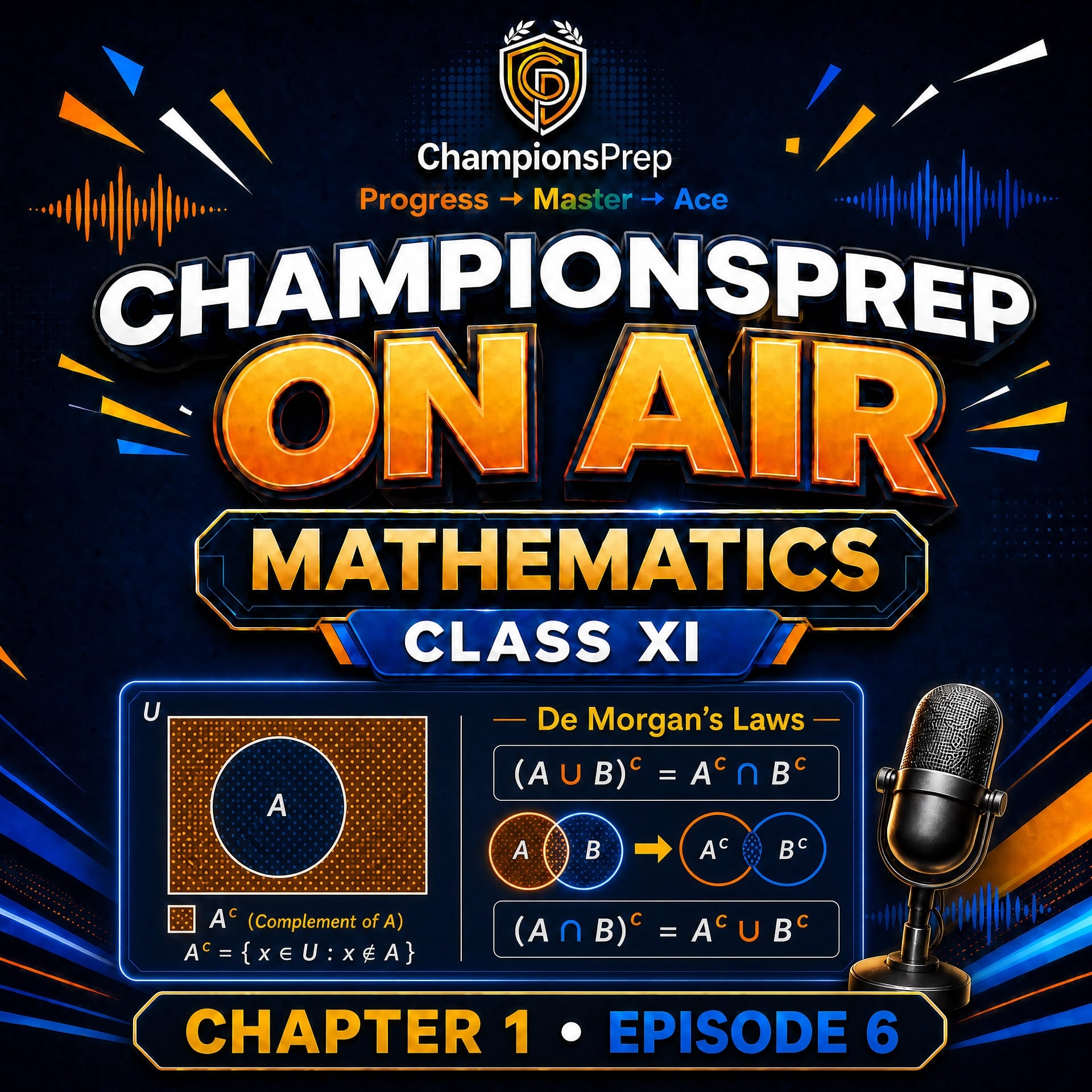
In a Venn diagram, A′ is shown by shading the entire region inside the rectangle (U) that lies outside the circle representing A. Since A′ is itself a subset of U, it is drawn as everything in the universal rectangle except the circle for A.
Interactive Venn Diagram: Set Operations, Union & Intersection
Adjust the cardinality of sets A and B and their intersection to watch the difference sets n(A - B), n(B - A), and union dynamically recalculate.
Venn Operations
Difference Sets
Visual Venn Diagram
Syllabus Checkpoints & Exam Watch-Outs
- Formula Check: n(A ∪ B) = n(A) + n(B) − n(A ∩ B). The intersection must be subtracted once because it is counted in both A and B.
- Order Matters: n(A - B) = n(A) - n(A ∩ B) and n(B - A) = n(B) - n(A ∩ B). Difference of sets is not commutative.
De Morgan's Laws
Named after the mathematician Augustus De Morgan, these two laws describe what happens when you take the complement of a union or an intersection. They are among the most frequently tested results in the entire chapter.
First Law (Complement of a Union):
(A ∪ B)′ = A′ ∩ B′
In words: the complement of the union of two sets equals the intersection of their complements.
Second Law (Complement of an Intersection):
(A ∩ B)′ = A′ ∪ B′
In words: the complement of the intersection of two sets equals the union of their complements.
Verifying De Morgan's First Law
Let U = {1, 2, 3, 4, 5, 6}, A = {2, 3}, and B = {3, 4, 5}.
- A′ = {1, 4, 5, 6}, and B′ = {1, 2, 6}, so A′ ∩ B′ = {1, 6}.
- A ∪ B = {2, 3, 4, 5}, so (A ∪ B)′ = {1, 6}.
Both sides equal {1, 6}, confirming (A ∪ B)′ = A′ ∩ B′.
Why De Morgan's Laws Make Intuitive Sense
Think of it this way: an element is not in "A or B" only if it fails to be in A and fails to be in B — which is exactly A′ ∩ B′. Similarly, an element is not in "A and B" if it fails to be in at least one of them — meaning it's in A′ or B′. This intuitive reading is often faster to apply in an exam than mechanically working through both sides of the equation.
Common Mistakes to Avoid
- Forgetting the "swap" between union and intersection — the complement of a union becomes an intersection, and the complement of an intersection becomes a union. Students often keep the same operation by mistake.
- Treating A′ as fixed regardless of U — the complement depends on which universal set you're working within; the same A can have a different complement under a different U.
- Skipping verification in proof questions — even though De Morgan's Laws are standard results, exams often ask you to verify them for a specific example by calculating both sides independently.
Solved Examples
Example 1: If U = {1, 2, 3, …, 9} and A = {2, 4, 6, 8}, find A′.
Solution: A′ = {1, 3, 5, 7, 9} — all elements of U not in A.
Example 2: Using the natural numbers as the universal set, find the complement of {x : x is an even natural number}.
Solution: The complement is {x : x is an odd natural number}, since every natural number not falling in the even set must be odd.
Example 3: If U = {a, b, c, d, e, f, g, h} and A = {a, b, c}, verify (A′)′ = A.
Solution: A′ = {d, e, f, g, h}. Taking the complement of A′ gives back {a, b, c} = A, confirming the law.
Together, complements and De Morgan's Laws complete your toolkit for this chapter — combined with union, intersection, and difference, you now have every operation needed to simplify and prove standard set-theory results in your exams.
Keep Learning
- Intersection and Difference of Sets: Class 11 Maths Concepts with Examples
- Venn Diagrams and Union of Sets: Class 11 Maths Explained Step by Step
- What Are Sets in Maths? Meaning, Representation & Examples
Master Every Chapter with ChampionsPrep
De Morgan's Laws and complement proofs are a favourite source of exam questions precisely because they're easy to get backwards under time pressure. ChampionsPrep's Class 11 Commerce question banks include dedicated practice on complements and proof-based questions, each with a full explanation to lock the logic in permanently.
Registration is free, and you only pay for what you use. Start practising today at https://app.championsprep.in and complete your mastery of the Sets chapter.
Test Your Knowledge
Frequently Asked Questions
What is the formula for the complement of a set? +
A′ = {x : x ∈ U and x ∉ A}, or equivalently, A′ = U − A, where U is the universal set.
What are De Morgan's Laws in set theory? +
De Morgan's Laws state that (A ∪ B)′ = A′ ∩ B′ and (A ∩ B)′ = A′ ∪ B′ — the complement of a union is the intersection of complements, and the complement of an intersection is the union of complements.
What is A ∪ A′ equal to? +
A ∪ A′ = U, the universal set, since a set combined with everything it excludes gives back the entire universal set.
What is (A′)′ equal to? +
(A′)′ = A. Taking the complement of a complement always returns the original set.
Does the complement of a set depend on the universal set? +
Yes. The complement is always calculated relative to a specific universal set U, so the same set A can have different complements under different universal sets.
Keep practising Mathematics
AI-powered feedback and structured revision for Mathematics — free to start, at your own pace.
AI-powered practice — free to start