

Intersection and Difference of Sets: Class 11 Maths Concepts with Examples
After union, Class 11 Maths introduces two more set operations that are just as important: intersection, which finds what two sets share, and difference, which finds what belongs to one set but not the other. Both are tested heavily through Venn diagram questions and multi-set word problems, so getting comfortable with their exact definitions matters.
What Is the Intersection of Two Sets?
The intersection of two sets A and B is the set of all elements that are common to both A and B. It is written A ∩ B, read as "A intersection B."
Formally: A ∩ B = {x : x ∈ A and x ∈ B}
The key word here is "and" — an element must belong to A and B simultaneously to be included in the intersection. Compare this with union, where the key word is "or."
Worked Example
Let A = {2, 4, 6, 8} and B = {6, 8, 10, 12}.
A ∩ B = {6, 8}
Only 6 and 8 appear in both sets, so only they are included.
Intersection with a Subset
If B ⊂ A, then A ∩ B = B. This is because every element of B is already inside A, so the "common" elements are exactly the elements of B itself.
For example, if A = {1, 2, 3, 4, 5, 6, 7, 8, 9, 10} and B = {2, 3, 5, 7}, then A ∩ B = {2, 3, 5, 7} = B, confirming B ⊂ A.
Disjoint Sets
If two sets A and B have no elements in common, so that A ∩ B = φ, they are called disjoint sets.
For example, A = {2, 4, 6, 8} and B = {1, 3, 5, 7} are disjoint sets, since no number appears in both lists. In a Venn diagram, disjoint sets are drawn as two separate, non-overlapping circles.
Representing Intersection with a Venn Diagram
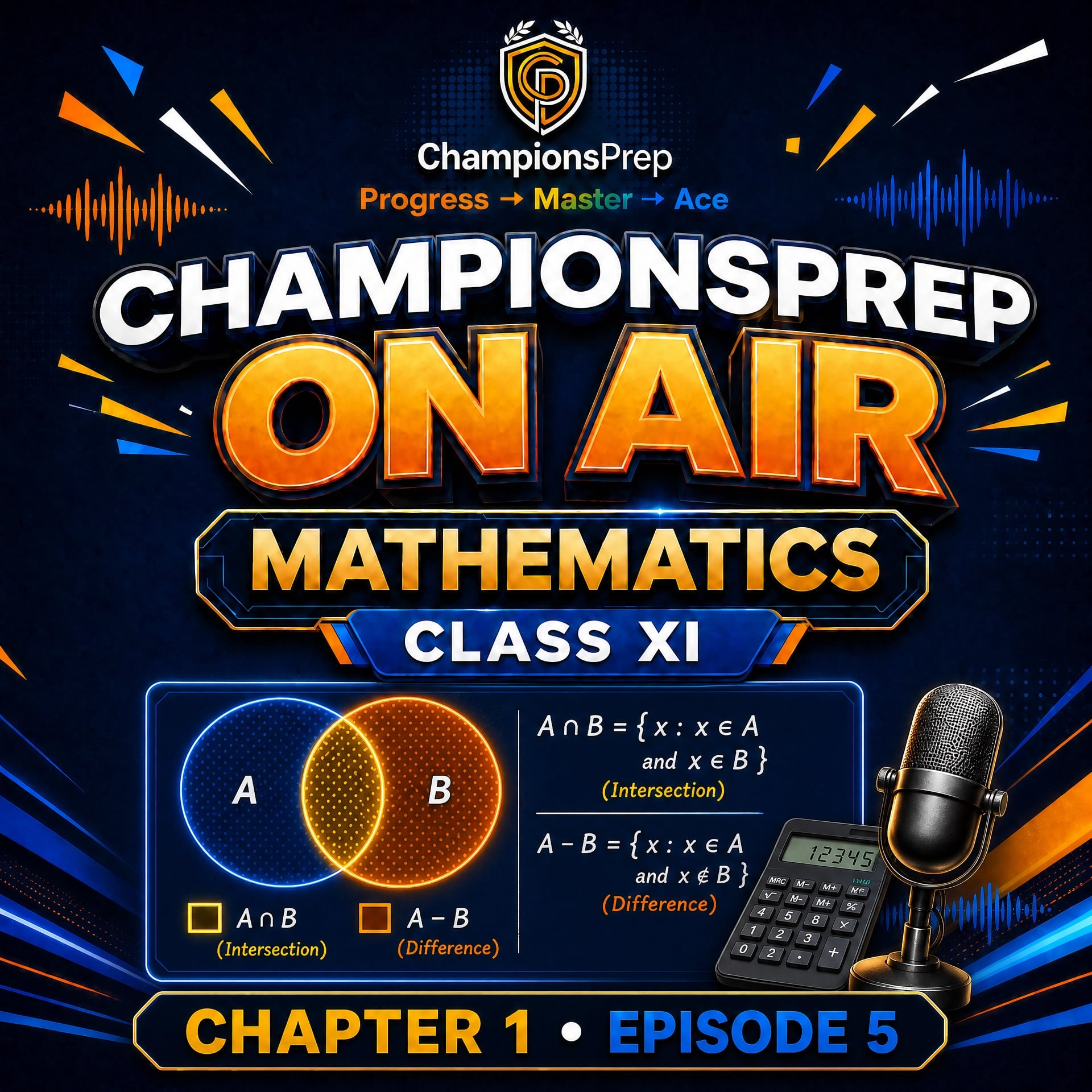
In a Venn diagram, A ∩ B is shown by shading only the overlapping region between the two circles — the part that belongs to both A and B simultaneously.
Intersection and Difference of Sets: Class 11 Maths Concepts with Examples
Properties of Intersection
Intersection follows several algebraic laws, similar in style to the laws for union:
- Commutative law: A ∩ B = B ∩ A
- Associative law: (A ∩ B) ∩ C = A ∩ (B ∩ C)
- Law of φ and U: φ ∩ A = φ, and U ∩ A = A
- Idempotent law: A ∩ A = A
- Distributive law: A ∩ (B ∪ C) = (A ∩ B) ∪ (A ∩ C) — intersection distributes over union, much like multiplication distributes over addition in arithmetic.
The distributive law is a frequent "prove that" question, and it is easiest to verify using a Venn diagram, shading each side of the equation separately to confirm they match.
What Is the Difference of Two Sets?
The difference of sets A and B, in that specific order, is the set of elements that belong to A but not to B. It is written A − B, read as "A minus B."
Formally: A − B = {x : x ∈ A and x ∉ B}
Important: A − B is generally not equal to B − A. Order matters here, unlike in union and intersection.
Worked Example
Let A = {1, 2, 3, 4, 5, 6} and B = {2, 4, 6, 8}.
- A − B = {1, 3, 5} — elements in A that are not in B.
- B − A = {8} — the only element in B that is not in A.
Clearly A − B ≠ B − A, confirming that difference is not commutative.
Interactive Venn Diagram: Set Difference & Intersection
Adjust the cardinality of sets A and B and their intersection to watch the difference sets n(A - B), n(B - A), and union dynamically recalculate.
Venn Operations
Difference Sets
Visual Venn Diagram
Syllabus Checkpoints & Exam Watch-Outs
- Formula Check: n(A ∪ B) = n(A) + n(B) − n(A ∩ B). The intersection must be subtracted once because it is counted in both A and B.
- Order Matters: n(A - B) = n(A) - n(A ∩ B) and n(B - A) = n(B) - n(A ∩ B). Difference of sets is not commutative.
Representing Difference with a Venn Diagram
A − B is shown by shading the part of circle A that does not overlap with circle B. This visually confirms why A − B and B − A give different results — you are shading a different "leftover" region each time.
A Useful Fact
The three sets A − B, A ∩ B, and B − A are always mutually disjoint — meaning no two of them ever overlap. Together, they neatly partition the union A ∪ B into three separate, non-overlapping pieces.
Solved Examples
Example 1: Let V = {a, e, i, o, u} and B = {a, i, k, u}. Find V − B and B − V.
Solution: V − B = {e, o} (elements in V not in B). B − V = {k} (the element in B not in V).
Example 2: If A = {3, 5, 7, 9, 11} and B = {7, 9, 11, 13}, find A ∩ B.
Solution: A ∩ B = {7, 9, 11}.
Example 3: Are {1, 2, 3, 4} and {x : x is a natural number, 4 ≤ x ≤ 6} disjoint?
Solution: The second set is {4, 5, 6}. Since 4 is common to both sets, they are not disjoint.
Common Mistakes to Avoid
- Reversing the order in difference: A − B and B − A are different sets — always match the order to the question.
- Confusing φ with disjoint: disjoint sets have an intersection equal to φ, but neither set itself needs to be empty.
- Forgetting that intersection needs "and," not "or" — mixing this up with union is one of the most common errors in this chapter.
Keep Learning
- Venn Diagrams and Union of Sets: Class 11 Maths Explained Step by Step
- Complement of a Set and De Morgan's Laws: Class 11 Maths Guide
- Equal Sets and Subsets in Class 11 Maths: Definitions, Rules & Examples
Master Every Chapter with ChampionsPrep
Intersection, difference, and disjoint sets are exactly where careful reading of "and" versus "or" separates a correct answer from a careless mistake. ChampionsPrep's Class 11 Commerce question banks give you plenty of practice on exactly this distinction, with instant, worked explanations for every question.
Registration is free, and you only pay for what you use. Start practising today at https://app.championsprep.in and sharpen the precision your exam demands.
Test Your Knowledge
Frequently Asked Questions
What is the difference between union and intersection? +
Union (A ∪ B) collects all elements from either set, while intersection (A ∩ B) keeps only the elements common to both sets.
What does it mean for two sets to be disjoint? +
Two sets are disjoint if they share no common elements, meaning their intersection is the empty set: A ∩ B = φ.
Is A − B the same as B − A? +
No. A − B contains elements in A but not B, while B − A contains elements in B but not A. These are generally different sets.
How is intersection shown in a Venn diagram? +
Intersection is shown by shading only the overlapping region shared by the two circles representing the sets.
What is the distributive law for intersection? +
A ∩ (B ∪ C) = (A ∩ B) ∪ (A ∩ C). Intersection distributes over union, similar to how multiplication distributes over addition.
Keep practising Mathematics
AI-powered feedback and structured revision for Mathematics — free to start, at your own pace.
AI-powered practice — free to start