

Once you know how to write a set, the next question Class 11 Maths asks is: how do two sets relate to each other? Are they identical? Does one sit entirely inside the other? This post covers equal sets, subsets, proper subsets, intervals as subsets of real numbers, and the universal set — all essential building blocks before you reach Venn diagrams and set operations.
Equal Sets
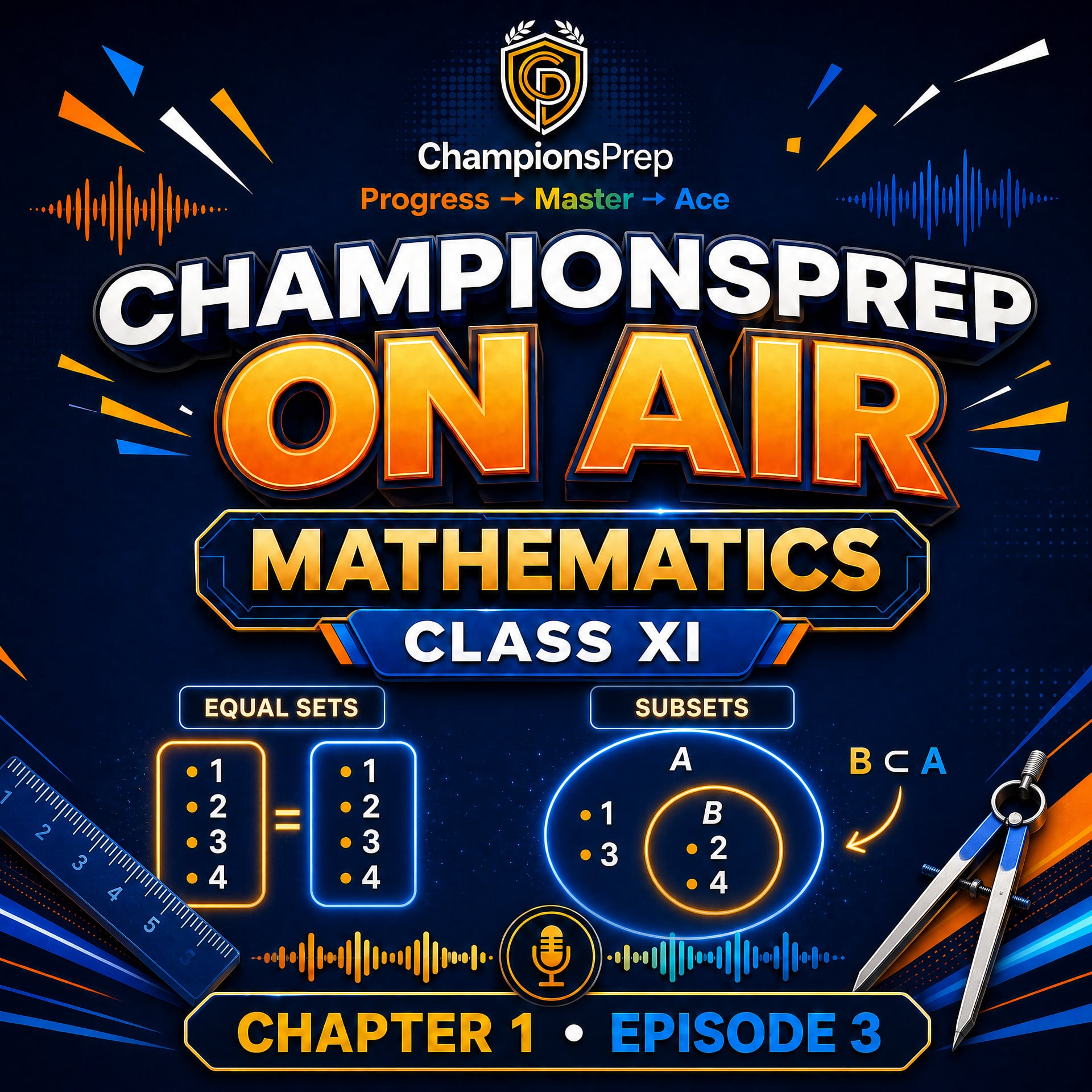
Two sets A and B are said to be equal, written A = B, if every element of A is also an element of B, and every element of B is also an element of A. In short, they contain exactly the same elements.
For example, if A = {1, 2, 3, 4} and B = {3, 1, 4, 2}, then A = B, because both sets contain the same four numbers — the order in which they are written does not matter.
If two sets do not have identical elements, they are called unequal, written A ≠ B.
Important note: Repeating an element does not change a set. {1, 2, 3} and {2, 2, 1, 3, 3} are equal sets, since both ultimately contain only the distinct elements 1, 2, and 3.
Subsets
A set A is called a subset of a set B if every element of A is also an element of B. This is written A ⊂ B, read as "A is a subset of B" or "A is contained in B."
Formally: A ⊂ B if, whenever a ∈ A, it follows that a ∈ B.
If A is not a subset of B, it is written A ⊄ B, meaning at least one element of A is missing from B.
Two useful facts follow directly from this definition:
- Every set is a subset of itself: A ⊂ A always holds.
- The empty set is a subset of every set: φ ⊂ A for any set A, since there are no elements in φ that could possibly fail to belong to A.
Subsets and Equality
If A ⊂ B and B ⊂ A both hold, then A and B contain exactly the same elements — which means A = B. This gives a useful two-way test for equality: to prove two sets are equal, you can show each is a subset of the other.
Equal Sets and Subsets in Class 11 Maths: Definitions, Rules & Examples
Proper Subsets
If A ⊂ B and A ≠ B, then A is called a proper subset of B, and B is called the superset of A.
For example, A = {1, 2, 3} is a proper subset of B = {1, 2, 3, 4}, since every element of A is in B, but B has an extra element (4) that A does not have.
A set with exactly one element, such as {a}, is called a singleton set.
A Word of Caution: ∈ vs ⊂
Students frequently confuse these two symbols:
- ∈ relates an element to a set (e.g., 3 ∈ {1, 2, 3}).
- ⊂ relates a set to another set (e.g., {3} ⊂ {1, 2, 3}).
An element itself can never be a subset of the set it belongs to, and a set is never "a member of" another set unless it is explicitly listed as an element inside it.
Intervals as Subsets of R
Since the set of real numbers R is infinite and continuous, mathematicians use interval notation as a shorthand for describing ranges of real numbers, all of which are subsets of R.
- Open interval (a, b) = {y : a < y < b} — includes all numbers strictly between a and b, excluding both endpoints.
- Closed interval [a, b] = {x : a ≤ x ≤ b} — includes both endpoints.
- Half-open intervals: [a, b) = {x : a ≤ x < b} includes a but excludes b; (a, b] = {x : a < x ≤ b} includes b but excludes a.
For example, {x : x ∈ R, −5 < x ≤ 7} can be written as the interval (−5, 7].
The Universal Set
In any given problem, we usually work within a fixed, relevant set that contains all the objects under discussion. This is called the universal set, denoted by U. All other sets in that context are treated as subsets of U.
For instance, if you are studying the number system, U could be the set of real numbers R. If you are studying a classroom's demographics, U would be the set of all students in that class.
Solved Examples
Example 1: Are A = {2, 3} and B = {x : x is a solution of x² + 5x + 6 = 0} equal?
Solution: Solving x² + 5x + 6 = 0 gives x = −2, −3. So B = {−2, −3}, which is not equal to A = {2, 3}.
Example 2: Is {a} ⊂ {a, b, c}? Is {a} ∈ {a, b, c}?
Solution: {a} ⊂ {a, b, c} is true, since the element a of {a} belongs to {a, b, c}. {a} ∈ {a, b, c} is false, since {a, b, c} contains a, b, c as elements — not the set {a} itself.
Example 3: Write [6, 12] in set-builder form.
Solution: [6, 12] = {x : x ∈ R, 6 ≤ x ≤ 12}.
Mastering subsets and intervals now will make Venn diagrams and set operations — union, intersection, and complement — far more intuitive, since all of them build directly on the idea of one set being contained within another.
Master Every Chapter with ChampionsPrep
Subsets and intervals are exactly the kind of topic where a small notation slip costs marks in an exam. ChampionsPrep's Class 11 Commerce question banks let you practise this concept with instantly explained MCQs and long-answer questions, so every mistake becomes a lesson before it becomes an exam-day loss.
Registration is free, and you only pay for what you use. Start practising today at app.championsprep.in and get exam-ready, one chapter at a time.
Frequently Asked Questions
What is the difference between a subset and a proper subset? +
A subset allows A and B to be equal. A proper subset requires A to be a subset of B and A not equal to B, meaning B must have at least one element that A does not have.
Is the empty set a subset of every set? +
Yes. The empty set is a subset of every set, including itself, because it has no elements that could fail the subset condition.
How do you prove two sets are equal using subsets? +
Show that A is a subset of B and B is a subset of A. If both hold true, then A and B contain exactly the same elements, so A equals B.
What is a universal set? +
A universal set is the overall set relevant to a particular context, of which all other sets being discussed are subsets.
Can a set be a subset of itself? +
Yes. By definition, every set is a subset of itself, since every element of a set is trivially also an element of that same set.
Keep practising Mathematics
AI-powered feedback and structured revision for Mathematics — free to start, at your own pace.
AI-powered practice — free to start