

Types of Relations in Class 12 Maths – Reflexive, Symmetric, Transitive & More
One of the highest-yield topics in Class 12 Mathematics Chapter 1 is the classification of relations. Every CBSE board paper and most competitive entrance exams like CUET, IPMAT, and NPAT include at least one question asking you to identify whether a given relation is reflexive, symmetric, transitive, or an equivalence relation.
The good news? These classifications follow clear, testable rules. Once you understand the logic behind each property, answering these questions becomes a reliable source of marks.
The Two Extreme Relations: Empty and Universal
Before diving into properties, it helps to understand the two extreme cases of any relation defined on a set A.
Empty Relation
A relation R on set A is called an empty relation if no element of A is related to any other element of A. Formally:
R = φ ⊂ A × A
Example: On A = {1, 2, 3, 4}, define R = {(a, b) : a − b = 10}. Since no two elements of A differ by 10, R contains no pairs — it is empty.
Both the empty relation and the universal relation are sometimes called trivial relations.
Universal Relation
A relation R on set A is called a universal relation if every element of A is related to every other element, including itself. Formally:
R = A × A
Example: On A = {1, 2, 3, 4}, define R = {(a, b) : |a − b| ≥ 0}. Since the absolute difference between any two numbers is always non-negative, every pair (a, b) satisfies the condition — so R = A × A.
Reflexive Relations
A relation R on set A is reflexive if every element is related to itself:
(a, a) ∈ R for every a ∈ A
How to Check Reflexivity
Look at every element in A and ask: is (a, a) in R? If even one element fails this test, the relation is not reflexive.
Example: R = {(a, b) : a divides b} defined on A = {1, 2, 3, 4, 5, 6}. Since every number divides itself, (1,1), (2,2), ..., (6,6) are all in R. So R is reflexive.
Counter-example: R = {(x, y) : x is the father of y}. A person cannot be their own father, so (a, a) ∉ R for any a. Not reflexive.
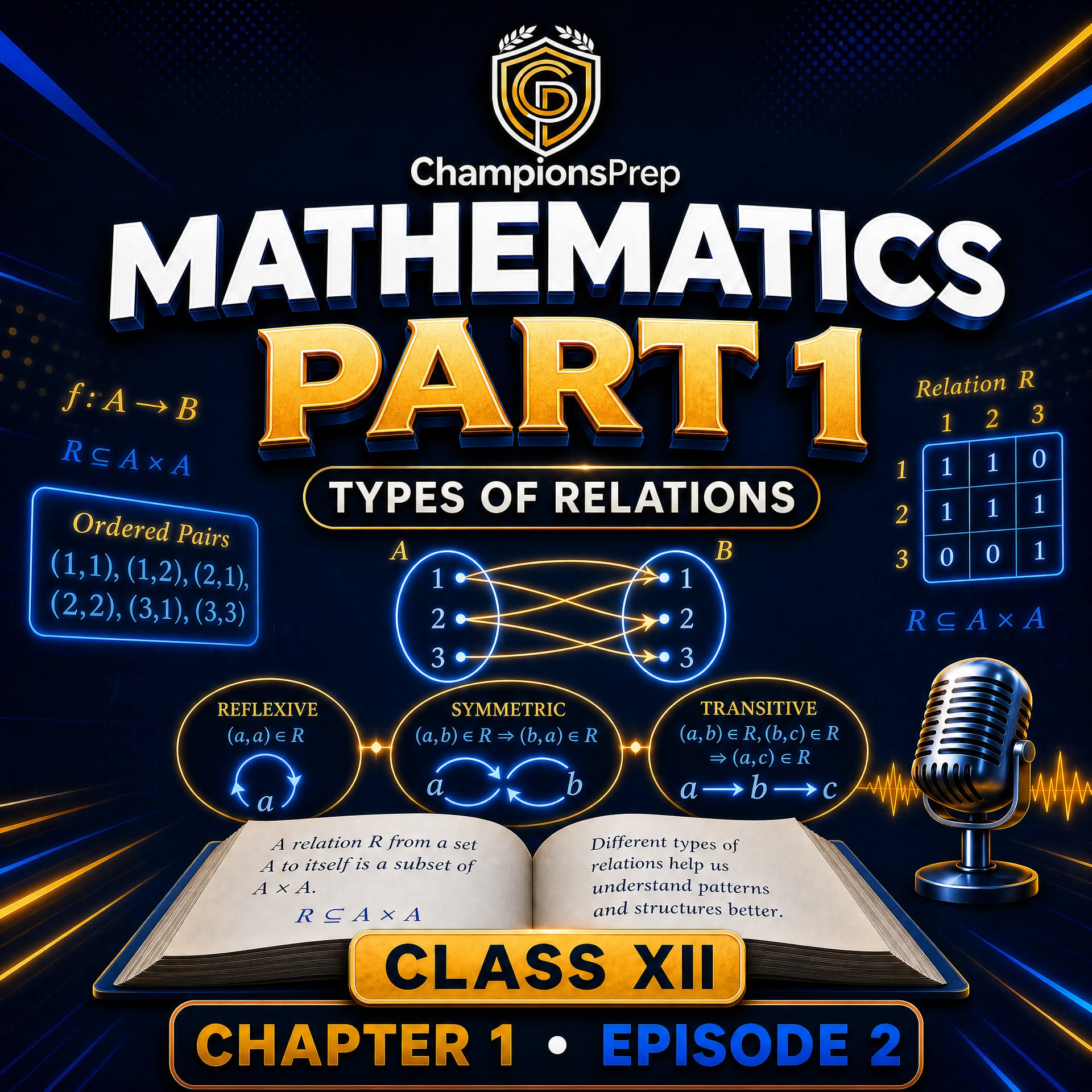
Types of Relations in Class 12 Maths – Reflexive, Symmetric, Transitive & More
Symmetric Relations
A relation R on set A is symmetric if, whenever (a, b) ∈ R, it also follows that (b, a) ∈ R:
(a₁, a₂) ∈ R implies (a₂, a₁) ∈ R, for all a₁, a₂ ∈ A
How to Check Symmetry
For every pair in R, check whether the reversed pair is also in R.
Example: R = {(L₁, L₂) : L₁ is perpendicular to L₂} defined on the set of all lines. If L₁ ⊥ L₂, then L₂ ⊥ L₁. Symmetric. ✓
Counter-example: R = {(x, y) : x is the wife of y}. If x is the wife of y, y is not the wife of x. Not symmetric.
Transitive Relations
A relation R on set A is transitive if a chain of two related pairs implies a third:
(a₁, a₂) ∈ R and (a₂, a₃) ∈ R implies (a₁, a₃) ∈ R, for all a₁, a₂, a₃ ∈ A
How to Check Transitivity
Look for "chains" in R. If you find (a, b) and (b, c) both in R, then (a, c) must also be there.
Example: R = {(a, b) : a − b is an integer} on Z. If a − b ∈ Z and b − c ∈ Z, then (a − b) + (b − c) = a − c ∈ Z. Transitive. ✓
Trick for exams: The perpendicularity relation on lines is symmetric but not transitive — if L₁ ⊥ L₂ and L₂ ⊥ L₃, then L₁ is actually parallel to L₃, not perpendicular.
Quick Classification Reference
| Relation | Reflexive | Symmetric | Transitive |
|---|---|---|---|
| y is divisible by x (on {1..6}) | ✓ | ✗ | ✓ |
| x − y is an integer (on Z) | ✓ | ✓ | ✓ |
| L₁ ⊥ L₂ (on all lines) | ✗ | ✓ | ✗ |
| x is father of y | ✗ | ✗ | ✗ |
| x and y work at same place | ✓ | ✓ | ✓ |
A relation that is reflexive, symmetric, and transitive is called an equivalence relation — arguably the most important concept in Section 1.2.
Can a relation be both symmetric and transitive but not reflexive?
Yes. For example, R = {(1, 2), (2, 1), (1, 1), (2, 2)} on {1, 2, 3} is symmetric and transitive but not reflexive, because (3, 3) is missing.
Is the empty relation reflexive?
No. For the empty relation, (a, a) is not in R for any a ∈ A, so it fails reflexivity (unless A itself is empty).
Is the universal relation always an equivalence relation?
Yes. On any set A, the universal relation R = A × A is reflexive (all (a,a) pairs are present), symmetric (if (a,b) is there so is (b,a)), and transitive.
What is the key difference between symmetric and transitive relations?
Symmetry says: if (a, b) is in R then (b, a) must be in R — it concerns pairs in isolation. Transitivity says: if (a, b) and (b, c) are in R then (a, c) must be — it concerns chains of pairs.
How many properties does an equivalence relation need?
Exactly three: it must be reflexive, symmetric, and transitive simultaneously.
Related Reading on ChampionsPrep
- Introduction to Relations and Functions – Class 12 →
- Equivalence Relations and Equivalence Classes →
- One-One and Onto Functions – Full Guide →
- Composition of Functions →
🎯 Test Your Knowledge
Can you classify the relation R = {(a, b) : 3 divides a − b} on Z? Try it yourself, then verify with topic-wise practice and instant solutions on ChampionsPrep.
Practice Relations Questions on ChampionsPrep →
Test Your Knowledge
Frequently Asked Questions
Can a relation be both symmetric and transitive but not reflexive? +
Yes. For example, a relation on {1, 2, 3} containing (1,2), (2,1), (1,1), (2,2) is symmetric and transitive but not reflexive because (3,3) is missing.
Is the empty relation reflexive? +
No. For the empty relation, (a,a) is not in R for any a ∈ A, so it fails the reflexivity condition unless A itself is empty.
Is the universal relation always an equivalence relation? +
Yes. The universal relation R = A × A is reflexive, symmetric, and transitive, making it an equivalence relation.
What is the key difference between symmetric and transitive relations? +
Symmetry concerns pairs in isolation: if (a,b) is in R then (b,a) must be. Transitivity concerns chains: if (a,b) and (b,c) are in R then (a,c) must be.
How many properties does an equivalence relation need? +
Three: a relation must be reflexive, symmetric, and transitive simultaneously to be called an equivalence relation.
Keep practising Mathematics
AI-powered feedback and structured revision for Mathematics — free to start, at your own pace.
AI-powered practice — free to start