

Bijective and Invertible Functions — Class 12 Maths Chapter 1 Complete Guide
Two concepts that consistently appear in CBSE board questions and competitive exams are bijective functions and invertible functions. They are deeply connected: a function has an inverse if and only if it is bijective. Once you understand this relationship, an entire class of exam questions becomes straightforward.
This guide covers both concepts with precise definitions, worked examples from the NCERT textbook, and the exam strategies you need.
What Is a Bijective Function?
A function f : X → Y is called bijective (or a one-one correspondence) if it is simultaneously:
- One-one (injective): distinct inputs give distinct outputs
- Onto (surjective): every element of the co-domain has a pre-image in the domain
A bijective function creates a perfect one-to-one pairing between every element of X and every element of Y — no elements are left out, and none are double-counted.
Why Bijectivity Matters
Bijectivity is not just a theoretical nicety. It is the exact condition under which a function can be reversed — which brings us to invertibility.
Classic Examples
Bijective: f : R → R, f(x) = 2x
One-one since f(x₁) = f(x₂) implies x₁ = x₂. Onto since for any y ∈ R, x = y/2 satisfies f(x) = y. ✓
Bijective: f : N → N, f(x) = x + 1 if x is odd, f(x) = x − 1 if x is even
Each odd number is swapped with the even number above it. Both injectivity and surjectivity hold. ✓
Not bijective: f : R → R, f(x) = x²
Neither one-one (f(−1) = f(1)) nor onto (−2 has no real square root). ✗
What Is an Invertible Function?
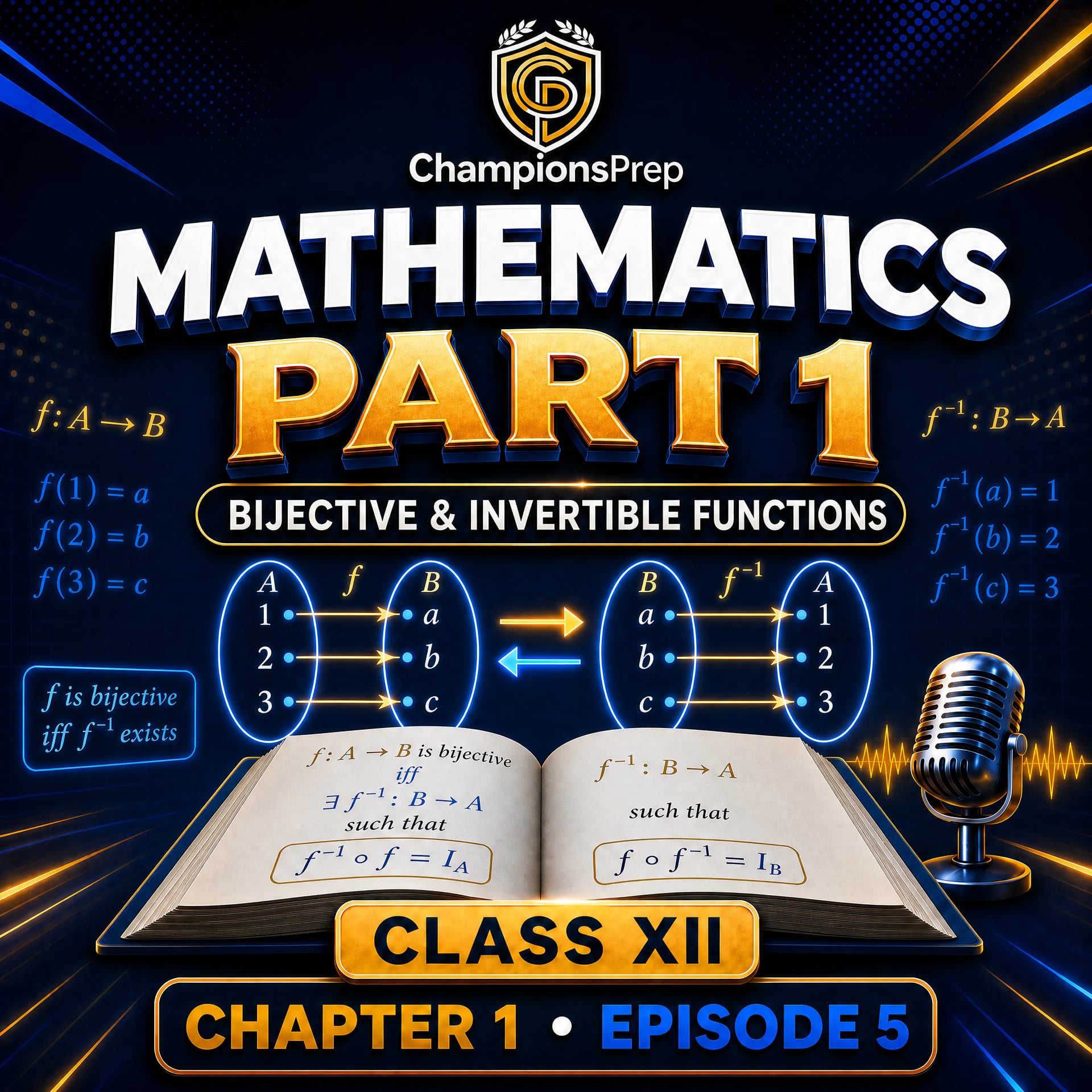
A function f : X → Y is called invertible if there exists a function g : Y → X such that:
g ∘ f = I_X and f ∘ g = I_Y
Here I_X and I_Y are the identity functions on X and Y respectively. The function g is called the inverse of f and is written f⁻¹.
The Golden Rule
A function is invertible if and only if it is bijective.
This means:
- To prove f is invertible, prove f is one-one and onto.
- To prove f is not invertible, show it is either not one-one or not onto (or both).
Bijective and Invertible Functions – Class 12 Maths Chapter 1 Complete Guide
How to Find the Inverse of a Function
Finding f⁻¹ is a two-step process:
Step 1: Express the equation y = f(x) and solve for x in terms of y.
Step 2: Define g(y) using this expression, then verify that g ∘ f = I_X and f ∘ g = I_Y.
Worked Example (NCERT)
Let $f : \mathbb{N} \to Y$, $f(x) = 4x + 3$, where $Y = \{y \in \mathbb{N} : y = 4x + 3 \text{ for some } x \in \mathbb{N}\}$. Prove $f$ is invertible and find its inverse.
Let $f : \\mathbb{N} \\to Y$, $f(x) = 4x + 3$, where $Y = \\{y \\in \\mathbb{N} : y = 4x + 3 \\text{ for some } x \\in \\mathbb{N}\\}$. Prove $f$ is invertible and find its inverse.
Let f : N → Y, f(x) = 4x + 3, where Y = {y ∈ N : y = 4x + 3 for some x ∈ N}.
Showing f is bijective:
One-one: f(x₁) = f(x₂) ⟹ 4x₁ + 3 = 4x₂ + 3 ⟹ x₁ = x₂. ✓
Onto: Every element of Y is, by definition, of the form 4x + 3. ✓
Finding the inverse:
From y = 4x + 3, we get x = (y − 3)/4. Define g : Y → N by g(y) = (y − 3)/4.
Verification:
g(f(x)) = g(4x + 3) = (4x + 3 − 3)/4 = x = I_N(x). ✓
f(g(y)) = f((y − 3)/4) = 4·(y − 3)/4 + 3 = y = I_Y(y). ✓
So f⁻¹(y) = (y − 3)/4.
Interactive Simulation: Exploring Invertibility & Bijective Mapping
Interactive What-If: Testing Invertibility & Bijective Mapping
Adjust slope 'a' of function f(x) = ax + b. A non-zero slope guarantees bijection and an inverse, while slope a = 0 makes f(x) constant (many-one, not onto) and destroys the inverse.
Function f(x) = ax + b
Function g(x) = cx + d
Compositions
Syllabus Checkpoints & Exam Watch-Outs
- A function is invertible iff it is bijective. A zero slope makes it constant and non-invertible.
Bijective Functions on Finite Sets
For finite sets, there is an important shortcut: on a finite set X, a function f : X → X is one-one if and only if it is onto. This means every bijection from a finite set to itself is simply a permutation of that set.
This also explains why the number of bijective functions from {1, 2, 3} to itself equals 3! = 6 — the number of permutations of three elements.
Composition and Bijectivity
If f : A → B and g : B → C are both bijective, then their composition g ∘ f : A → C is also bijective. Moreover, (g ∘ f)⁻¹ = f⁻¹ ∘ g⁻¹. This mirrors the reversal rule familiar from matrix inverses.
Related Reading on ChampionsPrep
- One-One and Onto Functions — Full Guide →
- Composition of Functions →
- Equivalence Relations and Classes →
- Introduction to Relations and Functions →
🎯 Master Bijective and Invertible Functions
Work through exam-style questions on bijections and inverses with instant, step-by-step AI explanations on ChampionsPrep.
Start Practising on ChampionsPrep →
Test Your Knowledge
Frequently Asked Questions
What is the difference between a bijective function and an invertible function? +
They are the same thing. A function is invertible if and only if it is bijective — both one-one and onto.
How do you check if a function is bijective? +
Check that it is one-one (f(x₁) = f(x₂) implies x₁ = x₂) and onto (every element of the co-domain has a pre-image). Both conditions must hold.
Can f : R → R, f(x) = x² be invertible? +
No. It is neither one-one nor onto, so it is not bijective and therefore not invertible.
What does it mean for gof = I_X? +
It means g undoes whatever f does — if f maps x to f(x), then g maps f(x) back to x. This establishes g as the inverse of f.
How many bijective functions exist from {1, 2, 3} to itself? +
Six — corresponding to the 3! = 6 permutations of three elements, since a bijection from a finite set to itself is a permutation.
Keep practising Mathematics
AI-powered feedback and structured revision for Mathematics — free to start, at your own pace.
AI-powered practice — free to start