

Equivalence Relations and Equivalence Classes – Class 12 Maths Explained
Among all the concepts in Class 12 Maths Chapter 1, the equivalence relation is the most elegant — and one of the most frequently tested. It combines three properties into a single, powerful idea that appears in number theory, geometry, and computer science. In this post, we cover what an equivalence relation is, how to prove one, what equivalence classes are, and how they partition a set.
What Is an Equivalence Relation?
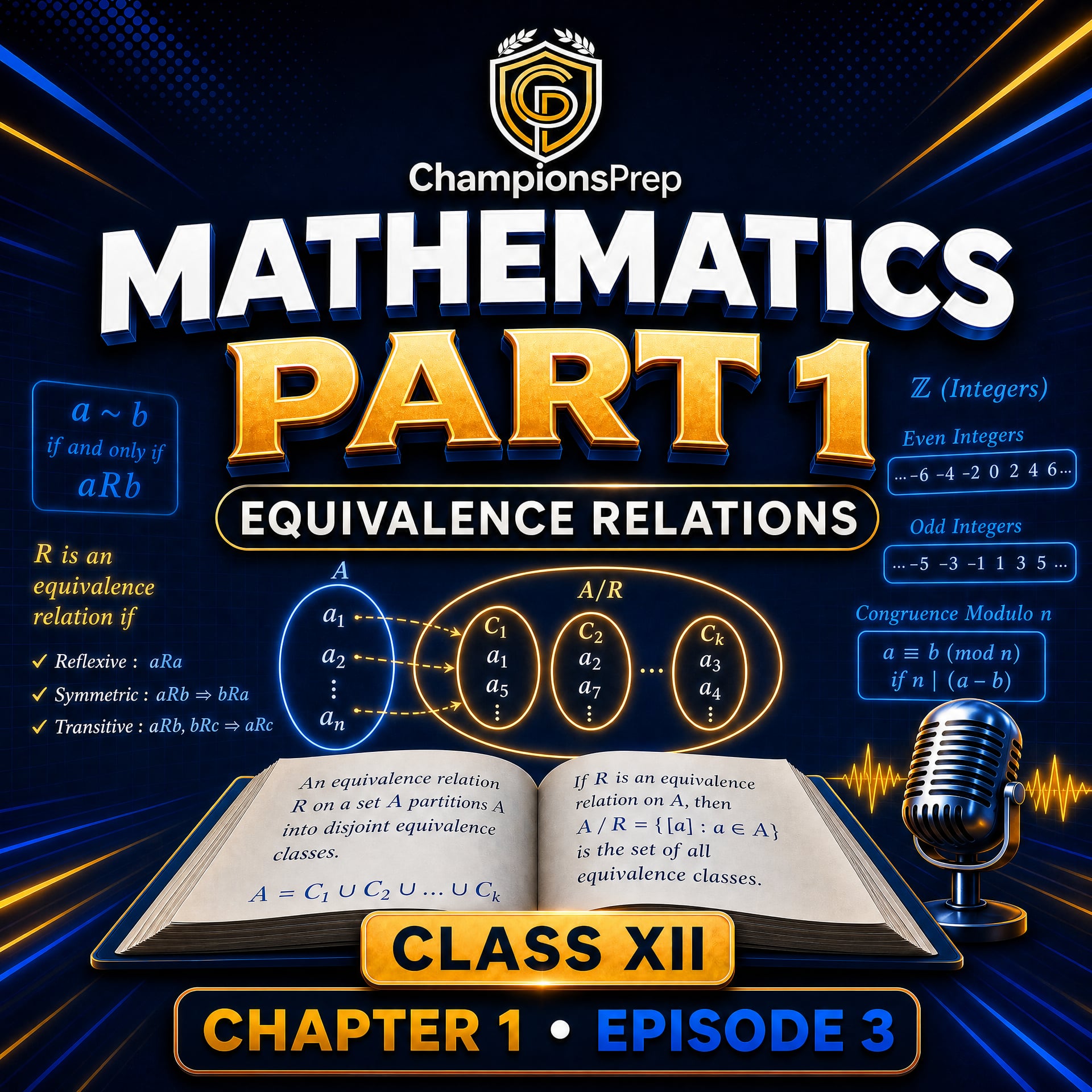
A relation R on a set A is called an equivalence relation if it satisfies all three properties simultaneously:
- Reflexive: (a, a) ∈ R for every a ∈ A
- Symmetric: (a, b) ∈ R implies (b, a) ∈ R
- Transitive: (a, b) ∈ R and (b, c) ∈ R implies (a, c) ∈ R
If even one property fails, the relation is not an equivalence relation. The name reflects a deeper idea: equivalence relations capture "essentially the same" in some well-defined respect.
Proving an Equivalence Relation – The Standard Method
The NCERT approach is to verify all three properties in sequence. Here is the method applied to a classic example.
Example: Congruence of Triangles
Let T be the set of all triangles in a plane, R = {(T₁, T₂) : T₁ is congruent to T₂}.
Reflexive: Every triangle is congruent to itself. So (T, T) ∈ R for all T. ✓
Symmetric: If T₁ ≅ T₂ then T₂ ≅ T₁. So (T₁, T₂) ∈ R implies (T₂, T₁) ∈ R. ✓
Transitive: If T₁ ≅ T₂ and T₂ ≅ T₃ then T₁ ≅ T₃. So (T₁, T₃) ∈ R. ✓
All three properties hold, so R is an equivalence relation. This three-step sequence is the template for every equivalence relation proof in the exam.
What Are Equivalence Classes?
Once you have an equivalence relation R on a set X, it naturally groups elements of X into equivalence classes. The equivalence class of element a, written [a], is:
[a] = {b ∈ X : (a, b) ∈ R}
Key Properties
- Every element of X belongs to exactly one equivalence class.
- Two equivalence classes are either identical or completely disjoint — they never partially overlap.
- The collection of all equivalence classes partitions X into non-overlapping subsets whose union is all of X.
Equivalence Relations and Equivalence Classes – Class 12 Maths Explained
A Concrete Example: Even and Odd Integers
Consider R = {(a, b) : 2 divides a − b} on Z. This is an equivalence relation (verifiable using the three properties). The equivalence classes are:
- [0] = {..., −4, −2, 0, 2, 4, ...} — all even integers
- [1] = {..., −3, −1, 1, 3, 5, ...} — all odd integers
These two classes are disjoint, their union is all of Z, and every integer belongs to exactly one class — a partition of Z into even and odd numbers, now made rigorous.
The Partition ↔ Equivalence Relation Duality
The relationship between equivalence relations and partitions goes both ways:
- Equivalence relation → partition: Every equivalence relation on X produces a partition of X into equivalence classes.
- Partition → equivalence relation: Given any partition of X into disjoint subsets, define an equivalence relation where two elements are related if and only if they belong to the same subset.
For example, A₁ = {1, 4, 7}, A₂ = {2, 5, 8}, A₃ = {3, 6, 9} partition {1, …, 9}. The corresponding equivalence relation is R = {(a, b) : 3 divides a − b} — a direct NCERT example.
Common Exam Mistakes
Mistake 1: Verifying only two properties.
All three — reflexive, symmetric, and transitive — are mandatory. Missing even one means the proof is incomplete.
Mistake 2: Confusing the equivalence class [a] with the whole set.
[a] is a subset of X containing only elements related to a, not the entire set.
Mistake 3: Assuming R₁ ∩ R₂ is not an equivalence relation.
If R₁ and R₂ are both equivalence relations on A, their intersection R₁ ∩ R₂ is also an equivalence relation — a popular NCERT exam question.
What makes a relation an equivalence relation?
It must be reflexive (every element relates to itself), symmetric (if a relates to b then b relates to a), and transitive (if a relates to b and b to c, then a relates to c) — all three simultaneously.
What is an equivalence class with an example?
For R = {(a, b) : 2 divides a − b} on Z, the equivalence class [0] is the set of all even integers — every integer whose difference with 0 is divisible by 2.
How many equivalence classes does the parity relation on Z have?
Two — the class of all even integers [0] and the class of all odd integers [1].
Is the intersection of two equivalence relations an equivalence relation?
Yes. If R₁ and R₂ are both equivalence relations on set A, then R₁ ∩ R₂ is also an equivalence relation on A.
How do equivalence classes form a partition?
Each element belongs to exactly one equivalence class. The classes are pairwise disjoint and their union equals the entire set — the definition of a partition.
Related Reading on ChampionsPrep
- Introduction to Relations and Functions →
- Types of Relations: Reflexive, Symmetric & Transitive →
- Bijective and Invertible Functions →
- Composition of Functions →
🎯 Solidify Your Understanding
Equivalence relations are guaranteed marks if you know the pattern. Practice classifying relations with instant AI-powered feedback on ChampionsPrep.
Practice Equivalence Relation Questions →
Test Your Knowledge
Frequently Asked Questions
What makes a relation an equivalence relation? +
A relation must be reflexive, symmetric, and transitive simultaneously to be called an equivalence relation.
What is an equivalence class with an example? +
For R = {(a, b) : 2 divides a − b} on Z, the equivalence class [0] is the set of all even integers.
How many equivalence classes does the parity relation on Z have? +
Two: the class of all even integers [0] and the class of all odd integers [1].
Is the intersection of two equivalence relations an equivalence relation? +
Yes. If R₁ and R₂ are both equivalence relations on set A, then R₁ ∩ R₂ is also an equivalence relation on A.
How do equivalence classes form a partition? +
Each element belongs to exactly one equivalence class. The classes are pairwise disjoint and their union equals the entire set — the definition of a partition.
Keep practising Mathematics
AI-powered feedback and structured revision for Mathematics — free to start, at your own pace.
AI-powered practice — free to start