
If you’ve covered the theory of Application of Integrals and want to test yourself before the exam, this post is built for you. It collects some of the most frequently repeated question patterns from CBSE Class 12 board papers, each solved in full, so you can check your working step by step.
Why These Questions Matter
CBSE tends to reuse the same handful of question patterns year after year, even when the specific numbers change. Recognizing the pattern — not just memorizing one answer — is what actually earns marks under exam pressure. The questions below are grouped by pattern type so you can see exactly what to look for.
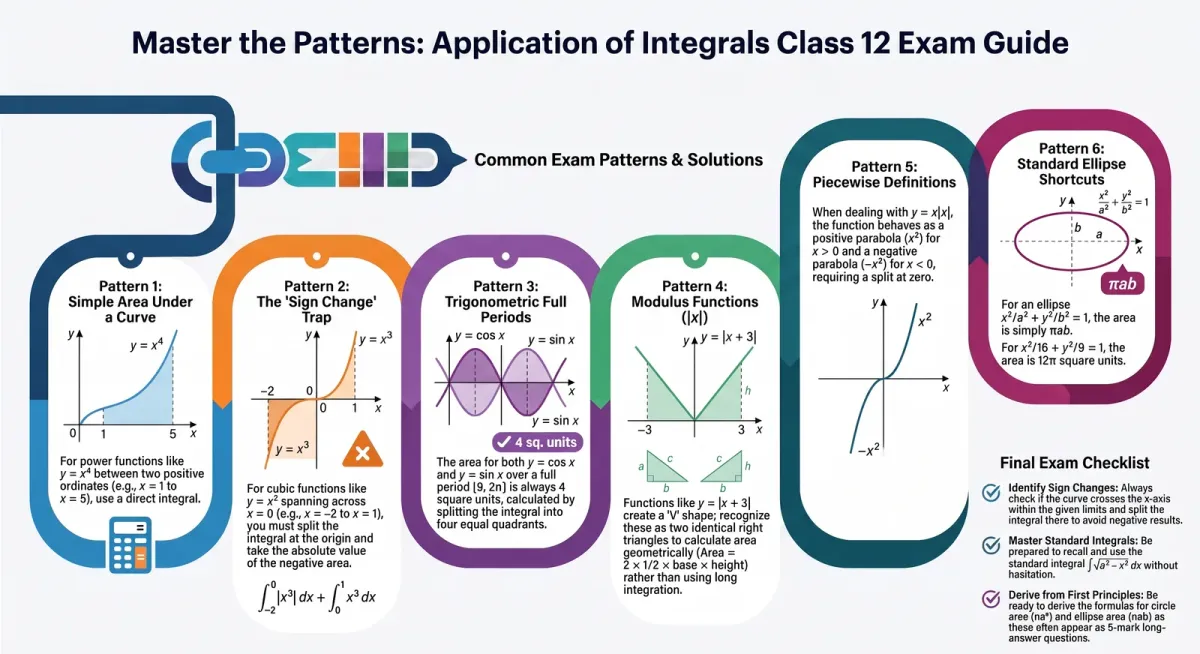
Pattern 1: Area Bounded by a Curve and Given Ordinates
Question: Find the area under the curve y = x⁴ between x = 1 and x = 5.
Solution: Area = ∫₁⁵ x⁴ dx = [x⁵/5]₁⁵ = 3125/5 − 1/5 = 3124/5 square units
This pattern — a power function between two given x-values — is the simplest type in the chapter and a reliable place to pick up easy marks.
Pattern 2: Curve With a Sign Change
Question: Find the area bounded by the curve y = x³, the x-axis, and the ordinates x = −2 and x = 1.
Solution: Since y = x³ is negative for x < 0 and positive for x > 0, split the integral at x = 0:
Area = |∫₋₂⁰ x³ dx| + ∫₀¹ x³ dx = |−4| + 1/4 = 4 + 1/4 = 17/4 square units
Whenever a cubic or odd-degree function spans across x = 0, expect this kind of split — it’s a favourite CBSE trap.
Pattern 3: Trigonometric Curve Over a Full Period
Question: Find the area bounded by the curve y = cos x between x = 0 and x = 2π.
Solution: Cosine is positive on [0, π/2], negative on [π/2, 3π/2], and positive again on [3π/2, 2π]. Splitting accordingly:
Area = ∫₀^(π/2) cos x dx + |∫_(π/2)^(3π/2) cos x dx| + ∫_(3π/2)^(2π) cos x dx = 1 + 2 + 1 = 4 square units
The same result (4 square units) holds for y = sin x over the same interval [0, 2π], by an almost identical argument — a pattern worth recognizing instantly rather than re-deriving each time.
Pattern 4: Area Involving a Modulus Function
Question: Sketch the graph of y = |x + 3| and evaluate ∫₋₆⁰ |x + 3| dx.
Solution: The expression x + 3 changes sign at x = −3. For x between −6 and −3, |x + 3| = −(x + 3); for x between −3 and 0, |x + 3| = x + 3.
Area = ∫₋₆⁻³ −(x + 3) dx + ∫₋₃⁰ (x + 3) dx
Geometrically, this is a “V” shape made of two identical right triangles, each with base 3 and height 3:
Area = 2 × (1/2 × 3 × 3) = 9 square units
Recognizing the triangular shape early can save you from doing the full integration by hand.
Pattern 5: A Function Defined Differently on Either Side of Zero
Question: The area bounded by the curve y = x|x|, the x-axis, and the ordinates x = −1 and x = 1.
Solution: For x > 0, y = x|x| = x², a positive parabola. For x < 0, y = x|x| = −x², which is negative (below the x-axis).
Area = |∫₋₁⁰ −x² dx| + ∫₀¹ x² dx = 1/3 + 1/3 = 2/3 square units
This question tests whether you can correctly rewrite a piecewise function before integrating — always split at x = 0 whenever |x| appears multiplied by another expression.
Pattern 6: Standard Ellipse Area
Question: Find the area of the region bounded by the ellipse x²/16 + y²/9 = 1.
Solution: With a = 4 and b = 3, Area = πab = π(4)(3) = 12π square units
This is a two-line answer once you know the formula — one of the fastest marks available in the entire chapter.
Quick Revision Checklist Before Your Exam
Before walking into your exam, make sure you can, without hesitation: recall the standard integral ∫√(a² − x²) dx; identify where a curve crosses the x-axis and split the integral there; derive πa² and πab from first principles; and correctly rewrite modulus and piecewise expressions like x|x| before integrating.
Related Reading
-
Area Between Two Curves: Class 12 Integration Methods Explained
-
Application of Integrals Class 12: Complete Guide to Area Under Curves
-
Area of an Ellipse Using Integration: Formula, Derivation & Solved Examples
Ready to Practice?
Recognizing patterns is a skill built through repetition. Get unlimited topic-wise practice questions and AI-powered doubt resolution on ChampionsPrep for just ₹10 per use — pay only for what you need. Practice on ChampionsPrep →
Test Your Knowledge
Top Solved Examples & Important Questions: Application of Integrals Class 12
Frequently Asked Questions
Which question pattern is most commonly repeated in CBSE board exams? +
Curve-and-sign-change questions (like y = x³ across a negative-to-positive interval) and trigonometric area questions over a full period are among the most frequently repeated patterns.
How many marks does a typical Application of Integrals question carry? +
Most questions in this chapter are worth 3 to 5 marks, with the ellipse and circle derivations sometimes appearing as 5-mark long-answer questions.
Why is splitting the integral at x = 0 so important for modulus questions? +
Because |x| and expressions like x|x| behave differently for positive and negative x, treating the entire interval as one continuous function leads to an incorrect or even negative final area.
Is it enough to memorize final answers for these patterns? +
No — CBSE frequently changes the specific numbers in a question, so you need to understand the method behind each pattern, not just the final numeric answer.
Where can I get more practice questions like these? +
ChampionsPrep offers topic-wise practice questions and instant doubt resolution specifically for Application of Integrals, letting you drill each pattern until it's automatic.
AI-powered practice — free to start