
How to Find Area Under a Simple Curve Using Integration
Almost every problem in the Application of Integrals chapter eventually reduces to one core skill: finding the area under a simple curve. Once you’re comfortable with this, circles, ellipses, and area-between-curves problems all become variations on the same theme. This post breaks down the method into clear, repeatable steps and works through several examples so you can apply it confidently in your CBSE or Maharashtra Board exam.
What Does “Area Under a Curve” Actually Mean?
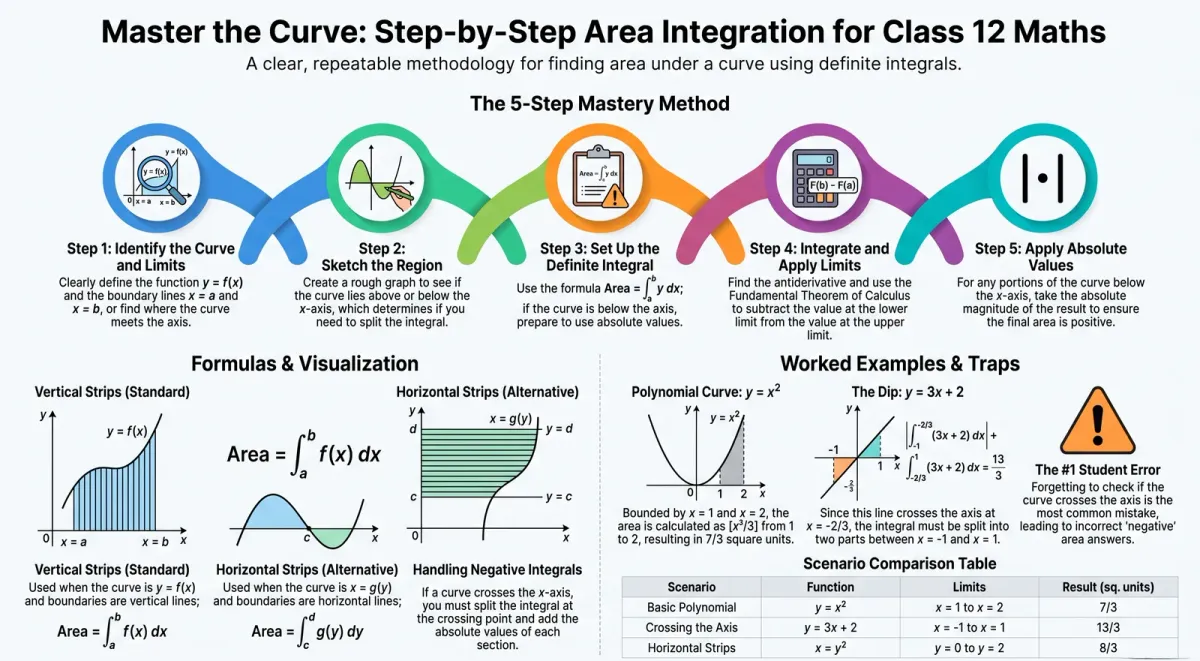
When we say “the area under y = f(x) between x = a and x = b,” we mean the region enclosed by the curve itself, the x-axis, and the two vertical boundary lines x = a and x = b. Geometrically, this region can be approximated by drawing many thin vertical rectangles (strips) under the curve and adding up their areas. As the strips get infinitely thin, this sum becomes a definite integral — which is exactly why this chapter follows Definite Integrals in your syllabus.
The Step-by-Step Method
Step 1: Identify the Curve, Axis, and Limits
Write down y = f(x) and note the boundary values x = a and x = b. If the interval isn’t given directly, you may need to find it — for instance, by locating where the curve meets the x-axis or another curve.
Step 2: Sketch the Region
This step is easy to skip but shouldn’t be. A rough sketch instantly tells you whether the curve lies above or below the x-axis in the given interval, which decides whether you’ll need an absolute value later.
Step 3: Set Up the Definite Integral
Using vertical strips, the area is:
Area = ∫ₐᵇ y dx = ∫ₐᵇ f(x) dx
If your sketch shows the curve is below the x-axis for all or part of the interval, remember that the integral there will come out negative — you’ll fix this in Step 5.
Step 4: Integrate and Substitute the Limits
Find the antiderivative of f(x), then apply the limits using the Fundamental Theorem of Calculus: evaluate the antiderivative at x = b, then subtract its value at x = a.
Step 5: Apply Absolute Values Where Needed
If part of the region lies below the x-axis, take the absolute value of that portion’s integral before adding it to the rest. Never simply subtract a negative area from a positive one — always add magnitudes.
Worked Example 1: A Basic Polynomial Curve
Find the area bounded by y = x², the x-axis, and the ordinates x = 1 and x = 2.
Area = ∫₁² x² dx = [x³/3]₁² = 8/3 − 1/3 = 7/3 square units
Since y = x² is always non-negative, there’s no sign issue here — a good example to build confidence before tackling trickier curves.
Worked Example 2: A Curve That Dips Below the Axis
Find the area bounded by y = 3x + 2, the x-axis, and the ordinates x = −1 and x = 1.
The line crosses the x-axis at x = −2/3. Between x = −1 and x = −2/3, the line lies below the axis; between x = −2/3 and x = 1, it lies above. So you must split the integral at x = −2/3:
Area = |∫₋₁⁻²/³ (3x + 2) dx| + ∫₋₂/₃¹ (3x + 2) dx = 1/6 + 25/6 = 13/3 square units
This example shows exactly why sketching first matters — without it, it’s easy to forget the split point entirely.
Worked Example 3: Using Horizontal Strips Instead
Sometimes the curve is more naturally expressed as x = g(y). Find the area bounded by x = y², the y-axis, and the lines y = 0 and y = 2.
Area = ∫₀² y² dy = [y³/3]₀² = 8/3 square units
Here, horizontal strips of width dy and length x = g(y) are summed instead of vertical ones — the logic is identical, just rotated.
Common Mistakes Students Make
Forgetting to check whether the curve crosses the x-axis within the given interval is the single biggest error in this topic — it leads to a negative final answer, which should immediately signal that something was missed. Another frequent mistake is mixing up the limits of integration, especially when the curve is given as x = g(y) instead of y = f(x). Finally, students often skip the sketch to save time, only to lose more time (and marks) fixing sign errors afterward.
1. What is the formula for area under a simple curve?
Area = ∫ₐᵇ y dx = ∫ₐᵇ f(x) dx, where y = f(x) is the curve, and x = a, x = b are the boundary lines.
2. Why do we sketch the curve before integrating?
A sketch shows whether the curve lies above or below the x-axis within the interval, which determines whether an absolute value is needed in the final answer.
3. What happens if the definite integral gives a negative value?
A negative value simply means the curve lies below the x-axis in that region. Take the absolute value of that portion before adding it to the total area.
4. When should I use horizontal strips instead of vertical strips?
Use horizontal strips (integrating with respect to y) when the curve is more easily expressed as x = g(y), or when the boundaries are given as horizontal lines y = c and y = d.
5. Is this topic asked directly in CBSE board exams?
Yes, area-under-a-curve questions appear almost every year, either as a standalone question or as the first step in a larger area-between-curves problem.
Ready to Practice?
Theory only gets you halfway — real exam speed comes from solving varied problems. ChampionsPrep gives you AI-powered doubt resolution and topic-wise practice on Area Under Simple Curves for just ₹10 per use. Practice on ChampionsPrep →
Test Your Knowledge
How to Find Area Under a Simple Curve Using Integration – Class 12 Maths
Frequently Asked Questions
What is the formula for area under a simple curve? +
Area = ∫ₐᵇ y dx = ∫ₐᵇ f(x) dx, where y = f(x) is the curve, and x = a, x = b are the boundary lines.
Why do we sketch the curve before integrating? +
A sketch shows whether the curve lies above or below the x-axis within the interval, which determines whether an absolute value is needed in the final answer.
What happens if the definite integral gives a negative value? +
A negative value simply means the curve lies below the x-axis in that region. Take the absolute value of that portion before adding it to the total area.
When should I use horizontal strips instead of vertical strips? +
Use horizontal strips (integrating with respect to y) when the curve is more easily expressed as x = g(y), or when the boundaries are given as horizontal lines y = c and y = d.
Is this topic asked directly in CBSE board exams? +
Yes, area-under-a-curve questions appear almost every year, either as a standalone question or as the first step in a larger area-between-curves problem.
AI-powered practice — free to start