
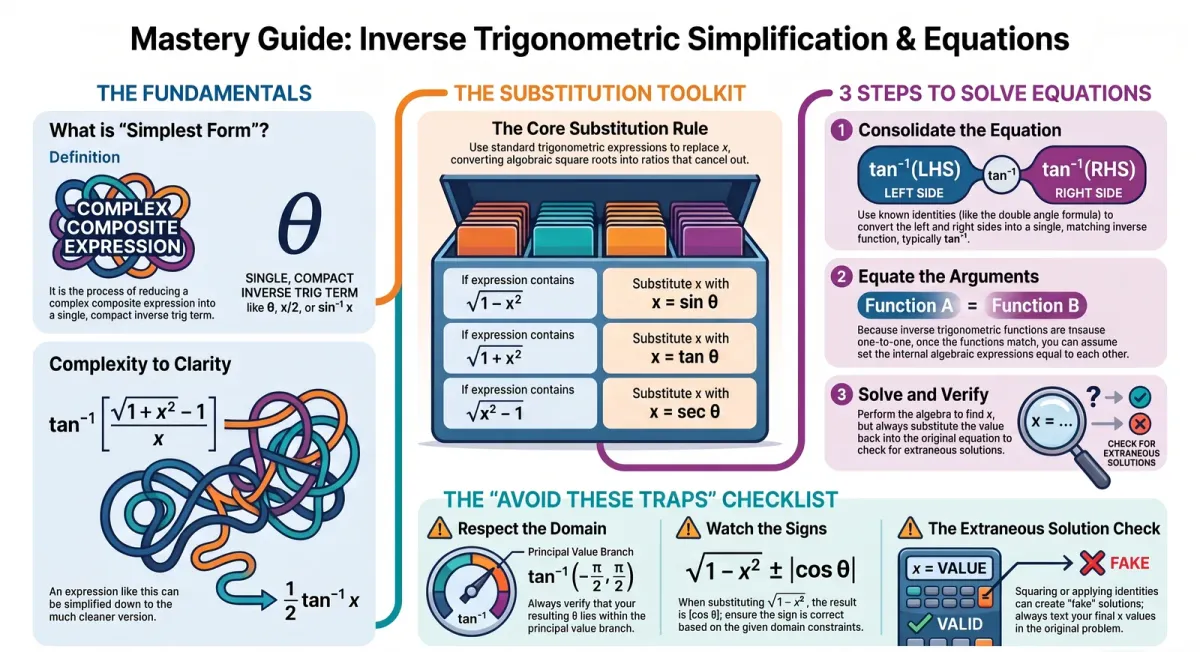
Of all the question types in Chapter 2, two consistently challenge students the most: “write in the simplest form” problems and “solve the equation” problems. Both require you to go beyond memorisation and apply a structured technique. Once you learn the underlying method — trigonometric substitution — these questions become almost routine. This guide teaches you that method and walks through representative examples from the NCERT textbook.
What Does “Simplest Form” Mean?
In the context of inverse trig problems, simplest form means expressing the given expression as a single, compact inverse trig term — typically something like θ, x/2, sin⁻¹ x, or sec⁻¹ x — rather than a complex composite expression.
For example: tan⁻¹[√(1 + x²) − 1)/x] looks complicated, but its simplest form is (1/2) tan⁻¹ x.
The target is always a single inverse trig function (or a simple expression involving one).
The Core Technique: Trigonometric Substitution
The most powerful method for simplifying inverse trig expressions is to substitute a standard trigonometric expression for x. This converts complex algebraic terms under square roots or inside fractions into simple trig ratios that cancel or combine into recognisable forms.
The Standard Substitutions
| If the expression contains… | Substitute |
|---|---|
| √(1 − x²) | x = sin θ or x = cos θ |
| √(1 + x²) | x = tan θ |
| √(x² − 1) | x = sec θ |
After substituting, use standard trig identities (double angle, half angle, Pythagorean, etc.) to simplify the expression inside the outer inverse trig function. The result is a clean expression in θ, which you convert back to an inverse trig of x.
Worked Examples
Example 1 — tan⁻¹[√(1 − cos x)/(1 + cos x)], for 0 < x < π
This expression contains 1 − cos x and 1 + cos x. The half-angle identities apply:
1 − cos x = 2 sin²(x/2) and 1 + cos x = 2 cos²(x/2)
So the expression becomes: tan⁻¹[√(sin²(x/2)/cos²(x/2))] = tan⁻¹[|sin(x/2)/cos(x/2)|]
For 0 < x < π, both sin(x/2) and cos(x/2) are positive, so:
= tan⁻¹[tan(x/2)] = x/2
This is the simplest form.
Example 2 — tan⁻¹[(cos x − sin x)/(cos x + sin x)], for −π/4 < x < 3π/4
Divide numerator and denominator by cos x:
= tan⁻¹[(1 − tan x)/(1 + tan x)]
Now use the tangent subtraction formula: tan(π/4 − x) = (tan π/4 − tan x)/(1 + tan π/4 · tan x) = (1 − tan x)/(1 + tan x)
So the expression becomes: tan⁻¹[tan(π/4 − x)] = π/4 − x
Example 3 — tan⁻¹[x/√(a² − x²)], for |x| < a
Substitute x = a sin θ, so θ = sin⁻¹(x/a):
√(a² − x²) = √(a² − a² sin²θ) = a cos θ
The expression becomes: tan⁻¹[a sin θ / a cos θ] = tan⁻¹(tan θ) = θ = sin⁻¹(x/a)
Example 4 — cot⁻¹[1/√(x² − 1)], for x > 1
Substitute x = sec θ, so θ = sec⁻¹ x:
√(x² − 1) = √(sec²θ − 1) = tan θ
The expression becomes: cot⁻¹[1/tan θ] = cot⁻¹(cot θ) = θ = sec⁻¹ x
Example 5 — tan⁻¹[(3a²x − x³)/(a³ − 3ax²)], for a > 0 and −a/√3 < x < a/√3
This pattern has the structure of the triple angle tangent formula. Substitute x = a tan θ:
(3a²x − x³)/(a³ − 3ax²) = a³(3tanθ − tan³θ)/a³(1 − 3tan²θ) = tan 3θ
The expression becomes: tan⁻¹(tan 3θ) = 3θ = 3 tan⁻¹(x/a)
Solving Inverse Trig Equations
Solving an equation like 2 tan⁻¹(cos x) = tan⁻¹(2 cosec x) follows a different but equally systematic process.
The General Method
Step 1: Apply a known identity to convert the left side into a single tan⁻¹. The double angle formula works here:
2 tan⁻¹(cos x) = tan⁻¹[(2 cos x)/(1 − cos²x)] = tan⁻¹[(2 cos x)/sin²x]
Step 2: Equate the arguments (since the tangent inverse is one-one):
(2 cos x)/sin²x = 2 cosec x = 2/sin x
Step 3: Simplify:
2 cos x / sin²x = 2/sin x → cos x / sin x = 1 → tan x = 1 → x = π/4 (the solution in the interval 0 < x < π/2)
If the question gives no interval, write the full solution: tan x = 1 gives x = nπ + π/4, where n is any integer.
Another Equation: sin⁻¹(1 − x) − 2 sin⁻¹ x = π/2
Rearrange: sin⁻¹(1 − x) = π/2 + 2 sin⁻¹ x
Take sine of both sides:
sin[sin⁻¹(1 − x)] = sin[π/2 + 2 sin⁻¹ x]
1 − x = cos[2 sin⁻¹ x]
Using the identity cos[2 sin⁻¹ x] = 1 − 2x²:
1 − x = 1 − 2x² → 2x² − x = 0 → x(2x − 1) = 0
So x = 0 or x = 1/2. Check: x = 1/2 is extraneous (it does not satisfy the original equation). Therefore x = 0.
Common Pitfalls to Avoid
Pitfall 1 — Ignoring the domain condition When applying tan⁻¹(tan θ) = θ, verify that θ lies in (−π/2, π/2). If your substitution produces 3θ (as in Example 5), verify the range of 3θ as well.
Pitfall 2 — Forgetting the extraneous solution check Equation-solving often produces two values. Always substitute each back into the original equation to eliminate extraneous solutions.
Pitfall 3 — Wrong sign under a square root When substituting x = sin θ in √(1 − x²), the result is |cos θ| = cos θ only when θ ∈ [0, π/2]. State the domain constraint and verify the sign.
Stop Struggling — Start Solving with ChampionsPrep
The substitution technique takes practice to recognise quickly under exam conditions. ChampionsPrep ( https://app.championsprep.in ) gives you categorised practice sets for simplification and equation-solving problems from Chapter 2, with AI-powered step-by-step solutions that show you exactly where your reasoning went wrong.
👉 Practise Simplest Form and Equation Questions on ChampionsPrep →
₹10 per doubt session — no subscription, full clarity.
Test Your Knowledge
How to Simplify Inverse Trig Expressions & Solve Equations – Class 12 Maths
Frequently Asked Questions
What is the first step in a simplest form inverse trig problem? +
Identify the standard substitution: √(1 − x²) suggests x = sin θ or cos θ; √(1 + x²) suggests x = tan θ; √(x² − 1) suggests x = sec θ. Then substitute and simplify using trig identities.
Can I solve every inverse trig equation by equating arguments? +
Only after converting both sides to the same inverse trig function. If the equation involves different functions, first apply properties or identities to express both sides in the same form.
Why must I check for extraneous solutions in inverse trig equations? +
Algebraic steps like squaring both sides or applying composite identities can introduce solutions that satisfy the derived equation but violate the original. Always verify each solution in the original equation.
What is the simplest form of tan⁻¹(tan 3π/4)? +
3π/4 is outside (−π/2, π/2), so you first compute tan(3π/4) = −1, then tan⁻¹(−1) = −π/4. The simplest form is −π/4.
Is the trigonometric substitution method used in integration too? +
Yes. The same substitutions (x = sin θ, x = tan θ, x = sec θ) appear in Chapter 7 Integrals, where they are used to evaluate integrals that lead to inverse trig functions.
AI-powered practice — free to start