
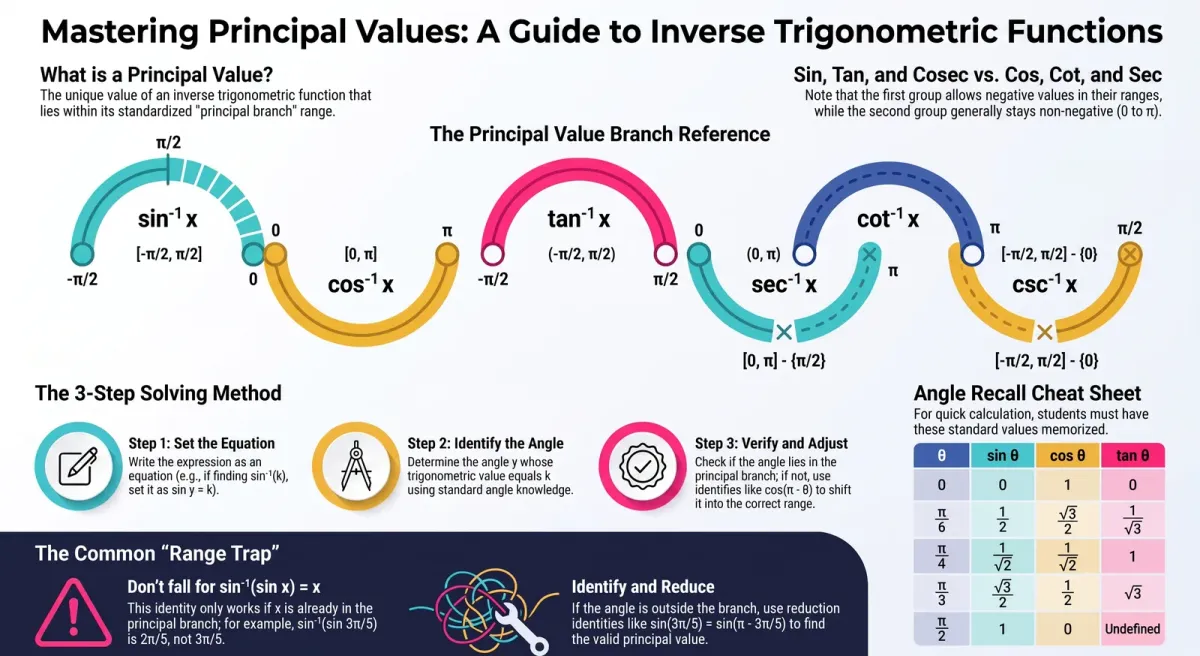
When a Class 12 board question asks you to “find the principal value of sin⁻¹(1/2)”, it is not just asking for a number. It is testing whether you understand what the principal value branch is, how to work within it, and how to recognise when a raw answer falls outside that branch and needs adjustment. This guide explains the concept thoroughly and walks you through worked examples for all six inverse trigonometric functions.
What Is the Principal Value of an Inverse Trig Function?
Each inverse trigonometric function has multiple possible branches — intervals on which the original function is one-one, each yielding a different inverse. For sin⁻¹ x, for example, valid branches exist on [−π/2, π/2], [π/2, 3π/2], [3π/2, 5π/2], and infinitely many others.
The principal value branch is the one that is chosen as the standard reference — the one that covers the most natural and symmetric portion of the number line around zero. Each inverse trig function has exactly one principal value branch:
| Function | Principal Value Branch Range |
|---|---|
| sin⁻¹ x | [−π/2, π/2] |
| cos⁻¹ x | [0, π] |
| tan⁻¹ x | (−π/2, π/2) |
| cot⁻¹ x | (0, π) |
| sec⁻¹ x | [0, π] − {π/2} |
| cosec⁻¹ x | [−π/2, π/2] − {0} |
The principal value of an inverse trig expression is the unique output that lies within this principal value branch. According to the NCERT textbook: “The value of an inverse trigonometric function which lies in the range of its principal branch is called the principal value of that function.”
The Standard Method for Finding Principal Values
The method is consistent across all six functions and can be applied in three clear steps:
Step 1: Write the inverse trig expression as an equation. If the expression is sin⁻¹(k) = y, then this means sin y = k.
Step 2: Find the angle y whose sine (or cosine, tangent, etc.) equals k.
Step 3: Verify that y lies within the principal value branch range. If it does, you are done. If it does not, use the relevant identity to shift it into the correct range.
Worked Examples: All Six Functions
Example 1 — sin⁻¹(1/√2)
Let sin⁻¹(1/√2) = y, so sin y = 1/√2.
We know that sin(π/4) = 1/√2. Since π/4 ∈ [−π/2, π/2], this is already within the principal branch.
Principal value = π/4
Example 2 — sin⁻¹(−1/2)
Let sin⁻¹(−1/2) = y, so sin y = −1/2.
We know sin(π/6) = 1/2, so sin(−π/6) = −1/2. Since −π/6 ∈ [−π/2, π/2], it lies within the principal branch.
Principal value = −π/6
Example 3 — cos⁻¹(−1/2)
Let cos⁻¹(−1/2) = y, so cos y = −1/2.
We know cos(π/3) = 1/2. For a negative cosine, we use the identity cos(π − θ) = −cos θ: cos(π − π/3) = −1/2, so cos(2π/3) = −1/2. Since 2π/3 ∈ [0, π], it lies within the principal branch.
Principal value = 2π/3
Example 4 — tan⁻¹(−√3)
Let tan⁻¹(−√3) = y, so tan y = −√3.
We know tan(π/3) = √3. Using tan(−θ) = −tan θ: tan(−π/3) = −√3. Since −π/3 ∈ (−π/2, π/2), it lies within the principal branch.
Principal value = −π/3
Example 5 — cot⁻¹(−1/√3)
Let cot⁻¹(−1/√3) = y, so cot y = −1/√3.
We know cot(π/3) = 1/√3. Using the identity cot(π − θ) = −cot θ: cot(π − π/3) = −1/√3, so cot(2π/3) = −1/√3. Since 2π/3 ∈ (0, π), it lies within the principal branch.
Principal value = 2π/3
Example 6 — cosec⁻¹(−√2)
Let cosec⁻¹(−√2) = y, so cosec y = −√2.
We know cosec(π/4) = √2. Using cosec(−θ) = −cosec θ: cosec(−π/4) = −√2. Since −π/4 ∈ [−π/2, π/2] and −π/4 ≠ 0, it lies within the principal branch.
Principal value = −π/4
When the Argument Falls Outside the Principal Branch
A common trap in problems like Exercise 2.2 and the Miscellaneous Exercise is that you may be asked to evaluate sin⁻¹(sin x) or cos⁻¹(cos x) where x is not in the principal branch.
For example: sin⁻¹(sin 3π/5)
At first glance it looks like the answer should be 3π/5. However, 3π/5 ∉ [−π/2, π/2], so it does not lie in the principal branch. The correct approach is to reduce:
sin(3π/5) = sin(π − 3π/5) = sin(2π/5)
Now 2π/5 ∈ [−π/2, π/2], so sin⁻¹(sin 3π/5) = 2π/5.
This type of question is extremely common in CBSE board exams and entrance tests. Recognising when to apply a reduction identity is the key skill.
Common Angles You Must Know by Heart
To find principal values efficiently under exam conditions, you need instant recall of these:
| θ | sin θ | cos θ | tan θ |
|---|---|---|---|
| 0 | 0 | 1 | 0 |
| π/6 | 1/2 | √3/2 | 1/√3 |
| π/4 | 1/√2 | 1/√2 | 1 |
| π/3 | √3/2 | 1/2 | √3 |
| π/2 | 1 | 0 | undefined |
Having these at your fingertips means you never need to derive them mid-calculation. For negative values, apply the relevant sign identity (sin is odd, cos is positive in [0, π], etc.).
Build Speed and Accuracy with ChampionsPrep
Finding principal values looks straightforward in theory — but speed matters in board exams. ChampionsPrep ( https://app.championsprep.in ) gives you timed MCQ practice on principal value questions, instant AI feedback on mistakes, and complete CBSE Chapter 2 coverage.
👉 Start Practising Principal Value Questions on ChampionsPrep →
₹10 per session — start any time, no commitment.
Test Your Knowledge
Principal Value of Inverse Trigonometric Functions: Concept, Method & Solved Examples
Frequently Asked Questions
What is the principal value branch of an inverse trig function? +
The principal value branch is the standardised interval used as the range of each inverse trig function. For sin⁻¹ it is [−π/2, π/2], for cos⁻¹ it is [0, π], and for tan⁻¹ it is (−π/2, π/2).
How do I find the principal value of cos⁻¹(−√3/2)? +
Set cos y = −√3/2. Since cos(π/6) = √3/2, the angle in [0, π] with negative cosine is π − π/6 = 5π/6. The principal value is 5π/6.
Is sin⁻¹(sin x) always equal to x? +
Only when x ∈ [−π/2, π/2]. For x outside this interval, apply reduction identities first to express sin x as the sine of an angle within [−π/2, π/2].
Can the principal value of an inverse trig function be negative? +
Yes, for sin⁻¹, tan⁻¹, and cosec⁻¹. Their principal branches include negative values. For cos⁻¹, cot⁻¹, and sec⁻¹, the range is non-negative.
How many marks does a principal value question carry in CBSE Class 12 boards? +
Typically 1–2 marks per question in the MCQ or short answer section. These are reliable marks if you have memorised standard angle values and know the principal branches.
AI-powered practice — free to start