
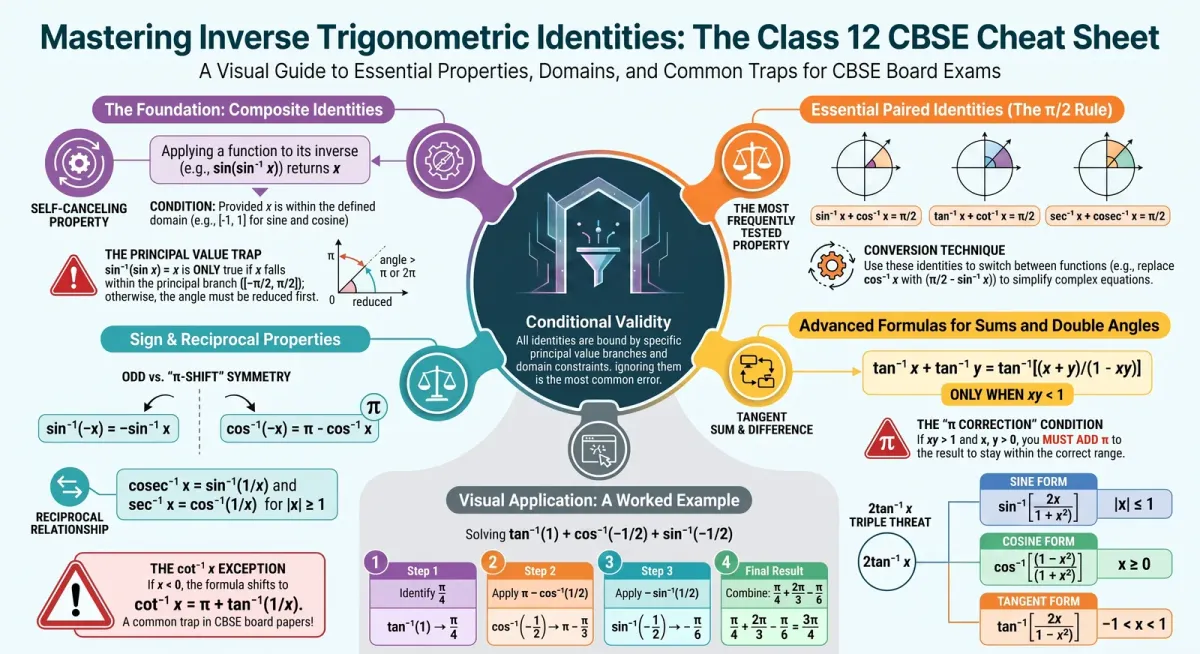
Once you have understood what inverse trigonometric functions are and how to find their principal values, the next step is learning their properties — the identities that allow you to simplify expressions, prove results, and solve equations. These properties are tested in every CBSE board paper, either directly (simplify the expression) or indirectly (prove that LHS = RHS). This article covers every key identity from Section 2.3 of the NCERT Class 12 Maths textbook.
Why Properties Matter
The properties of inverse trig functions are not isolated formulas — they are tools. In board exams, Exercise 2.2 and the Miscellaneous Exercise are full of problems that cannot be solved by direct evaluation. Instead, you need to recognise which identity applies, substitute it, and simplify step by step. A firm grip on these identities is what separates a student who struggles with Chapter 2 from one who handles it confidently.
Important caveat from NCERT: These properties hold within the principal value branches of the corresponding inverse trig functions, and are valid only for the specific values of x in their domains. They are not universally valid across all real numbers. This nuance is tested in problems involving composite expressions like sin⁻¹(sin x).
Category 1 — Composite Identities (Function and Its Inverse)
The most fundamental properties describe what happens when you apply a trig function and its inverse in sequence:
| Identity | Domain |
|---|---|
| sin(sin⁻¹ x) = x | x ∈ [−1, 1] |
| sin⁻¹(sin x) = x | x ∈ [−π/2, π/2] |
| cos(cos⁻¹ x) = x | x ∈ [−1, 1] |
| cos⁻¹(cos x) = x | x ∈ [0, π] |
| tan(tan⁻¹ x) = x | x ∈ ℝ |
| tan⁻¹(tan x) = x | x ∈ (−π/2, π/2) |
The pattern is consistent across all six functions. The key condition is that the argument must lie within the principal value branch — if it does not, you must first reduce it.
Category 2 — Complementary Angle (Paired) Identities
These are among the most frequently tested identities in CBSE exams:
sin⁻¹ x + cos⁻¹ x = π/2, for x ∈ [−1, 1]
tan⁻¹ x + cot⁻¹ x = π/2, for x ∈ ℝ
sec⁻¹ x + cosec⁻¹ x = π/2, for |x| ≥ 1
These three pairs follow directly from the complementary relationship between the original trig functions. Since sin and cos are complementary (sin θ = cos(π/2 − θ)), their inverses add up to π/2. The same logic applies to tan/cot and sec/cosec.
How to Use Them
These identities allow you to convert between paired functions:
-
cos⁻¹ x = π/2 − sin⁻¹ x
-
cot⁻¹ x = π/2 − tan⁻¹ x
-
cosec⁻¹ x = π/2 − sec⁻¹ x
This is useful when a problem asks you to evaluate or simplify an expression involving both sin⁻¹ and cos⁻¹ of the same argument.
Category 3 — Sign (Odd/Even) Properties
sin⁻¹(−x) = −sin⁻¹ x, for x ∈ [−1, 1]
tan⁻¹(−x) = −tan⁻¹ x, for x ∈ ℝ
cosec⁻¹(−x) = −cosec⁻¹ x, for |x| ≥ 1
These three functions are odd — their inverses also have odd symmetry. Substituting −x flips the sign of the output.
For the remaining three, the rule is different:
cos⁻¹(−x) = π − cos⁻¹ x, for x ∈ [−1, 1]
sec⁻¹(−x) = π − sec⁻¹ x, for |x| ≥ 1
cot⁻¹(−x) = π − cot⁻¹ x, for x ∈ ℝ
The cosine, secant, and cotangent functions are even (or have even-like symmetry), and their inverses reflect this: substituting −x shifts the output by π rather than negating it.
Category 4 — Reciprocal Identities
cosec⁻¹ x = sin⁻¹(1/x), for |x| ≥ 1
sec⁻¹ x = cos⁻¹(1/x), for |x| ≥ 1
cot⁻¹ x = tan⁻¹(1/x), for x > 0
For x < 0: cot⁻¹ x = π + tan⁻¹(1/x)
The first two follow directly from the reciprocal relationship between cosec/sin and sec/cos. The formula for cot⁻¹ requires extra care because of the sign of x — this is a common exam trap.
Category 5 — Sum and Difference Formulas for tan⁻¹
These are used heavily in Exercise 2.2 and the Miscellaneous Exercise:
tan⁻¹ x + tan⁻¹ y = tan⁻¹[(x + y)/(1 − xy)], when xy < 1
tan⁻¹ x + tan⁻¹ y = π + tan⁻¹[(x + y)/(1 − xy)], when xy > 1 and x, y > 0
tan⁻¹ x + tan⁻¹ y = −π + tan⁻¹[(x + y)/(1 − xy)], when xy > 1 and x, y < 0
tan⁻¹ x − tan⁻¹ y = tan⁻¹[(x − y)/(1 + xy)], when xy > −1
The condition xy < 1 is critical. If it is not satisfied, you must correct the result by adding π when x and y are both positive, or subtracting π when both are negative. Forgetting this correction is one of the most common errors in Class 12 proofs.
Category 6 — Double Angle Identities for 2 tan⁻¹ x
2 tan⁻¹ x = sin⁻¹[2x/(1 + x²)], for |x| ≤ 1
2 tan⁻¹ x = cos⁻¹[(1 − x²)/(1 + x²)], for x ≥ 0
2 tan⁻¹ x = tan⁻¹[2x/(1 − x²)], for −1 < x < 1
These follow from the double angle formulas for sin, cos, and tan when you substitute x = tan θ. They appear in both proofs and in “write in simplest form” problems.
A Worked Application: tan⁻¹(1) + cos⁻¹(−1/2) + sin⁻¹(−1/2)
Step 1: tan⁻¹(1) = π/4 (standard angle)
Step 2: cos⁻¹(−1/2): using cos⁻¹(−x) = π − cos⁻¹(x), this equals π − π/3 = 2π/3
Step 3: sin⁻¹(−1/2): using sin⁻¹(−x) = −sin⁻¹(x), this equals −π/6
Total: π/4 + 2π/3 − π/6 = 3π/12 + 8π/12 − 2π/12 = 9π/12 = 3π/4
This combines three different categories of properties in one calculation — exactly the style of question you encounter in Exercise 2.2 Question 11.
Master Every Identity with ChampionsPrep
Knowing an identity and applying it confidently under exam pressure are very different skills. ChampionsPrep ( https://app.championsprep.in ) provides structured Chapter 2 practice with questions mapped to each property category, instant AI feedback, and CBSE-style long-form questions with model answers.
👉 Practise Inverse Trig Identities on ChampionsPrep →
₹10 per doubt session — clear every step, every time.
Test Your Knowledge
Properties of Inverse Trigonometric Functions: Key Identities for Class 12 Maths
Frequently Asked Questions
What is sin⁻¹ x + cos⁻¹ x equal to? +
sin⁻¹ x + cos⁻¹ x = π/2 for all x ∈ [−1, 1]. This is one of the most fundamental identities in Class 12 Chapter 2.
Why does cos⁻¹(−x) equal π − cos⁻¹(x) instead of −cos⁻¹(x)? +
Because the range of cos⁻¹ is [0, π], which has no negative values. The identity π − cos⁻¹(x) ensures the result stays within the principal value branch.
When does the tan⁻¹ x + tan⁻¹ y formula need a π correction? +
When xy > 1. If x and y are both positive, tan⁻¹ x + tan⁻¹ y = π + tan⁻¹[(x+y)/(1−xy)]; if both are negative, tan⁻¹ x + tan⁻¹ y = −π + tan⁻¹[(x+y)/(1−xy)]. Without the correction the result falls outside the principal range.
Are the properties of inverse trig functions valid for all x? +
Only within the stated domain conditions. For example, sin⁻¹(sin x) = x only when x ∈ [−π/2, π/2]. For values outside the principal branch, reduction identities must be applied first.
Which property of inverse trig functions is most commonly tested in CBSE boards? +
The complementary pair sin⁻¹ x + cos⁻¹ x = π/2 is tested most frequently, followed by the tan⁻¹ addition formula and the 2tan⁻¹ double angle identities.
AI-powered practice — free to start