
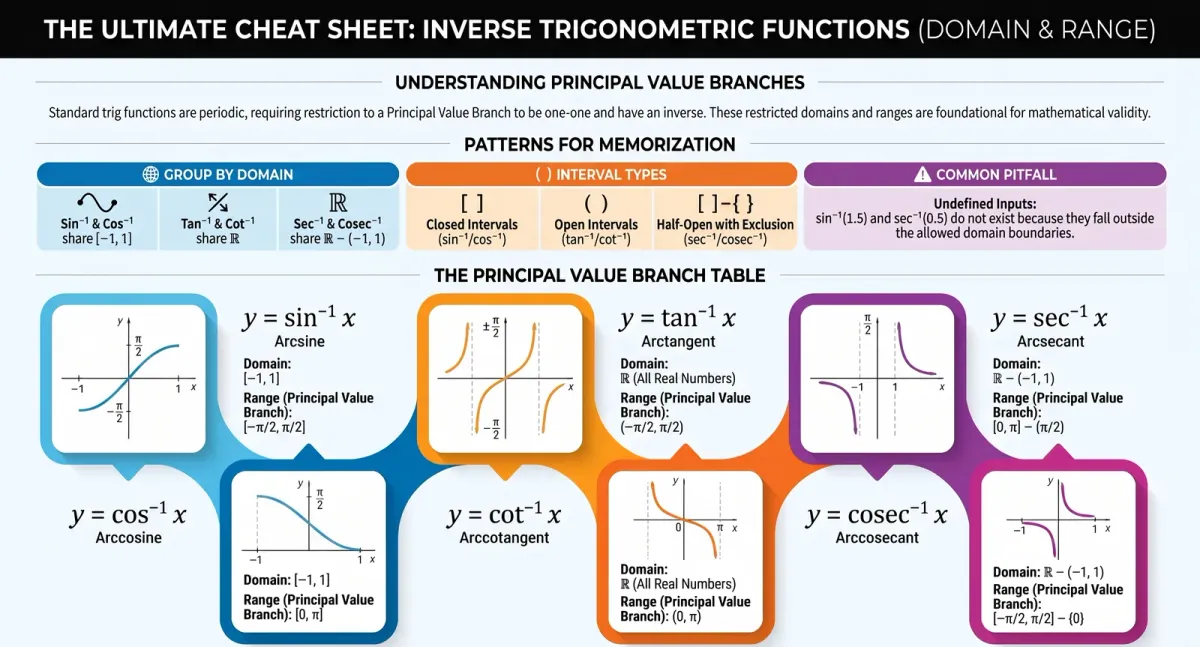
One of the most tested topics in CBSE Class 12 Maths Chapter 2 is knowing the exact domain and range of each inverse trigonometric function. Get these wrong and every subsequent step in a problem — finding principal values, simplifying expressions, or proving identities — unravels quickly. This guide gives you the complete picture: every domain, every range, and why each restriction exists.
Why Domains and Ranges Are Restricted
Standard trigonometric functions are periodic — they repeat values across cycles — making them not one-one over their full domains. For an inverse to exist, the original function must be one-one and onto. The strategy is to restrict each trig function to a specific interval — the principal value branch — where it is strictly monotonic. The inverse is then defined on that restricted version.
The table below summarises all six principal value branches:
| Function | Domain | Range (Principal Value Branch) |
|---|---|---|
| y = sin⁻¹ x | [−1, 1] | [−π/2, π/2] |
| y = cos⁻¹ x | [−1, 1] | [0, π] |
| y = tan⁻¹ x | ℝ | (−π/2, π/2) |
| y = cot⁻¹ x | ℝ | (0, π) |
| y = sec⁻¹ x | ℝ − (−1, 1) | [0, π] − {π/2} |
| y = cosec⁻¹ x | ℝ − (−1, 1) | [−π/2, π/2] − {0} |
Let us now go through each function in detail.
sin⁻¹ x — Arcsine
Domain: [−1, 1]
The sine function produces outputs only in [−1, 1]. So only values from −1 to 1 can be valid inputs to sin⁻¹. Inputs outside this range are undefined — for example, sin⁻¹(2) does not exist.
Range: [−π/2, π/2]
The sine function is strictly increasing on [−π/2, π/2] and covers the full range [−1, 1] exactly once on this interval. This makes it the natural principal value branch. The output of sin⁻¹ x always lies between −π/2 and π/2, inclusive.
Key identity: sin(sin⁻¹ x) = x for all x ∈ [−1, 1], and sin⁻¹(sin x) = x for all x ∈ [−π/2, π/2].
cos⁻¹ x — Arccosine
Domain: [−1, 1]
Same reasoning as arcsine — cosine produces values in [−1, 1], so only values in that interval are valid inputs to cos⁻¹.
Range: [0, π]
The cosine function is strictly decreasing on [0, π], mapping each angle in [0, π] to exactly one value in [−1, 1]. This is the principal value branch.
Notice the asymmetry: unlike sin⁻¹, which is centred at zero, cos⁻¹ is centred at π/2. The principal value of cos⁻¹(0) is π/2, and cos⁻¹(1) = 0 while cos⁻¹(−1) = π.
tan⁻¹ x — Arctangent
Domain: ℝ (All Real Numbers)
The tangent function, when restricted to (−π/2, π/2), takes every real value from −∞ to +∞. So the inverse function tan⁻¹ x is defined for all x ∈ ℝ — there is no restriction on the input.
Range: (−π/2, π/2)
The range is an open interval. Tan⁻¹ x never actually reaches −π/2 or π/2 because the tangent function approaches infinity asymptotically at those points.
As x → +∞, tan⁻¹ x → π/2 from below; as x → −∞, tan⁻¹ x → −π/2 from above. This gives the characteristic S-shaped graph of y = tan⁻¹ x.
cot⁻¹ x — Arccotangent
Domain: ℝ
The cotangent function restricted to (0, π) produces all real values, so cot⁻¹ accepts any real number.
Range: (0, π)
The principal value branch is the open interval (0, π). Note that both 0 and π are excluded. cot⁻¹ x is a strictly decreasing function.
Note: Do not conflate cot⁻¹ x with π/2 − tan⁻¹ x without checking the sign of x; the identity changes for negative values.
sec⁻¹ x — Arcsecant
Domain: ℝ − (−1, 1)
The secant function produces values ≥ 1 or ≤ −1 (it never lies strictly between −1 and 1). So sec⁻¹ x is only defined for |x| ≥ 1 — that is, for x ∈ (−∞, −1] ∪ [1, +∞).
Range: [0, π] − {π/2}
The range is [0, π] with π/2 removed — sec(π/2) is undefined, so π/2 cannot appear as an output. For x ≥ 1 the output lies in [0, π/2); for x ≤ −1 it lies in (π/2, π].
cosec⁻¹ x — Arccosecant
Domain: ℝ − (−1, 1)
The cosecant function also produces values with |y| ≥ 1, so cosec⁻¹ x requires inputs x with |x| ≥ 1. Values between −1 and 1 are excluded.
Range: [−π/2, π/2] − {0}
The range is [−π/2, π/2] with 0 removed. Zero is excluded because cosec(0) is undefined. For x ≥ 1, the output lies in (0, π/2]; for x ≤ −1, the output lies in [−π/2, 0).
Comparing the Six: Key Observations
A few patterns worth noting as you prepare for exams:
Functions with domain [−1, 1]: sin⁻¹ and cos⁻¹ only.
Functions with domain ℝ: tan⁻¹ and cot⁻¹.
Functions with domain ℝ − (−1, 1): sec⁻¹ and cosec⁻¹.
Closed versus open intervals in the range:
-
sin⁻¹ and cos⁻¹ have closed intervals as their ranges (both endpoints included).
-
tan⁻¹ and cot⁻¹ have open intervals (neither endpoint reached).
-
sec⁻¹ and cosec⁻¹ have half-open intervals with one exclusion (π/2 or 0 respectively).
These distinctions are directly tested in CBSE board questions, especially in multiple-choice formats like Q13 of Exercise 2.1, which asks what can be concluded when sin⁻¹ x = y.
Revise Smarter with ChampionsPrep
Knowing the domain and range tables is necessary — but exam success requires applying them correctly under time constraints. ChampionsPrep ( https://app.championsprep.in ) provides topic-wise MCQs and long-form practice questions mapped directly to the CBSE Chapter 2 syllabus, with instant AI-powered explanations for every solution.
👉 Practise Domain and Range Questions on ChampionsPrep →
₹10 per doubt — no subscription needed.
Test Your Knowledge
Domains and Ranges of All 6 Inverse Trigonometric Functions – Class 12 Maths
Frequently Asked Questions
What happens if I input a value outside the domain of an inverse trig function? +
The function is undefined for inputs outside its domain. For example, sin⁻¹(1.5) does not exist because 1.5 is outside [−1, 1], and sec⁻¹(0.5) is undefined because 0.5 lies in (−1, 1).
Why is 0 excluded from the range of cosec⁻¹ x? +
Because cosec(0) is undefined. The cosecant function has a vertical asymptote at 0, so 0 can never be a valid output of cosec⁻¹ x.
Why is π/2 excluded from the range of sec⁻¹ x? +
Because sec(π/2) is undefined. The secant function is undefined at odd multiples of π/2, so π/2 cannot appear as an output of sec⁻¹ x.
Is the range of tan⁻¹ x open or closed? +
Open: (−π/2, π/2). The endpoints are never reached because tangent approaches infinity asymptotically as the angle approaches ±π/2.
How can I memorise all six domains and ranges of inverse trig functions? +
Group them: sin⁻¹ and cos⁻¹ take domain [−1, 1]; tan⁻¹ and cot⁻¹ take all reals; sec⁻¹ and cosec⁻¹ need |x| ≥ 1. For ranges, sec⁻¹ mirrors cos⁻¹ but excludes π/2, and cosec⁻¹ mirrors sin⁻¹ but excludes 0.
AI-powered practice — free to start