
If you have ever wondered how engineers calculate an angle from a known ratio, how navigation systems determine direction, or how physicists model wave behaviour — inverse trigonometric functions are doing the heavy lifting in the background. Chapter 2 of Class 12 Mathematics introduces you to these functions, and mastering them is essential for board exams, CUET, and beyond.
In this guide you will learn exactly what inverse trigonometric functions are, why they require special domain restrictions before they can even exist, and how all six standard trigonometric functions give rise to their own inverses.
Why You Cannot Simply “Reverse” a Trigonometric Function
To understand inverse trigonometric functions, you first need to recall a rule from Chapter 1: a function can have an inverse only if it is both one-one (injective) and onto (surjective).
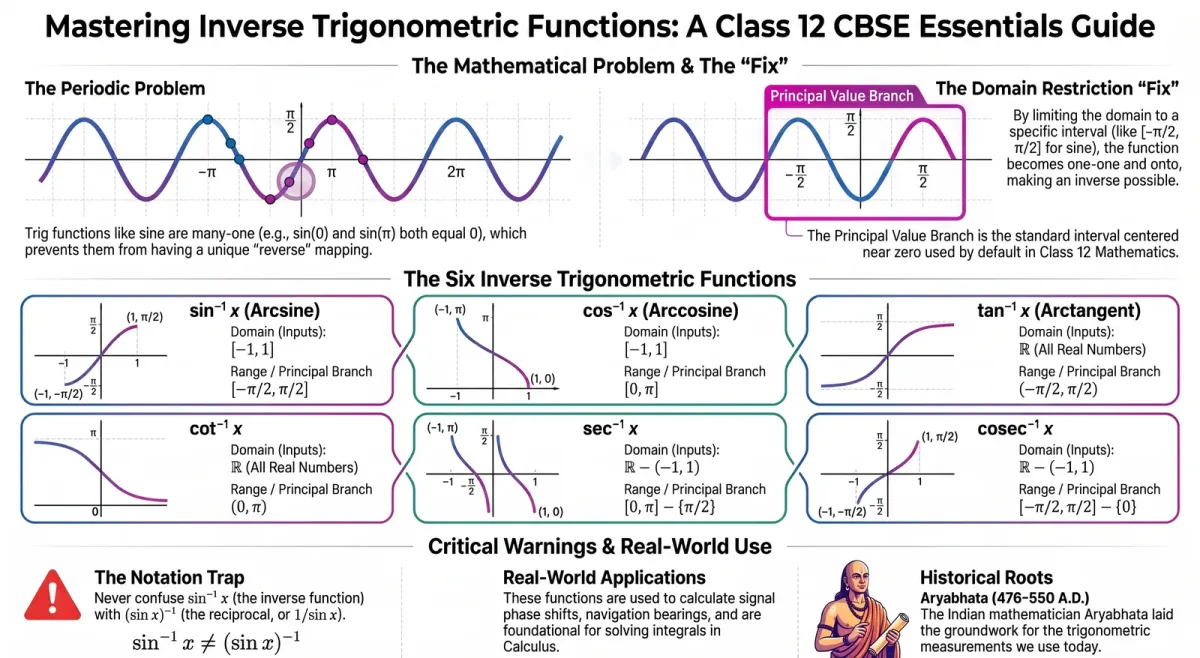
Trigonometric functions, defined over all real numbers, fail both tests. The sine function, for example, gives sin(0) = 0 and sin(π) = 0 — two completely different inputs producing the same output. This makes it many-one, not one-one, and so it cannot have an inverse in the conventional sense.
This is not a flaw. It simply reflects the periodic nature of these functions — they repeat their values in cycles as the angle increases. The same output appears at infinitely many input values. Without addressing this, there is no unique “reverse” mapping to define.
The Key Insight: Restrict the Domain
The elegant mathematical fix is to limit the domain of the trigonometric function to a smaller interval where it behaves strictly — that is, where it is both one-one and onto.
For the sine function, the natural domain spans all real numbers with range [−1, 1]. If we restrict the domain to just [−π/2, π/2], the function becomes strictly increasing, maps each input to exactly one output, and covers the entire range [−1, 1]. This restricted version is invertible. Its inverse is what we call sin⁻¹ x, also written as arcsin x.
The Six Inverse Trigonometric Functions
Every standard trigonometric function, once its domain is restricted appropriately, produces an inverse. Here are all six:
sin⁻¹ x (Arcsine)
-
Domain: [−1, 1]
-
Range (Principal Branch): [−π/2, π/2]
-
Meaning: sin⁻¹ x = y means sin y = x, with y in [−π/2, π/2]
cos⁻¹ x (Arccosine)
-
Domain: [−1, 1]
-
Range (Principal Branch): [0, π]
-
The cosine function is one-one and decreasing on [0, π], making this the natural principal branch.
tan⁻¹ x (Arctangent)
-
Domain: ℝ (all real numbers)
-
Range (Principal Branch): (−π/2, π/2)
-
Unlike sine and cosine, the domain of tan⁻¹ is unrestricted — it can accept any real number as input.
cot⁻¹ x (Arccotangent)
-
Domain: ℝ
-
Range (Principal Branch): (0, π)
-
Note the open interval: cot⁻¹ x never equals exactly 0 or π.
sec⁻¹ x (Arcsecant)
-
Domain: ℝ − (−1, 1)
-
Range (Principal Branch): [0, π] − {π/2}
-
Since sec x is always ≥ 1 or ≤ −1, values between −1 and 1 are excluded entirely.
cosec⁻¹ x (Arccosecant)
-
Domain: ℝ − (−1, 1)
-
Range (Principal Branch): [−π/2, π/2] − {0}
-
Zero is excluded from the range because cosec is undefined at 0.
One Critical Notation Warning
This is among the most common mistakes in Class 12 exams: sin⁻¹ x is not the same as (sin x)⁻¹.
The notation (sin x)⁻¹ means the reciprocal — that is, 1/sin x = cosec x. The notation sin⁻¹ x is a completely different concept: it is the inverse function, giving the angle whose sine equals x. The same distinction applies to all six functions. Confusing the two in a board exam or entrance test can cost you marks on otherwise straightforward questions.
What “Branch” Means
When the domain is restricted to [−π/2, π/2] for sine, we get one specific inverse. But sine is also one-one on [π/2, 3π/2], on [−3π/2, −π/2], and infinitely many other intervals. Each such interval produces a different branch of sin⁻¹ x.
The branch whose range is [−π/2, π/2] is called the principal value branch, and it is the one we use by default throughout Class 12. When a question asks for the value of sin⁻¹(1/2) without specifying a branch, the answer is always taken from the principal value branch: π/6.
Why Inverse Trig Functions Matter Beyond the Exam
Inverse trigonometric functions are not just abstract constructs for textbook exercises. They are foundational tools in calculus — several standard integrals, such as ∫ 1/√(1 − x²) dx = sin⁻¹ x + C, are expressed directly in terms of these functions.
In physics and engineering, they allow you to recover angles from given ratios: determining the angle of elevation of an object, computing signal phase shifts, or calculating navigation bearings. The great Indian mathematician Aryabhata (476–550 A.D.) contributed foundational work on sine and angle measurement that eventually led to the trigonometric framework we study today.
Start Practising — with ChampionsPrep
Knowing the concept is step one. Scoring full marks on exam day takes targeted practice on the exact question types that appear in CBSE boards, CUET, and IPMAT. At ChampionsPrep ( https://app.championsprep.in ), you get topic-wise question banks, instant AI doubt resolution, and step-by-step solutions for Class 12 Maths.
👉 Practise Inverse Trigonometric Functions on ChampionsPrep →
Just ₹10 per doubt session — no subscriptions, no lock-in.
Test Your Knowledge
What Are Inverse Trigonometric Functions? A Complete Guide for Class 12 CBSE
Frequently Asked Questions
What does sin⁻¹ x actually mean? +
sin⁻¹ x is the angle y in [−π/2, π/2] such that sin y = x. It is the function inverse of sine, not 1/sin x.
Why do trig functions need domain restrictions before they can be inverted? +
Trigonometric functions are periodic — the same output appears for multiple inputs. An inverse requires each output to correspond to exactly one input, which is achieved by restricting the domain to a strictly one-one interval.
What is the difference between a branch and the principal branch of an inverse trig function? +
Each interval where a trig function is one-one gives a different branch of its inverse. The principal branch is the standard one used in Class 12 — for sin⁻¹, it has range [−π/2, π/2].
Is the domain of tan⁻¹ x really all real numbers? +
Yes. The restricted tangent function maps the interval (−π/2, π/2) to all of ℝ, so its inverse tan⁻¹ accepts any real number and returns a value in (−π/2, π/2).
Which inverse trig functions have restricted domains? +
sin⁻¹ x and cos⁻¹ x have domain [−1, 1]; sec⁻¹ x and cosec⁻¹ x have domain ℝ − (−1, 1). Only tan⁻¹ x and cot⁻¹ x accept all real numbers.
AI-powered practice — free to start