
Once you understand what a matrix is and how to classify it, the next logical step is learning how to perform arithmetic on matrices. Matrix addition, scalar multiplication, and subtraction are the foundational operations in this chapter — and they follow rules that are both intuitive and precise.
This guide covers every operation with definitions, NCERT-based examples, key properties, and exam-focused tips to help you score full marks in CBSE boards.
What is Matrix Addition?
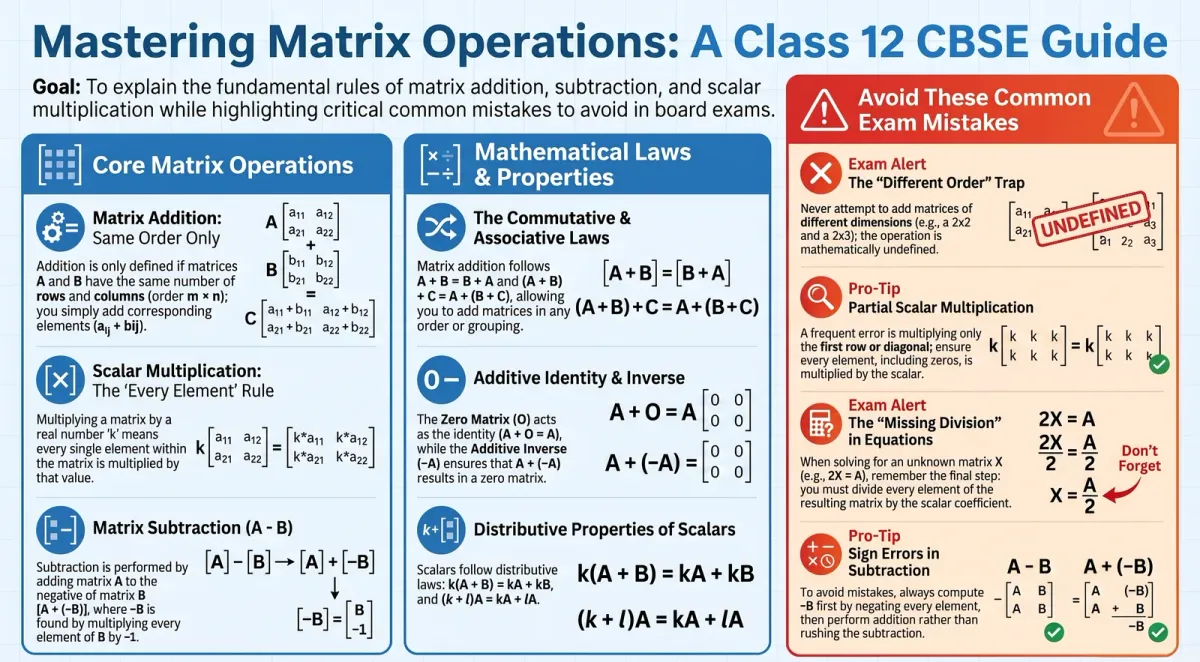
Matrix addition is the operation of adding two matrices by combining their corresponding elements. However, addition is only defined when the two matrices are of the same order.
Definition
If A = [aij] and B = [bij] are two matrices of the same order m × n, then their sum A + B is a matrix C = [cij] of order m × n, where:
cij = aij + bij for all valid i and jWorked Example (NCERT)
Let A = [[√3, 1, -1], [2, 3, 0]] and B = [[2, √5, 1], [-2, 3, 1/2]]
Both are 2 × 3 matrices, so addition is defined:
A + B = | √3+2   1+√5    0  |
        |   0      6    1/2 |
Important: If A and B have different orders, A + B is not defined. For example, a 2 × 2 matrix and a 2 × 3 matrix cannot be added.
Properties of Matrix Addition
Matrix addition satisfies four key properties that mirror the familiar properties of number addition.
1. Commutative Law
For matrices of the same order: A + B = B + A
This holds because aij + bij = bij + aij (addition of real numbers is commutative).
2. Associative Law
For three matrices of the same order: (A + B) + C = A + (B + C)
You can add matrices in any grouping without changing the result.
3. Existence of Additive Identity
The zero matrix O (of the same order) satisfies: A + O = O + A = A
The zero matrix plays the role of “zero” in matrix arithmetic.
4. Existence of Additive Inverse
For any matrix A, the matrix −A = (−1)A satisfies:
A + (−A) = (−A) + A = OHere, −A is the additive inverse of A. Every element of −A is the negative of the corresponding element in A.
Scalar Multiplication of a Matrix
Scalar multiplication means multiplying every element of a matrix by a fixed real number (called a scalar).
Definition
If A = [aij] is an m × n matrix and k is a scalar, then kA = [k·aij] — every element is multiplied by k.
Example
If A = |  3    1   1.5 |
       | √5    7   -3  |
       |  2    0    5  |

Then 3A = |   9    3   4.5 |
          | 3√5   21   -9  |
          |   6    0   15  |
Negative of a Matrix
The negative of a matrix A is −A = (−1)A. Every element of A is multiplied by −1.
If A = |  3   1 |     then -A = | -3  -1 |
       | -5   x |               |  5  -x |
Matrix Subtraction: Difference of Two Matrices
The difference A − B is defined as A + (−B), that is, adding A to the negative of B.
If A = [aij] and B = [bij] are of the same order m × n:
A - B = [aij - bij]Worked Example (NCERT Example 7)
Given A = [[1, 2, 3], [2, 3, 1]] and B = [[3, -1, 3], [-1, 0, 2]], find 2A − B.
2A = | 2  4  6 |     -B = | -3   1  -3 |
     | 4  6  2 |           |  1   0  -2 |

2A - B = | 2-3   4+1   6-3 |   =  | -1   5   3 |
         | 4+1   6+0   2-2 |      |  5   6   0 |
Properties of Scalar Multiplication
For matrices A and B of the same order and scalars k and l:
-
k(A + B) = kA + kB (distributive over matrix addition)
-
(k + l)A = kA + lA (distributive over scalar addition)
These properties are used extensively when solving for unknown matrices in equations.
Finding Unknown Matrix X (Typical Board Question)
Example (NCERT Example 8): If 2A + 3X = 5B, find X.
3X = 5B - 2A
 X = (1/3)(5B - 2A)
Compute 5B and 2A, subtract, then divide every element by 3. This is a reliable approach for any equation of the form pA + qX = rB.
Common Mistakes Students Make in Matrix Operations
Understanding the rules is one thing — applying them correctly under exam conditions is another. Here are the most common errors that cost students marks.
Mistake 1: Adding Matrices of Different Orders
A surprising number of students attempt to add matrices with different numbers of rows or columns. Always check orders before performing any operation. If A is 2 × 3 and B is 3 × 2, you cannot compute A + B.
Mistake 2: Multiplying Only Some Elements During Scalar Multiplication
When computing kA, every single element must be multiplied by k — including diagonal elements and elements that happen to be 0. Missing any element changes the result.
Mistake 3: Forgetting to Divide by the Scalar When Solving for X
In equations of the form pA + qX = rB, students correctly isolate qX but then forget to divide each element by q to find X. Always complete this final step.
Mistake 4: Incorrect Sign in Matrix Subtraction
A − B = A + (−B). Compute −B first (negate every element), then add. Rushing through subtraction often leads to sign errors in the final matrix.
Key Board Exam Tips
-
Check orders first: Always verify both matrices have the same order before attempting addition or subtraction.
-
Scalar multiplication: Multiply every element — don’t skip row 1 or the diagonal.
-
Solving for X: Isolate X using the four addition properties, then divide by the scalar coefficient.
-
Additive inverse: −A is formed by negating every element, not just non-diagonal ones.
-
Common error: Students sometimes multiply only diagonal elements during scalar multiplication — every element must be multiplied.
Suggested Reading on ChampionsPrep
-
Types of Matrices: All Seven Types with Examples and Definitions
-
Matrix Multiplication: Rules, Conditions, and Properties for Class 12
-
Transpose of a Matrix: Definition, Properties and Reversal Law
Test Your Knowledge
Sharpen Your Skills Today
Addition and scalar multiplication are the gateway operations for everything that follows — from matrix equations to linear systems. Practise until these operations are second nature.
Work through 100+ targeted practice questions on Matrix Operations at ChampionsPrep . Instant results, CBSE-aligned, ₹10 per use.
Matrix Addition and Scalar Multiplication: Class 12 CBSE Complete Guide
Frequently Asked Questions
What is the condition for matrix addition? +
Two matrices can be added only if they are of the same order. If A is m × n, then B must also be m × n for A + B to be defined.
What is scalar multiplication in matrices? +
Scalar multiplication means multiplying every element of a matrix by a fixed real number called a scalar. If k is a scalar and A = [aij], then kA = [k·aij].
What is the additive identity in matrix addition? +
The additive identity is the zero matrix O. For any matrix A of the same order, A + O = O + A = A.
What is the negative of a matrix? +
The negative of a matrix A is −A = (−1)A. It is formed by multiplying every element of A by −1. Adding A and −A gives the zero matrix: A + (−A) = O.
Is matrix addition commutative? +
Yes. Matrix addition is commutative: A + B = B + A for any two matrices of the same order. It is also associative: (A + B) + C = A + (B + C).
AI-powered practice — free to start