
Matrices are among the most powerful tools in modern mathematics. From organising business sales data to encoding secure messages in cryptography, matrices condense complex real-world information into compact, structured rectangular arrays. For Class 12 CBSE students, Chapter 3 — Matrices — is a foundational unit that links directly to Determinants, systems of linear equations, and higher applied mathematics.
This guide walks you through the essentials: the definition of a matrix, how to read matrix notation, how to determine its order, and how to construct a matrix from a formula — all aligned with NCERT Class 12 Mathematics.
What is a Matrix? Definition and Core Idea
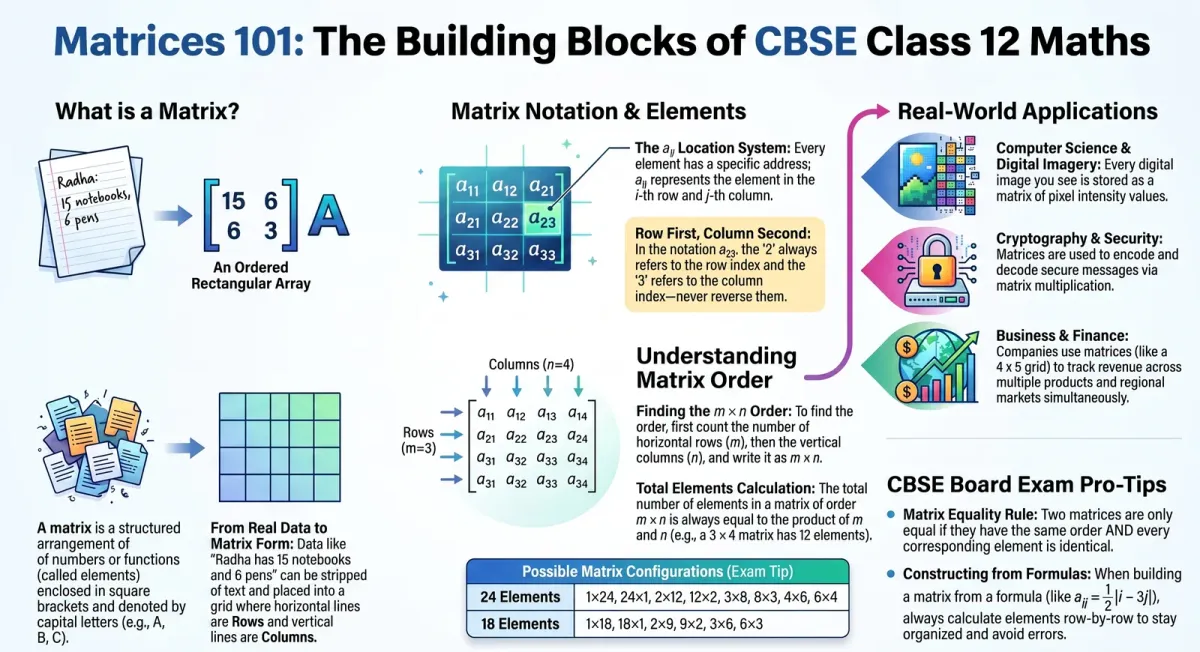
A matrix is defined as an ordered rectangular array of numbers or functions. The numbers or functions placed inside this arrangement are called its elements or entries, and the entire structure is enclosed in square brackets. We typically denote matrices by capital letters: A, B, C.
Consider a simple real-life scenario. Three friends — Radha, Fauzia, and Simran — own different numbers of notebooks and pens:
-
Radha: 15 notebooks, 6 pens
-
Fauzia: 10 notebooks, 2 pens
-
Simran: 13 notebooks, 5 pens
This information can be neatly represented as:
A = | 15  6 |
    | 10  2 |
    | 13  5 |
The horizontal lines are called rows and the vertical lines are called columns. Matrix A above has 3 rows and 2 columns. This is how matrices compress structured data into a form that is easy to manipulate mathematically.
Why Are Matrices Important?
Before matrices, handling large sets of related data required verbose descriptions or tables. Matrices provide a standardised, compact format with well-defined arithmetic rules — rules that scale efficiently for computers, engineering systems, and economic models alike.
Matrix Notation: Understanding aij
The standard notation for any matrix of order m × n is:
A = [aij], where 1 ≤ i ≤ m and 1 ≤ j ≤ nHere:
-
m = total number of rows
-
n = total number of columns
-
aij = the element in the i-th row and j-th column
This subscript notation tells you exactly where each element lives. The element a₂₃ is in the 2nd row and 3rd column. Always remember this rule: row index first, column index second.
The total number of elements in any m × n matrix always equals mn. A matrix of order 3 × 4 contains exactly 12 elements.
Order of a Matrix: How to Find It
The order of a matrix describes its dimensions, written as m × n (“m by n”). Identifying the correct order is one of the most common and fundamental tasks in exam questions.
Step-by-Step Method
-
Count the number of horizontal lines (rows) → this gives m
-
Count the number of vertical lines (columns) → this gives n
-
Write the order as m × n
Board Exam Question: If a matrix has 24 elements, what are all its possible orders?
You need every pair (m, n) where m × n = 24. These are: 1×24, 24×1, 2×12, 12×2, 3×8, 8×3, 4×6, and 6×4. This type of 2-mark question appears regularly in CBSE examinations.
Constructing a Matrix from a Formula
A very common CBSE board question defines the elements of a matrix using a formula and asks you to write out the complete matrix. Approach this systematically — row by row, left to right.
Example (NCERT Exercise 3.1): Construct a 3 × 2 matrix A = [aij] where aij = (1/2)|i − 3j|
Substituting each (i, j) pair:
-
a₁₁ = ½|1 − 3| = 1
-
a₁₂ = ½|1 − 6| = 5/2
-
a₂₁ = ½|2 − 3| = 1/2
-
a₂₂ = ½|2 − 6| = 2
-
a₃₁ = ½|3 − 3| = 0
-
a₃₂ = ½|3 − 6| = 3/2
A = |   1    5/2 |
    |  1/2    2  |
    |   0    3/2 |
Organising calculations in a table before writing the final matrix helps avoid errors under exam conditions.
Real-World Applications of Matrices
Matrices appear across a remarkable range of fields:
-
Business and Finance: A company with 4 products across 5 regional markets uses a 4 × 5 matrix to track all 20 revenue figures simultaneously.
-
Computer Science: Every digital image is stored as a matrix of pixel intensity values. Neural networks process data as sequences of matrix multiplications.
-
Physics and Engineering: Rotation, magnification, and reflection of objects in 2D or 3D space are expressed as matrix transformations.
-
Cryptography: Matrix multiplication encodes and decodes secure communications.
-
Economics and Social Sciences: Transition matrices model market share shifts, population movement, and input-output economic systems.
The defining advantage of matrices is that one compact notation captures enormous amounts of structured data and enables standardised, programmable operations on that data.
CBSE Board Exam Tips for Matrices Basics
-
Always state the order of a matrix when asked — write m × n explicitly.
-
Row before column: The element aij is in row i and column j — never reverse this.
-
Equality check: Two matrices are equal only if they share the same order AND every corresponding element is equal.
-
Formula construction: Calculate elements row by row to stay organised.
-
Count elements: Before listing orders, note that total elements = m × n.
Suggested Reading on ChampionsPrep
-
Types of Matrices: Row, Column, Square, Diagonal, Identity and Zero — Full Guide
-
Matrix Addition and Scalar Multiplication with NCERT Solved Examples
-
Matrix Multiplication: Rules, Steps, and CBSE Board Practice Questions
Test Your Knowledge
Ready to Master Matrices?
Notation, order, and element identification are the building blocks of the entire Matrices chapter. Every concept that follows — addition, multiplication, transpose, inverses — builds directly on these fundamentals.
Practice 100+ topic-wise MCQs and long-form questions on Matrices at ChampionsPrep . CBSE-aligned, Commerce-focused. Just ₹10 per session — no subscriptions.
What is a Matrix? Complete Introduction for Class 12 CBSE Students
Frequently Asked Questions
What is a matrix in Class 12 Maths? +
A matrix is an ordered rectangular array of numbers or functions enclosed in square brackets. Its elements are arranged in rows and columns and it is denoted by a capital letter. The size of a matrix is described by its order m × n.
How do you find the order of a matrix? +
Count the number of rows (m) and the number of columns (n). The order is written as m × n. For example, a matrix with 3 rows and 4 columns has order 3 × 4 and contains 12 elements.
What does the notation aij mean in a matrix? +
The notation aij refers to the element in the i-th row and j-th column of the matrix. For example, a23 is in the 2nd row and 3rd column.
How many possible orders can a matrix with 18 elements have? +
A matrix with 18 elements can have the following orders: 1×18, 18×1, 2×9, 9×2, 3×6, and 6×3. These are all pairs (m, n) where m × n = 18.
Why are matrices important in Class 12 CBSE? +
Matrices form the foundation for solving systems of linear equations, computing determinants, and applying linear algebra to real-world problems in business, science, and technology. The chapter carries significant marks in CBSE board examinations.
AI-powered practice — free to start