
Not all matrices are the same. Depending on the number of rows and columns, the values of elements, and the relationship between positions, matrices are classified into several distinct types. Understanding these classifications is essential for Class 12 CBSE students because exam questions often ask you to identify the type of a given matrix or verify a property based on its type.
This guide covers all seven types of matrices from NCERT Chapter 3 — along with equality of matrices — with clear definitions, examples, and board exam tips.
Column Matrix and Row Matrix
These two types are defined purely by the number of rows or columns.
Column Matrix
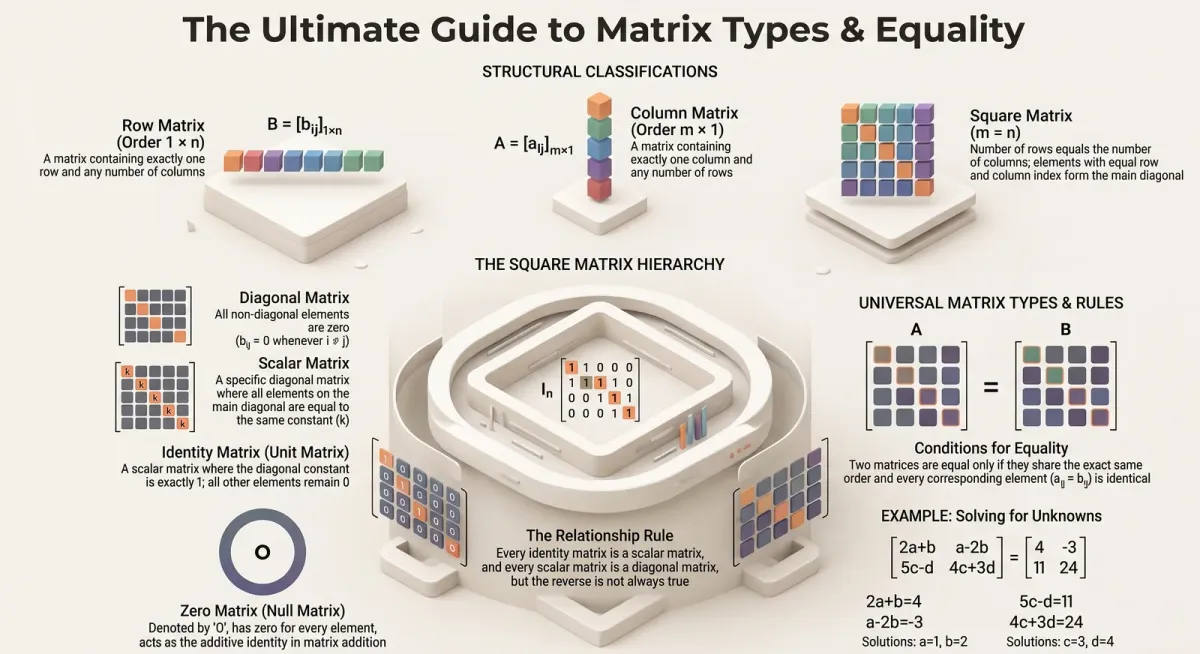
A matrix is called a column matrix if it has only one column. It is of order m × 1.
A = |  0  |
    | √3  |
    | -1  |
    | 1/2 |
This matrix has order 4 × 1 and is a column matrix. In general, A = [aij]_{m×1} is a column matrix.
Row Matrix
A matrix is called a row matrix if it has only one row. It is of order 1 × n.
B = [ -1/2 √5 2 3 ]This is a row matrix of order 1 × 4. In general, B = [bij]_{1×n} is a row matrix.
Exam Tip: A row matrix has exactly one row and any number of columns. A column matrix has exactly one column and any number of rows.
Square Matrix
A matrix in which the number of rows equals the number of columns is called a square matrix. An m × n matrix is square if m = n, and it is called a square matrix of order n.
A = |  3   -1   0 |
    | 3/2  3√2  1 |
    |  4    3  -1 |
This is a square matrix of order 3.
The Diagonal of a Square Matrix
For a square matrix A = [aij] of order n, the elements a₁₁, a₂₂, a₃₃, …, aₙₙ form the diagonal (also called the principal diagonal or main diagonal).
For example, if A = [[1, -3, 1], [2, 4, -1], [3, 5, 6]], then the diagonal elements are 1, 4, 6.
Diagonal Matrix
A square matrix B = [bij] is called a diagonal matrix if all non-diagonal elements are zero — that is, bij = 0 whenever i ≠ j.
Examples of diagonal matrices of order 1, 2, and 3:
A = [4],    B = | -1  0 |,    C = | -1.1  0  0 |
               |  0  2 |         |  0    2  0 |
                                  |  0    0  3 |
Note that diagonal elements can be any value — only off-diagonal elements must be zero.
Scalar Matrix
A scalar matrix is a diagonal matrix in which all diagonal elements are equal. That is, B = [bij] is scalar if:
-
bij = 0 when i ≠ j (off-diagonal elements are zero)
-
bij = k when i = j (all diagonal elements equal the same constant k)
A = [3],    B = | -1   0 |,    C = | √3  0   0  |
               |  0  -1 |         |  0  √3  0  |
                                   |  0   0  √3 |
All three are scalar matrices — A of order 1, B of order 2, C of order 3.
Key Insight: Every scalar matrix is a diagonal matrix, but not every diagonal matrix is a scalar matrix.
Identity Matrix
An identity matrix (also called a unit matrix) is a square matrix in which:
-
All diagonal elements are 1
-
All other elements are 0
Formally, A = [aij]_{n×n} is the identity matrix if aij = 1 when i = j, and aij = 0 when i ≠ j.
We denote the identity matrix of order n as Iₙ.
I₁ = [1],    I₂ = | 1  0 |,    I₃ = | 1  0  0 |
                   | 0  1 |          | 0  1  0 |
                                     | 0  0  1 |
Key Insight: Every identity matrix is a scalar matrix (with k = 1), but not every scalar matrix is an identity matrix.
Zero Matrix (Null Matrix)
A matrix in which all elements are zero is called a zero matrix or null matrix, denoted by O.
[0],    | 0  0 |,    | 0  0  0 |,    [0  0]
        | 0  0 |     | 0  0  0 |
All of the above are zero matrices of different orders. The order is determined by context.
Note: The zero matrix plays the role of the additive identity in matrix addition — adding any matrix to a zero matrix of the same order returns the original matrix unchanged.
Equality of Matrices
Two matrices A = [aij] and B = [bij] are said to be equal if and only if:
-
They are of the same order (same number of rows and columns)
-
Every corresponding element is equal: aij = bij for all valid i and j
Worked Example
If [[x, y], [z, a]] = [[-1.5, 0], [2, √6]], then by equality: x = −1.5, y = 0, z = 2, a = √6.
Important: Two matrices with different orders can never be equal, even if they contain the same numbers. For instance, [[2, 3], [0, 1]] and [[2, 3, 0], [1, 0, 0]] are not equal because their orders differ.
Using Equality to Solve for Unknowns
CBSE board questions frequently present two equal matrices and ask you to find unknown variables. Equate corresponding elements and solve the resulting system of equations — this is a reliable 3-mark question type.
Example: If [[2a+b, a−2b], [5c−d, 4c+3d]] = [[4, −3], [11, 24]], find a, b, c, d.
Equating elements: 2a+b = 4, a−2b = −3, 5c−d = 11, 4c+3d = 24. Solving these pairs gives a = 1, b = 2, c = 3, d = 4.
Suggested Reading on ChampionsPrep
-
What is a Matrix? Definition, Order, and Notation — Class 12 Guide
-
Matrix Operations: Addition, Subtraction, and Scalar Multiplication
-
Symmetric and Skew Symmetric Matrices — Full Explanation
Test Your Knowledge
Practice Makes Perfect
Being able to quickly identify matrix types and apply the equality condition is a skill that pays dividends across every section of this chapter. Train your recognition speed with targeted practice.
Attempt 100+ MCQs and long-form questions on Matrix Types at ChampionsPrep . Board-aligned, instant feedback, just ₹10 per use.
Types of Matrices Explained with Examples | Class 12 CBSE Maths
Frequently Asked Questions
What is a square matrix? +
A square matrix is a matrix in which the number of rows equals the number of columns. An m × n matrix is square when m = n and is called a square matrix of order n.
What is the difference between a diagonal matrix and a scalar matrix? +
A diagonal matrix has all non-diagonal elements equal to zero, but diagonal elements can be different. A scalar matrix is a special diagonal matrix where all diagonal elements are equal to the same constant k.
What is an identity matrix? +
An identity matrix is a square matrix in which all diagonal elements are 1 and all other elements are 0. It is denoted by In for order n and acts as the multiplicative identity in matrix multiplication.
When are two matrices said to be equal? +
Two matrices A and B are equal if they have the same order and every corresponding element is equal, that is aij = bij for all i and j.
What is a zero matrix? +
A zero matrix, also called a null matrix, is a matrix in which all elements are zero. It is denoted by O and acts as the additive identity in matrix addition.
AI-powered practice — free to start