
The hyperbola is the last of the four conic sections in Chapter 10, and the one whose two-branch shape sets it apart from the circle, ellipse, and parabola. Where an ellipse is built on a constant sum of distances to two foci, a hyperbola is built on a constant difference. This post defines the hyperbola, derives its standard equation, and works through eccentricity and latus rectum calculations with exam-style examples.
Definition of a Hyperbola
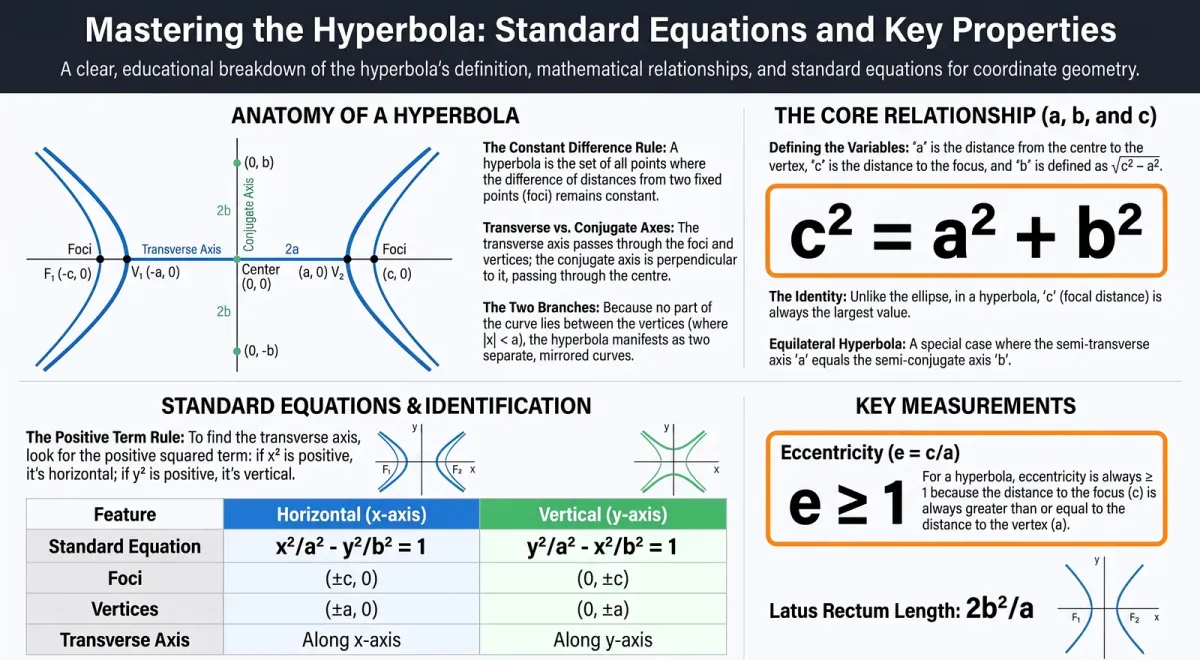
A hyperbola is the set of all points where the difference of distances from two fixed points is constant. These fixed points are the foci. “Difference” here means the distance to the farther focus minus the distance to the closer one.
The midpoint of the segment joining the foci is the centre of the hyperbola. The line through the foci is the transverse axis, and the line through the centre, perpendicular to the transverse axis, is the conjugate axis. The points where the hyperbola crosses the transverse axis are the vertices.
Relating a, b, and c
Let 2c be the distance between the two foci, and 2a the distance between the two vertices (the length of the transverse axis). Define b by:
b = √(c² − a²)
Here, 2b is the length of the conjugate axis. Rearranging gives the relationship you’ll use constantly:
c² = a² + b²
Notice this is the mirror image of the ellipse’s a² = b² + c² relationship — in a hyperbola, c is the largest of the three quantities, not a.
Eccentricity of a Hyperbola
Just as with the ellipse, the eccentricity is defined as:
e = c/a
But because c is always greater than a in a hyperbola (unlike an ellipse, where c < a), the eccentricity of a hyperbola is always greater than 1. In terms of eccentricity, the foci sit at a distance of ae from the centre.
The Two Standard Equations of a Hyperbola
Depending on whether the transverse axis lies along the x-axis or the y-axis, there are two standard forms, both centred at the origin:
| Equation | Transverse Axis | Foci | Vertices |
|---|---|---|---|
| x²/a² − y²/b² = 1 | x-axis | (±c, 0) | (±a, 0) |
| y²/a² − x²/b² = 1 | y-axis | (0, ±c) | (0, ±a) |
Key identification rule: unlike the ellipse, you don’t compare denominators to find the transverse axis — instead, look at which squared term is positive. If the x² term is positive, the transverse axis is along the x-axis; if the y² term is positive, it’s along the y-axis.
Note: A hyperbola in which a = b is called an equilateral hyperbola.
For the horizontal form x²/a² − y²/b² = 1, every point (x, y) satisfies |x| ≥ a — no part of the curve lies between the lines x = −a and x = a. For the vertical form y²/a² − x²/b² = 1 the same reasoning gives |y| ≥ a. That is exactly why the hyperbola has two separate branches rather than one continuous curve like the ellipse.
Latus Rectum of a Hyperbola
The latus rectum is a line segment perpendicular to the transverse axis, passing through a focus, with both endpoints on the hyperbola. Just as with the ellipse, its length for x²/a² − y²/b² = 1 is:
2b²/a
Worked Example: Extracting Hyperbola Features from a Given Equation
Example: Find the coordinates of the foci and vertices, the eccentricity, and the latus rectum length of the hyperbola x²/9 − y²/16 = 1.
Solution: Comparing with x²/a² − y²/b² = 1: a = 3, b = 4.
Using c² = a² + b² = 9 + 16 = 25, so c = 5.
-
Foci: (±5, 0)
-
Vertices: (±3, 0)
-
Eccentricity: e = c/a = 5/3
-
Latus rectum: 2b²/a = 32/3
Worked Example: Building the Equation from Given Conditions
Example: Find the equation of the hyperbola with foci (0, ±12) and latus rectum length 36.
Solution: Since the foci are (0, ±12), the transverse axis lies along the y-axis, so c = 12, and the equation takes the form y²/a² − x²/b² = 1.
From the latus rectum formula:
2b²/a = 36, so b² = 18a
Using c² = a² + b²:
144 = a² + 18a
a² + 18a − 144 = 0
Solving this quadratic gives a = 6 or a = −24. Since a cannot be negative, a = 6, and therefore b² = 108.
The required equation is:
y²/36 − x²/108 = 1
Key Takeaways
-
A hyperbola is defined by a constant difference of distances from two foci, unlike an ellipse’s constant sum.
-
The relationship c² = a² + b² connects the semi-transverse axis, semi-conjugate axis, and focal distance.
-
Eccentricity e = c/a is always strictly greater than 1 for a hyperbola, unlike the ellipse where 0 < e < 1.
-
To identify the transverse axis, check which squared term (x² or y²) is positive — not which denominator is larger, as with the ellipse.
-
Latus rectum length is 2b²/a, the same formula structure as for the ellipse.
Keep Learning: Explore the Rest of This Series
-
Sections of a Cone: Circle, Ellipse, Parabola & Hyperbola Explained (Class 11 Maths)
-
Circle: Definition, Equation, Centre and Radius Explained (Class 11 Maths)
-
Parabola: Standard Equations, Focus, Directrix and Latus Rectum (Class 11 Maths)
-
Ellipse: Standard Equations, Eccentricity and Latus Rectum (Class 11 Maths)
Practise Hyperbola Problems With ChampionsPrep
Want structured practice on extracting foci, eccentricity, and latus rectum from a hyperbola’s equation, or constructing equations from given conditions? ChampionsPrep offers AI-powered, NCERT-aligned question banks for CBSE and Maharashtra Board Class XI–XII Commerce students, plus prep for CUET, IPMAT, JIPMAT, NPAT, SET. Registration is free, and you pay only as you use the platform. Start practising Hyperbolas on ChampionsPrep.
Test Your Knowledge
Hyperbola: Standard Equations, Eccentricity and Latus Rectum
Frequently Asked Questions
What is the standard equation of a hyperbola? +
With transverse axis along the x-axis: x²/a² − y²/b² = 1. With transverse axis along the y-axis: y²/a² − x²/b² = 1. Both are centred at the origin, with c² = a² + b².
What is the difference between an ellipse and a hyperbola? +
An ellipse is defined by a constant sum of distances from two foci and forms one closed curve. A hyperbola is defined by a constant difference of distances from two foci and forms two separate open branches.
Why is the eccentricity of a hyperbola always greater than 1? +
Because c > a always holds for a hyperbola (unlike an ellipse, where c < a), the ratio e = c/a is always greater than 1. The value e = 1 belongs to the parabola, not the hyperbola.
What is an equilateral hyperbola? +
An equilateral hyperbola is a special case where the semi-transverse axis equals the semi-conjugate axis, i.e., a = b.
How do you identify which axis is the transverse axis from the equation? +
Check which squared term carries a positive sign. If x² is positive (and y² negative), the transverse axis is along the x-axis. If y² is positive (and x² negative), it's along the y-axis.
AI-powered practice — free to start