
A parabola is the curve you get when you throw a ball, design a satellite dish, or shape a headlight reflector. In Chapter 10 of CBSE Class 11 Mathematics, the parabola is defined purely in terms of distances — a point and a line — and four standard equations emerge covering every orientation. This post derives the parabola’s defining equation, explains the four standard forms, and works through focus, directrix, axis, and latus rectum calculations.
Definition of a Parabola
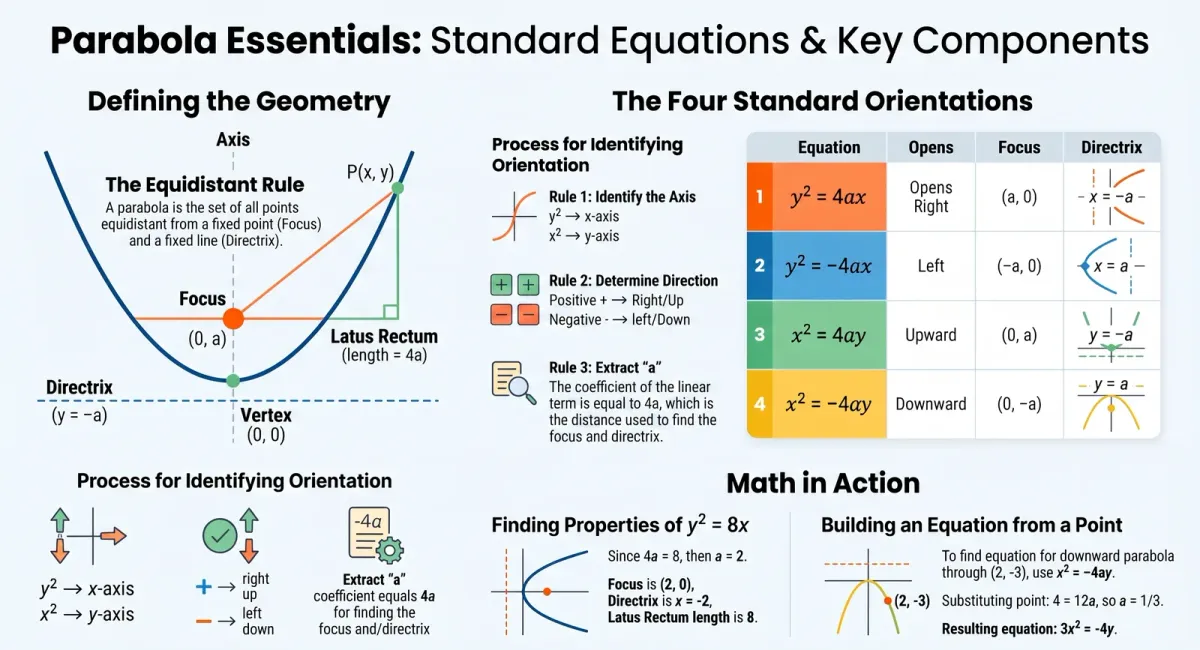
A parabola is the set of all points equidistant from a fixed line and a fixed point not on it. The fixed point is the focus, and the fixed line is the directrix.
The name comes from the Greek parabole — paraballein, “to throw beside” — fitting for the arc a thrown object traces.
A line through the focus, perpendicular to the directrix, is the axis. Where the parabola crosses its axis is the vertex.
Note: If the fixed point lay on the fixed line, the equidistant points would collapse into a single straight line — the degenerate case covered in our overview post.
Deriving the Standard Equation
Consider a parabola with focus F(a, 0), a > 0, and directrix x = −a. Take the vertex at the origin, with the x-axis as the axis. For any point P(x, y) on the parabola, the defining condition is:
PF = PB
where PB is the perpendicular distance from P to the directrix, and B has coordinates (−a, y).
Using the distance formula:
PF = √[(x − a)² + y²] and PB = √[(x + a)²]
Setting PF = PB and squaring:
(x − a)² + y² = (x + a)²
Expanding and simplifying:
x² − 2ax + a² + y² = x² + 2ax + a²
y² = 4ax
This is the standard equation of a parabola opening right, vertex at origin, focus at (a, 0), directrix x = −a.
The Four Standard Equations of a Parabola
Depending on axis direction and opening, there are exactly four standard forms, each with vertex at the origin:
| Equation | Focus | Directrix | Opens |
|---|---|---|---|
| y² = 4ax | (a, 0) | x = −a | Right |
| y² = −4ax | (−a, 0) | x = a | Left |
| x² = 4ay | (0, a) | y = −a | Upward |
| x² = −4ay | (0, −a) | y = a | Downward |
How to Identify Orientation Quickly
Three rules let you read a parabola’s shape directly from its equation:
-
Which variable is squared decides the axis. y² means the axis lies along the x-axis; x² means it lies along the y-axis.
-
The sign of the linear term decides direction. For a y²-term equation, positive means opens right, negative means left. For x²-term, positive means upward, negative downward.
-
The coefficient (4a) gives “a” directly, which then hands you the focus, directrix, and latus rectum in one step.
Latus Rectum of a Parabola
The latus rectum is a line segment perpendicular to the axis, through the focus, with both endpoints on the parabola. For y² = 4ax, its length works out to exactly 4a.
This follows directly: if A is one endpoint, symmetry about the x-axis means the focal chord through F(a, 0) has half-length equal to the focal distance, so doubling it gives 4a.
Worked Example: Finding Focus, Axis, Directrix and Latus Rectum
Example: Find the coordinates of the focus, the axis, the directrix, and the latus rectum length of y² = 8x.
Solution: The equation involves y², so the axis lies along the x-axis, and since the coefficient of x is positive, the parabola opens right.
Comparing y² = 8x with y² = 4ax gives 4a = 8, so a = 2.
-
Focus: (2, 0)
-
Directrix: x = −2
-
Latus rectum: 4a = 4 × 2 = 8
Worked Example: Building the Equation from Given Conditions
Example: Find the equation of the parabola symmetric about the y-axis, passing through (2, −3).
Solution: Since the parabola is symmetric about the y-axis with vertex at origin, its equation is x² = 4ay or x² = −4ay. Because (2, −3) lies in the fourth quadrant, it must open downward, so the equation is x² = −4ay.
Substituting (2, −3):
2² = −4a(−3)
4 = 12a
a = 1/3
Therefore, the equation is:
x² = −4(1/3)y
3x² = −4y
This “identify the form first, substitute the point to solve for a” strategy works for almost every parabola-construction problem you’ll meet.
Key Takeaways
-
A parabola is defined by equal distances from a fixed point (focus) and a fixed line (directrix).
-
There are exactly four standard equations, distinguished by which variable is squared and the sign of the other term.
-
The latus rectum length for y² = 4ax, or any variant, is always 4a.
-
When building an equation from given conditions, fix the standard form using symmetry and the point’s quadrant, then solve for “a”.
Keep Learning: Explore the Rest of This Series
-
Sections of a Cone: Circle, Ellipse, Parabola & Hyperbola Explained (Class 11 Maths)
-
Circle: Definition, Equation, Centre and Radius Explained (Class 11 Maths)
Practise Parabola Problems With ChampionsPrep
Want structured practice on identifying standard forms, computing focus and directrix, or building equations from given conditions? ChampionsPrep offers AI-powered, NCERT-aligned question banks for CBSE and Maharashtra Board Class XI–XII Commerce students, plus prep for CUET, IPMAT, JIPMAT, NPAT, SET. Registration is free, and you only pay as you use the platform. Start practising Parabolas on ChampionsPrep.
Test Your Knowledge
Parabola: Standard Equations, Focus, Directrix and Latus Rectum
Frequently Asked Questions
What is the standard equation of a parabola with vertex at the origin? +
Depending on orientation: y² = 4ax, y² = −4ax, x² = 4ay, or x² = −4ay, where a is the distance from vertex to focus.
What is the latus rectum of a parabola? +
A segment perpendicular to the parabola's axis, through the focus, with both endpoints on the curve. Its length equals 4a for y² = 4ax.
How do you determine which way a parabola opens from its equation? +
If y² is present, the axis lies along the x-axis; it opens right if the x-coefficient is positive, left if negative. If x² is present, the axis lies along the y-axis; upward if positive, downward if negative.
What is the difference between the focus and the vertex of a parabola? +
The vertex is where the parabola meets its own axis (the origin, in standard form). The focus is a fixed point inside the curve, at distance "a" from the vertex, used in its defining condition.
Can the focus of a parabola lie on the directrix? +
No. The focus and directrix are a fixed point not on the fixed line. If they coincided, the "parabola" would collapse into a straight line through that point, perpendicular to the given line.
AI-powered practice — free to start