
Of the four conic sections in Chapter 10, the circle is the one you’ve known the longest — but Class 11 Maths asks you to derive its equation algebraically using the distance formula. This post covers the formal definition of a circle, derives its standard equation, and shows how to extract the centre and radius from an expanded (general) equation.
Definition of a Circle
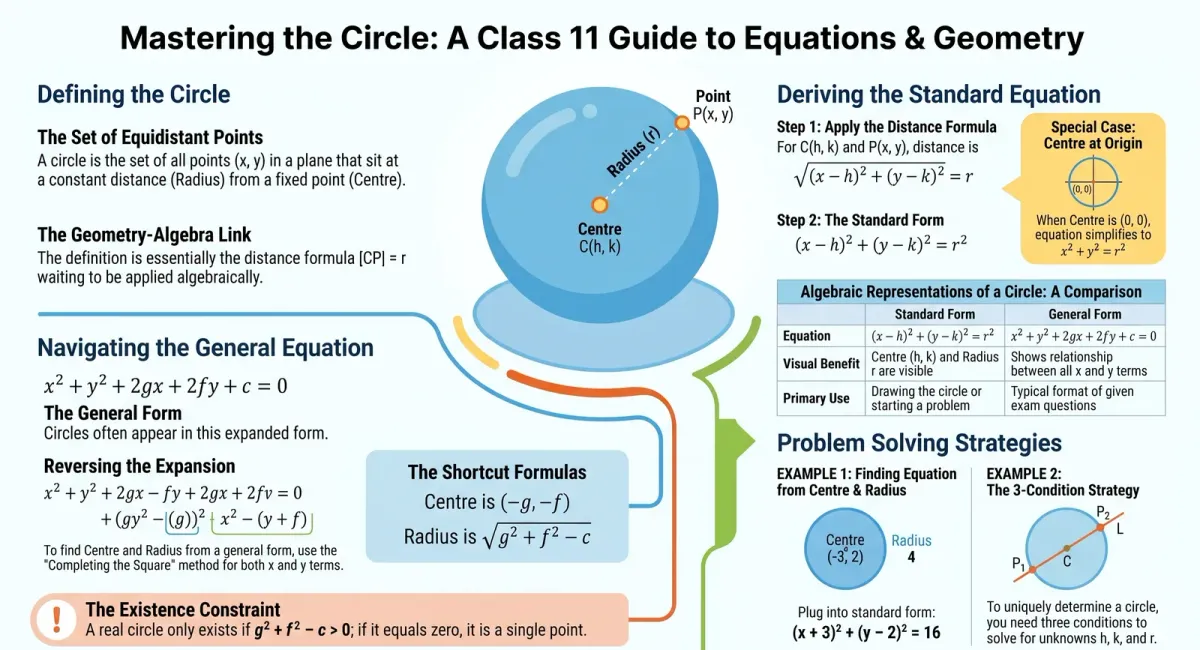
A circle is the set of all points in a plane that are equidistant from one fixed point. This fixed point is the centre, and the constant distance to any point on the circle is the radius.
This definition is really the distance formula waiting to be applied. Fix a centre point and demand every point on your curve sits exactly the same distance from it, and geometry guarantees a perfect circle.
Deriving the Standard Equation of a Circle
Let the centre be C(h, k) and the radius be r. Take any point P(x, y) on the circle. By the definition above, the distance from C to P must always equal r:
|CP| = r
Applying the distance formula between C(h, k) and P(x, y):
√[(x − h)² + (y − k)²] = r
Squaring both sides gives the standard equation of a circle:
(x − h)² + (y − k)² = r²
This single equation captures every circle in this chapter — just plug in the specific centre (h, k) and radius r.
Special Case: Centre at the Origin
When the centre coincides with the origin, h = 0 and k = 0, and the equation simplifies to:
x² + y² = r²
This form appears constantly in problems involving symmetry about both axes.
Worked Example: Finding the Equation from Centre and Radius
Example: Find the equation of the circle with centre (−3, 2) and radius 4.
Solution: Here h = −3, k = 2, r = 4. Substituting into the standard form:
(x − (−3))² + (y − 2)² = 4²
(x + 3)² + (y − 2)² = 16
That’s the complete equation, unless the question specifically asks for the general (expanded) form.
Going the Other Way: Finding Centre and Radius from the General Equation
Exam questions often give a circle’s equation already expanded, mixing x², y², x, y, and a constant together. Your job is to reverse-engineer the centre and radius using completing the square.
Example: Find the centre and radius of the circle x² + y² + 8x + 10y − 8 = 0.
Solution: Group the x-terms and y-terms, moving the constant to the other side:
(x² + 8x) + (y² + 10y) = 8
Now complete the square within each bracket. For x² + 8x, half of 8 is 4, and 4² = 16. For y² + 10y, half of 10 is 5, and 5² = 25. Add both to each side:
(x² + 8x + 16) + (y² + 10y + 25) = 8 + 16 + 25
(x + 4)² + (y + 5)² = 49
Rewriting to match the standard form:
{x − (−4)}² + {y − (−5)}² = 7²
Comparing with (x − h)² + (y − k)² = r², the circle has centre (−4, −5) and radius 7.
This method works for any equation x² + y² + 2gx + 2fy + c = 0, representing a circle with centre (−g, −f) and radius √(g² + f² − c), provided g² + f² − c is positive.
Worked Example: Circle Through Two Points with a Constrained Centre
A common exam question gives two points the circle passes through, plus a line the centre must lie on.
Example: Find the equation of the circle passing through the points (2, −2) and (3, 4), given that the centre lies on the line x + y = 2.
Solution: Let the circle’s equation be (x − h)² + (y − k)² = r². Since it passes through both points, each must satisfy this equation:
(2 − h)² + (−2 − k)² = r² … (1)
(3 − h)² + (4 − k)² = r² … (2)
Since the centre lies on x + y = 2:
h + k = 2 … (3)
Solving (1), (2), and (3) together (expand (1) and (2), subtract to eliminate r², then combine with (3)) gives h = 0.7, k = 1.3, r² = 12.58. The required equation is:
(x − 0.7)² + (y − 1.3)² = 12.58
This three-equation strategy — two points on the circle plus a centre constraint — is frequently tested, worth practising until the elimination steps become automatic.
Key Takeaways
-
A circle’s equation needs just two things: its centre (h, k) and radius r.
-
The standard form (x − h)² + (y − k)² = r² comes directly from the distance formula applied to the circle’s definition.
-
Given a general/expanded equation, complete the square on x-terms and y-terms to recover the centre and radius.
-
Problems with points on the circle plus a centre constraint reduce to a system of equations — eliminate r² early.
Keep Learning: Explore the Rest of This Series
Practise Circle Equations With ChampionsPrep
Want unlimited practice on finding a circle’s equation from its centre, radius, or constrained conditions? ChampionsPrep delivers AI-powered, NCERT-aligned question banks for CBSE and Maharashtra Board Class XI–XII Commerce students, plus prep for CUET, IPMAT, JIPMAT, NPAT, and SET. Registration is free, and you only pay as you use the platform. Start practising Circles on ChampionsPrep.
Test Your Knowledge
Circle: Definition, Equation, Centre and Radius Explained
Frequently Asked Questions
What is the standard equation of a circle? +
For centre (h, k) and radius r, it is (x − h)² + (y − k)² = r². At the origin, this simplifies to x² + y² = r².
How do you find the centre and radius from the general equation of a circle? +
Rewrite x² + y² + 2gx + 2fy + c = 0 by completing the square on x-terms and y-terms. The centre is (−g, −f), radius √(g² + f² − c).
Can any equation of the form x² + y² + 2gx + 2fy + c = 0 represent a circle? +
Only if g² + f² − c > 0. If it equals zero, the "circle" shrinks to a point; if negative, no real circle exists.
How many conditions are needed to uniquely determine a circle's equation? +
Three, since a circle's equation has three unknowns: h, k, r (or g, f, c in general form).
What is the difference between the standard form and the general form of a circle's equation? +
Standard form directly displays the centre and radius. General form is the same equation expanded out, needing completion of the square to identify them.
AI-powered practice — free to start