
An ellipse is the shape traced by every planet orbiting the sun, the profile of a whispering gallery’s walls, and the cross-section of a cylinder sliced at an angle. Chapter 10 of CBSE Class 11 Mathematics defines the ellipse through one property involving distances to two fixed points, building up to two standard equations, eccentricity, and the latus rectum. This post covers all of it, with worked examples matching typical exam patterns.
Definition of an Ellipse
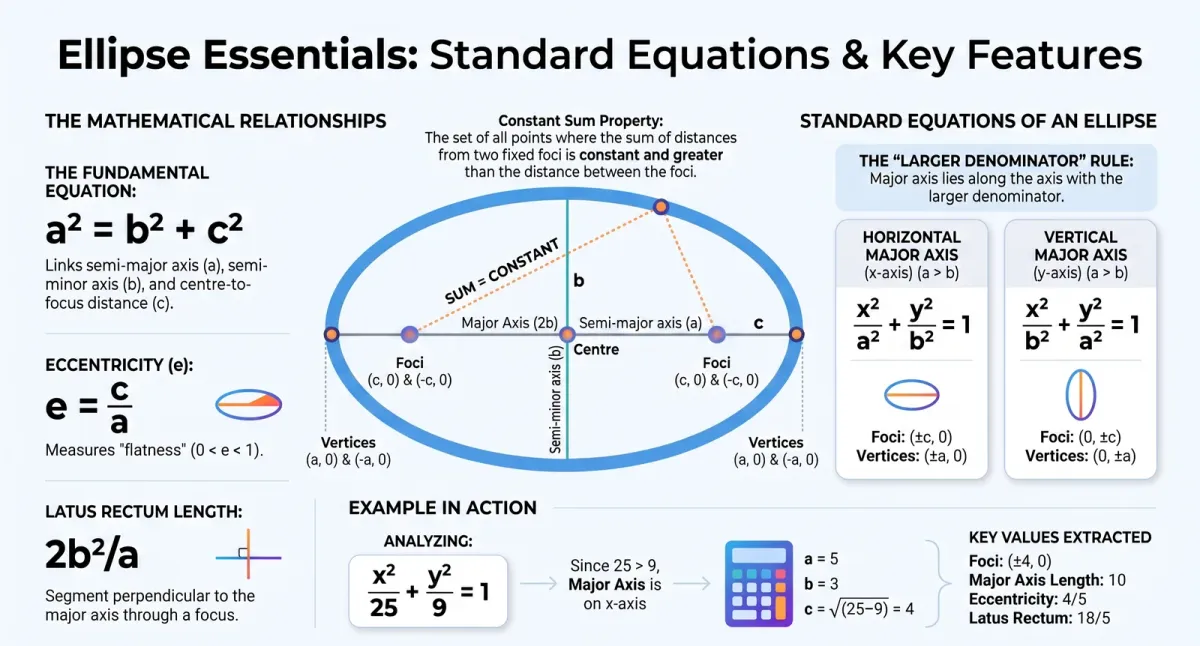
An ellipse is the set of all points in a plane such that the sum of distances from two fixed points is constant. These two fixed points are the foci (plural of focus).
Note: This constant sum is always greater than the distance between the two foci, otherwise no such curve could exist.
The midpoint of the segment joining the foci is the centre. The segment through both foci is the major axis, and the segment through the centre, perpendicular to it, is the minor axis. Where the ellipse meets the major axis are the vertices.
Relating Semi-Major Axis, Semi-Minor Axis, and Focal Distance
Let 2a be the major axis length, 2b the minor axis length, and 2c the distance between foci. A point P at one end of the major axis gives a distance-sum of (c + a) + (a − c) = 2a. A point Q at one end of the minor axis gives, by symmetry, a sum of 2√(b² + c²).
Since both points lie on the ellipse, these sums must be equal:
2√(b² + c²) = 2a
Squaring gives the fundamental relationship:
a² = b² + c², or equivalently c = √(a² − b²)
This relationship drives nearly every ellipse calculation in this chapter — given any two of a, b, and c, you can find the third.
Eccentricity of an Ellipse
The eccentricity (e) of an ellipse is the ratio of the distance from centre to focus, to the distance from centre to vertex:
e = c/a
Since 0 < c < a for any genuine ellipse, e always satisfies 0 < e < 1. In terms of e, each focus sits at distance ae from the centre — a useful shortcut when eccentricity is given directly instead of c.
The Two Standard Equations of an Ellipse
Depending on whether the major axis lies along the x-axis or y-axis, there are two standard forms, both centred at the origin:
| Equation | Major Axis | Foci | Condition |
|---|---|---|---|
| x²/a² + y²/b² = 1 | x-axis | (±c, 0) | a > b |
| x²/b² + y²/a² = 1 | y-axis | (0, ±c) | a > b |
The key rule for telling these apart: the major axis lies along whichever axis has the larger denominator. If the x² term has the bigger denominator, the major axis is horizontal; if y² has it, vertical.
Latus Rectum of an Ellipse
The latus rectum is a segment perpendicular to the major axis, through a focus, with both endpoints on the ellipse. For x²/a² + y²/b² = 1, its length is:
2b²/a
This value shows up frequently in “find all key features” style exam questions, worth memorising alongside a² = b² + c².
Worked Example: Extracting Ellipse Features from a Given Equation
Example: Find the coordinates of the foci, the vertices, the length of the major and minor axes, the eccentricity, and the latus rectum of the ellipse x²/25 + y²/9 = 1.
Solution: Since the denominator under x² (25) is larger than under y² (9), the major axis lies along the x-axis. Comparing with x²/a² + y²/b² = 1: a = 5, b = 3. Using c = √(a² − b²) = √(25 − 9) = √16 = 4.
-
Foci: (−4, 0) and (4, 0)
-
Vertices: (−5, 0) and (5, 0)
-
Major axis length: 2a = 10
-
Minor axis length: 2b = 6
-
Eccentricity: e = c/a = 4/5
-
Latus rectum: 2b²/a = 18/5
Worked Example: Building the Equation from Given Conditions
Example: Find the equation of the ellipse whose vertices are (±13, 0) and whose foci are (±5, 0).
Solution: Since the vertices lie on the x-axis, the major axis is horizontal, so the equation takes the form x²/a² + y²/b² = 1.
Given a = 13, c = 5. Using c² = a² − b²:
25 = 169 − b²
b² = 144
Therefore, the equation of the ellipse is:
x²/169 + y²/144 = 1
This “identify which axis is major from the given points, then use a² = b² + c² for the missing value” approach solves most ellipse-construction problems.
Key Takeaways
-
An ellipse is defined by a constant sum of distances from two foci, unlike a circle’s single fixed centre.
-
a² = b² + c² connects the semi-major axis, semi-minor axis, and focal distance — the starting point for almost every calculation.
-
Eccentricity e = c/a always lies strictly between 0 and 1.
-
The major axis lies along the axis with the larger denominator in the standard equation.
-
Latus rectum length is 2b²/a, regardless of which axis is major.
Keep Learning: Explore the Rest of This Series
-
Sections of a Cone: Circle, Ellipse, Parabola & Hyperbola Explained (Class 11 Maths)
-
Circle: Definition, Equation, Centre and Radius Explained (Class 11 Maths)
-
Parabola: Standard Equations, Focus, Directrix and Latus Rectum (Class 11 Maths)
Practise Ellipse Problems With ChampionsPrep
Want guided practice on extracting foci, eccentricity, and latus rectum from an ellipse’s equation, or constructing equations from given conditions? ChampionsPrep offers AI-powered, NCERT-aligned question banks for CBSE and Maharashtra Board Class XI–XII Commerce students, plus prep for CUET, IPMAT, JIPMAT, NPAT, SET. Registration is free, and you only pay as you use the platform. Start practising Ellipses on ChampionsPrep.
Test Your Knowledge
Ellipse: Standard Equations, Eccentricity and Latus Rectum
Frequently Asked Questions
What is the standard equation of an ellipse? +
With major axis along x-axis: x²/a² + y²/b² = 1 (a > b). With major axis along y-axis: x²/b² + y²/a² = 1 (a > b). Both centred at the origin.
How do you find the eccentricity of an ellipse? +
e = c/a, where c = √(a² − b²) is the distance from centre to focus and a is the semi-major axis. For any ellipse, 0 < e < 1.
How do you determine whether the major axis is along the x-axis or y-axis? +
Compare the two denominators. The major axis lies along whichever axis has the larger denominator under its squared term.
What is the length of the latus rectum of an ellipse? +
For the standard equation x²/a² + y²/b² = 1, the latus rectum length is 2b²/a.
Why is the eccentricity of an ellipse always less than 1? +
Because c is always strictly less than a for a genuine ellipse (foci lie strictly inside the curve, closer to the centre than the vertices), c/a is always less than 1.
AI-powered practice — free to start