
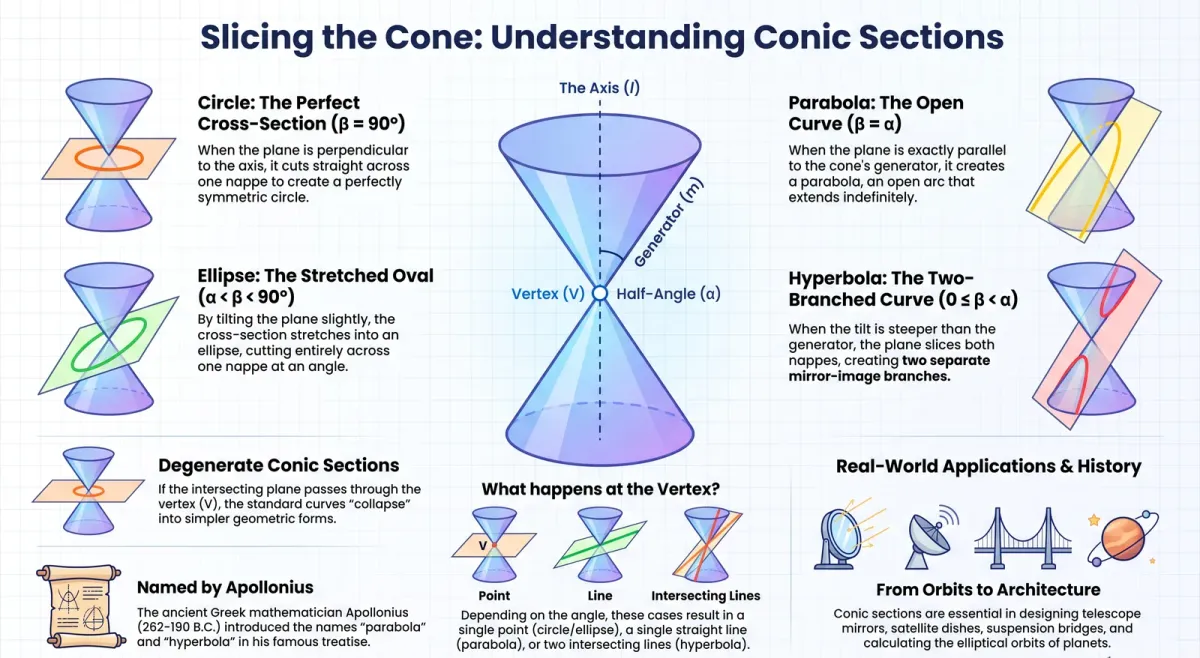
Every circle you’ve drawn with a compass, every parabolic arc a cricket ball traces through the air, and every elliptical orbit a planet follows around the sun belongs to a single family of curves called conic sections. Chapter 10 of the CBSE Class 11 NCERT Mathematics textbook opens with a simple idea: take a cone, slice it with a flat plane at different angles, and four different-looking curves fall out — the circle, the ellipse, the parabola, and the hyperbola. This post covers exactly how that slicing works, why the names “parabola” and “hyperbola” exist, and what happens when the slice passes through the cone’s vertex.
What Is a Double-Napped Cone?
Picture a fixed vertical line l and a second line m intersecting it at point V, tilted at a constant angle α to l. Rotate m around l, keeping α unchanged. The surface this traces, extending infinitely in both directions from V, is a double-napped right circular cone.
A few terms recur throughout the chapter:
-
Vertex (V): the point where the two halves of the cone meet.
-
Axis: the fixed line l about which the rotation happens.
-
Generator: the rotating line m; every position it passes through is a generator of the cone.
-
Nappe: the vertex splits the cone into an upper nappe and a lower nappe, two mirror-image shapes joined at one point.
What Is a Conic Section?
A conic section is the curve produced when a plane intersects this cone. Which curve results depends on the angle β the plane makes with the cone’s axis, and whether it passes through the vertex or cuts one or both nappes instead.
When the plane avoids the vertex and slices cleanly through the nappe, four curves are possible, governed by comparing β to α, the cone’s half-angle.
Circle: When β = 90°
If the intersecting plane is exactly perpendicular to the axis of the cone (β = 90°), the cross-section is a circle. This is the most symmetric case — the plane cuts straight across one nappe, parallel to the circular base, giving a curve where every point is equidistant from a central axis point.
Ellipse: When α < β < 90°
Tilt the plane slightly away from perpendicular, so β is still greater than α but less than 90°, and the circular cross-section stretches into an ellipse. The plane still cuts entirely across one nappe, but at an angle, producing an oval rather than a perfect circle.
Parabola: When β = α
Something interesting happens when the plane becomes exactly parallel to one of the cone’s generators — when β equals α. The cross-section is now a parabola, an open curve extending indefinitely in one direction. The names “parabola” and “hyperbola” were introduced by the ancient Greek mathematician Apollonius. “Parabola” comes from the Greek parabolē, meaning “application” (from para, “beside”, and ballein, “to throw”); it refers to the application of areas that Apollonius used to describe the curve, not to the arc of a thrown ball, although a ball’s path is very nearly a parabola.
Hyperbola: When 0 ≤ β < α
If the plane tilts even further, so β is less than α (including β = 0, a plane parallel to the axis), it no longer cuts across just one nappe — it slices through both nappes simultaneously. The result is a hyperbola, a curve with two separate, mirror-image branches opening away from each other.
In each case, the plane never touches the vertex — it cuts entirely through the cone’s body (or both bodies, for the hyperbola).
Degenerate Conic Sections
What happens if the plane does pass through the vertex V? These special cases are called degenerate conic sections, and they mirror the same angle conditions described above, just collapsed down to simpler shapes:
-
A point: When α < β ≤ 90°, the plane touches the cone only at the vertex — the degenerate form of a circle or ellipse.
-
A straight line: When β = α, the plane contains one generator, and the “curve” is that line itself — the degenerate case of a parabola.
-
A pair of intersecting straight lines: When 0 ≤ β < α, the plane passes through the vertex and cuts both nappes, giving two lines crossing at V — the degenerate case of a hyperbola.
These forms rarely appear directly in exam problems, but understanding them clarifies why the standard equations behave the way they do — each curve is a limiting case of the same process.
Why This Chapter Matters
Once you understand how these four curves arise from one cone, the rest of Chapter 10 becomes far more intuitive. Each curve gets its own standard equation, derived using the distance formula and a defining geometric property — equidistance from a point for circles, from a point and a line for parabolas, and so on. We cover each equation, with worked examples, in the rest of this series.
Conic sections show up in telescope and antenna design, satellite dish shapes, planetary orbits, and suspension bridge cables — all explored in our applications post at the end of this series.
Ready to Master Conic Sections?
Struggling to visualise how one cone produces four curves, or want guided practice on every angle condition here? ChampionsPrep offers AI-powered, chapter-wise practice built from the NCERT syllabus for CBSE and Maharashtra Board Class XI–XII Commerce students, plus prep for CUET, IPMAT, JIPMAT, NPAT, and SET. Registration is free, and you only pay as you use the platform. Start practicing Conic Sections on ChampionsPrep.
Test Your Knowledge
Sections of a Cone: Circle, Ellipse, Parabola & Hyperbola Explained
Frequently Asked Questions
What are the four types of conic sections? +
The circle, ellipse, parabola, and hyperbola. Each arises from intersecting a double-napped right circular cone with a plane at a different angle relative to the cone's axis.
What is the difference between a conic section and a degenerate conic section? +
A conic section occurs when the plane avoids the vertex. A degenerate conic occurs when the plane passes through the vertex, giving a point, a straight line, or a pair of intersecting lines instead.
Who gave the names "parabola" and "hyperbola"? +
The Greek mathematician Apollonius (262–190 B.C.) named the parabola and the hyperbola; his treatise on conic sections remained an important reference for centuries.
Why does a hyperbola have two branches while a parabola has only one? +
A parabola forms when the plane cuts only one nappe (β = α). A hyperbola cuts through both nappes at once (0 ≤ β < α), naturally producing two branches, one per nappe.
What angle condition produces a circle instead of an ellipse? +
A circle forms only when the plane is exactly perpendicular to the cone's axis (β = 90°). Any smaller angle, still greater than α, produces an ellipse instead.
AI-powered practice — free to start