
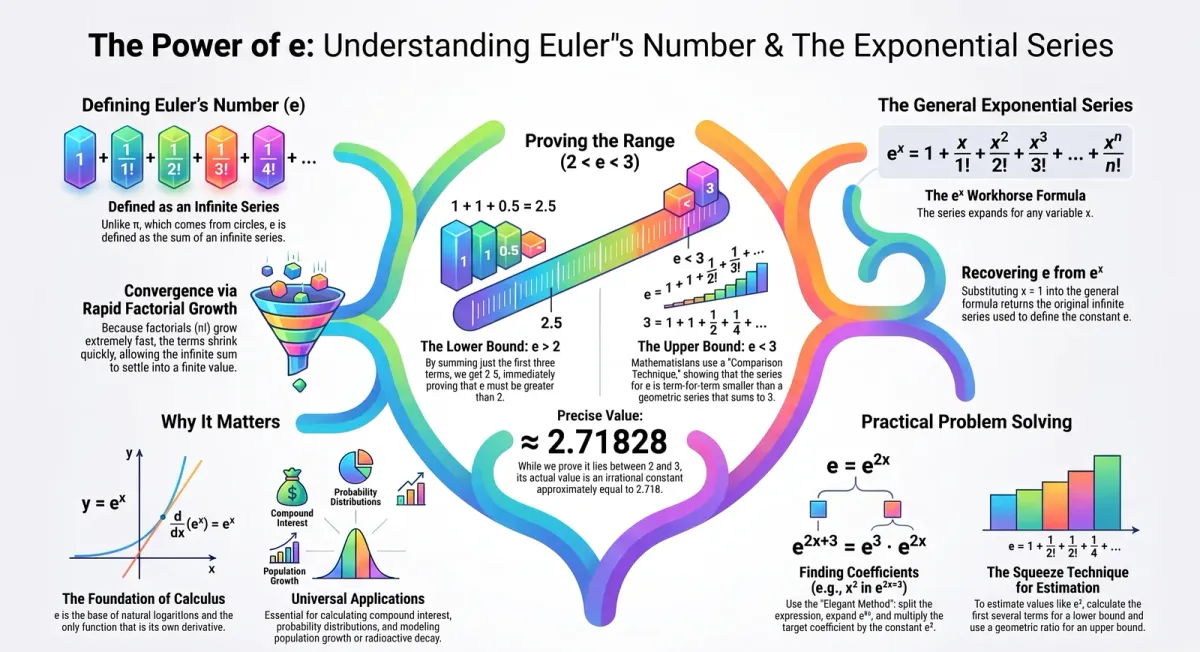
Every student encounters π early in geometry, tied to circles. Section A.1.4 introduces its calculus counterpart: the number e, first defined by Leonhard Euler in his 1748 calculus text. Unlike π, which arises from a geometric ratio, e is defined directly as the sum of an infinite series. This post explains how e is defined, proves its value lies between 2 and 3, introduces the general exponential series for eˣ, and works through two NCERT examples.
Defining the Number e as an Infinite Series
Consider the infinite series of numbers:
1 + 1/1! + 1/2! + 1/3! + 1/4! + …
The sum of this series is, by definition, the number e. Since factorials grow extremely fast, each term shrinks quickly, which is what allows this infinite series to settle to a finite sum in the first place — the same underlying principle seen in the infinite geometric series covered earlier in this appendix.
Proving That 2 < e < 3
NCERT proves the value lies in a specific range using a comparison technique. Since every term of the series is positive, e > 2 follows immediately from the first three terms (1 + 1 + 1/2 = 2.5). The more interesting bound is the upper limit.
Consider the two sums:
1/3! + 1/4! + 1/5! + … + 1/n! + … and 1/2² + 1/2³ + 1/2⁴ + … + 1/2ⁿ⁻¹ + …
Comparing term by term: 1/3! = 1/6 and 1/2² = 1/4, so 1/3! < 1/2²; similarly 1/4! = 1/24 < 1/2³ = 1/8, and 1/5! = 1/120 < 1/2⁴ = 1/16. By analogy, 1/n! < 1/2ⁿ⁻¹ for every n > 2. This means the entire sum (2) is less than the entire sum (3). The second sum is itself a geometric series with a = 1/4 and r = 1/2, which by the sum-to-infinity formula from the previous section equals (1/4)/(1 - 1/2) = 1/2.
Adding 1 + 1/1! + 1/2! = 1 + 1 + 1/2 = 5/2 to both sides of the inequality, the left-hand side becomes exactly the series defining e, while the right-hand side becomes 5/2 + 1/2 = 3. This proves e < 3, and combined with e > 2, gives 2 < e < 3.
The General Exponential Series for eˣ
Once e is defined, NCERT extends the idea to define an exponential series in a variable x:
eˣ = 1 + x/1! + x²/2! + x³/3! + … + xⁿ/n! + …
Putting x = 1 recovers the original series that defines e. This general formula is the workhorse for the two worked examples that follow — both involve substituting an expression in place of x and extracting a specific coefficient.
Worked Example 1: Coefficient of x² in e²ˣ⁺³
Problem. Find the coefficient of x² in the expansion of e²ˣ⁺³ as a series in powers of x.
Solution (elegant method). Write e²ˣ⁺³ = e³ · e²ˣ, splitting the constant part from the variable part. Now expand e²ˣ using the exponential series with x replaced by 2x:
e²ˣ = 1 + 2x/1! + (2x)²/2! + (2x)³/3! + …
The coefficient of x² inside this expansion is 2²/2! = 4/2 = 2. Multiplying by the constant factor e³ pulled out earlier gives the coefficient of x² in the full expression:
Coefficient of x² = e³ · (2²/2!) = 2e³
NCERT also demonstrates a longer, direct method — expanding (2x + 3)ⁿ/n! using the ordinary Binomial Theorem for each n, isolating the x² term, and summing the resulting series over all n from 2 onward. That approach also arrives at 2e³, but the factoring method e³ · e²ˣ shown above is far faster and is the preferred technique for this type of problem.
Worked Example 2: Estimating the Value of e²
Problem. Find the value of e², rounded off to one decimal place.
Solution. Substituting x = 2 into the exponential series:
e² = 1 + 2/1! + 2²/2! + 2³/3! + 2⁴/4! + 2⁵/5! + 2⁶/6! + …
Computing the first seven terms gives 1 + 2 + 2 + 4/3 + 2/3 + 4/15 + 4/45 + …, which totals at least 7.355. For an upper bound, NCERT groups the remaining terms (from the 2⁵/5! term onward) into a geometric-style bound using the ratio 2/6 = 1/3, arriving at an upper limit of 7 + 4/15 × [1/(1 - 1/3)] = 7 + 2/5 = 7.4.
Since e² lies between 7.355 and 7.4, its value rounded to one decimal place is 7.4. This same squeeze technique — bounding a series from below with a partial sum and from above using a geometric comparison — is the same method used earlier to prove 2 < e < 3.
Why This Matters Beyond Class 11
The number e reappears constantly in higher mathematics — in calculus, compound interest formulas, probability distributions, and growth/decay models. Section A.1.5 of this appendix, on the logarithmic series, builds directly on the exponential series covered here, since loge is the inverse of the exponential function.
Keep Learning: Related Reading
-
Infinite Series in Maths: Definition, Sequences & Sigma Notation Explained
-
Infinite Geometric Series: Sum to Infinity Formula & Solved Examples (Class 11 Maths)
-
Logarithmic Series: loge(1+x) Expansion, Formula & Solved Examples (Class 11 Maths)
Master the Exponential Series With ChampionsPrep
The exponential series bridges Class 11 Maths and the calculus that follows — and it shows up regularly in CUET, IPMAT, and JIPMAT quantitative sections. ChampionsPrep offers structured, NCERT-aligned practice for CBSE Class XI–XII Commerce students on exactly this kind of topic. Registration is completely free, and you only pay as you use the platform — start practising the exponential series today.
Test Your Knowledge

Exponential Series & Euler's Number e: Formula, Derivation & Examples (Class 11 Maths)
Frequently Asked Questions
What is the value of e in mathematics? +
Euler's number e is defined as the sum of the infinite series 1 + 1/1! + 1/2! + 1/3! + ..., and its value can be proved to lie between 2 and 3; more precisely, e ≈ 2.71828.
What is the general formula for the exponential series? +
The exponential series is eˣ = 1 + x/1! + x²/2! + x³/3! + ... + xⁿ/n! + ..., valid for every real value of x. Substituting x = 1 gives the series that defines e itself.
How do you prove that e is less than 3? +
By comparing the series 1/3! + 1/4! + ... term by term against the geometric series 1/2² + 1/2³ + ..., and showing 1/n! < 1/2ⁿ⁻¹ for n > 2. Since the geometric series sums to 1/2, adding the first three terms of e's series (5/2) gives an upper bound of 3.
How do you find the coefficient of x² in e²ˣ⁺³? +
Split e²ˣ⁺³ as e³ · e²ˣ, then expand e²ˣ using the exponential series with 2x in place of x. The coefficient of x² in that expansion is 2²/2!, so the overall coefficient is e³ · 2²/2! = 2e³.
Why is the number e important beyond this chapter? +
The number e is the base of natural logarithms, appears throughout calculus as the function equal to its own derivative, and is fundamental to compound interest, exponential growth and decay, and probability theory — making the exponential series one of the most widely used tools in higher mathematics.
AI-powered practice — free to start