
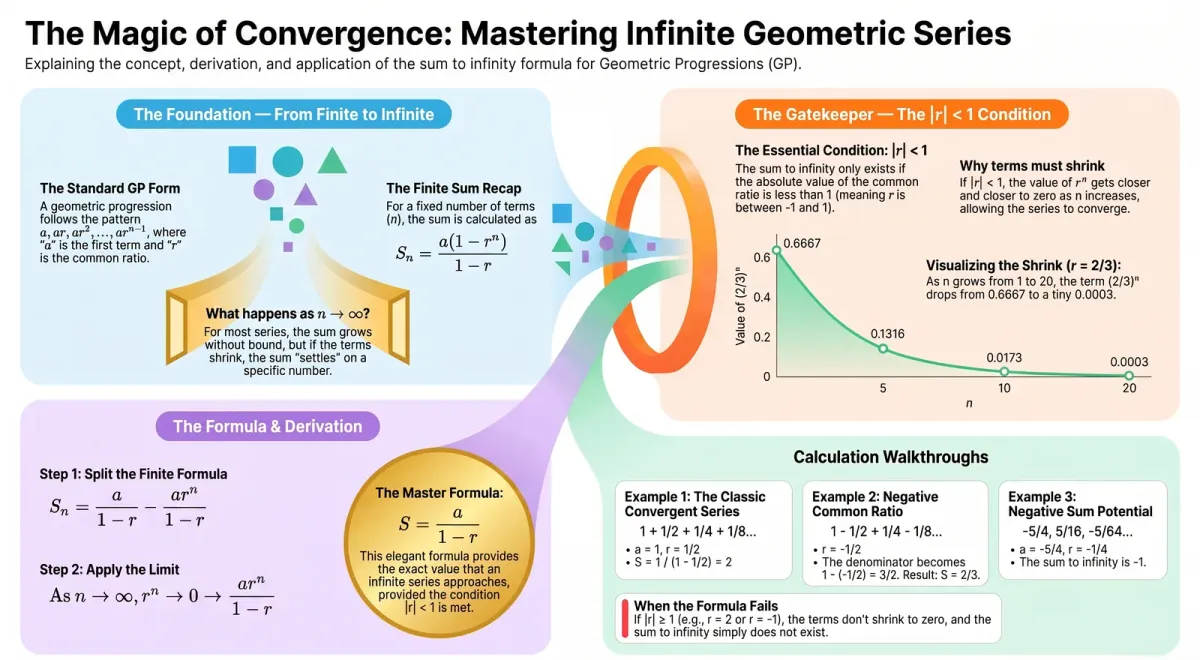
Chapter 9 of the NCERT Class 11 Maths textbook teaches how to sum a geometric progression (GP) with a fixed number of terms, using the formula Sₙ = a(1 - rⁿ)/(1 - r). Section A.1.3 of Appendix 1 asks a natural follow-up question: what happens to this sum as the number of terms n grows without bound? Remarkably, for a large class of geometric progressions, the sum does not grow forever — it approaches a fixed, finite value. This post derives the sum to infinity formula, explains exactly when it applies, and works through solved examples.
Recap: The Standard Form of a GP
A sequence a₁, a₂, a₃, …, aₙ is called a geometric progression if the ratio aₖ₊₁/aₖ is constant for every k. This constant is called the common ratio, denoted r. Taking a₁ = a, the standard form of a GP is:
a, ar, ar², …, arⁿ⁻¹
where a is the first term and r is the common ratio. The sum of the first n terms of this GP is already familiar from Chapter 9:
Sₙ = a(1 - rⁿ) / (1 - r)
This appendix now extends the idea to the infinite series a + ar + ar² + … + arⁿ⁻¹ + …, which never stops.
Investigating the Behaviour of rⁿ as n Grows
To understand what happens as more and more terms are added, NCERT works through the concrete GP 1, 2/3, 4/9, …, where a = 1 and r = 2/3. Here, Sₙ = 3[1 - (2/3)ⁿ]. The key question is: what happens to (2/3)ⁿ as n becomes larger and larger?
| n | 1 | 5 | 10 | 20 |
|---|---|---|---|---|
| (2/3)ⁿ | 0.6667 | 0.1316872428 | 0.01734152992 | 0.00030072866 |
The table makes the pattern unmistakable: as n increases, (2/3)ⁿ gets closer and closer to zero. Mathematically, we say that as n → ∞, (2/3)ⁿ → 0. Since Sₙ = 3[1 - (2/3)ⁿ], this means Sₙ approaches 3 × (1 - 0) = 3 as n becomes very large. This limiting value, 3, is called the sum of the infinite geometric series.
Infinite GP Convergence Simulator
Change the first term (a) and common ratio (r) to see terms list and check if the sum to infinity converges.
Series Terms List
Sum to Infinity
Since |r| = 0.5 < 1, the terms shrink to 0. The sum stabilizes at 2.
Syllabus Checkpoints & Exam Watch-Outs
- Exam Trap: The formula S_∞ = a / (1 - r) ONLY applies when |r| < 1. If |r| ≥ 1, the series diverges and the sum to infinity is undefined!
- If r is negative, the terms will alternate sign (+, -, +, -, ...). Make sure to include the negative sign in your r-value when using formulas.
Deriving the Sum to Infinity Formula
This behaviour generalises to any geometric progression a, ar, ar², … whose common ratio r satisfies |r| < 1. Starting from the finite-sum formula:
Sₙ = a(1 - rⁿ)/(1 - r) = a/(1 - r) - arⁿ/(1 - r)
Since |r| < 1, the term rⁿ shrinks toward 0 as n → ∞ (exactly as seen in the table above), which means arⁿ/(1 - r) also approaches 0. Therefore:
Sₙ → a/(1 - r) as n → ∞
The sum to infinity of the geometric series is denoted simply by S, giving the central formula of this section:
S = a / (1 - r), valid whenever |r| < 1
If |r| ≥ 1, this formula does not apply — the series either grows without bound or fails to settle to a single value, so the “sum to infinity” simply does not exist in the usual sense.
Two Illustrative Examples From NCERT
(i) 1 + 1/2 + 1/2² + 1/2³ + … = 1 / (1 - 1/2) = 2
Here a = 1 and r = 1/2, which satisfies |r| < 1. Applying the formula directly gives a sum of exactly 2 — a clean, memorable result showing that infinitely many shrinking positive terms can add up to a finite number.
(ii) 1 - 1/2 + 1/2² - 1/2³ + … = 1 / [1 - (-1/2)] = 1 / (3/2) = 2/3
This example has a negative common ratio, r = -1/2. Since |-1/2| = 1/2 < 1, the formula still applies. Note carefully that the denominator becomes 1 - (-1/2) = 1 + 1/2 = 3/2, so the final sum is 2/3.
Worked Example: A Series With Negative Terms
Example. Find the sum to infinity of the GP: -5/4, 5/16, -5/64, …
Solution. Identify the first term and common ratio. Here a = -5/4. To find r, divide the second term by the first: r = (5/16) / (-5/4) = -1/4. Since |r| = 1/4 < 1, the sum to infinity formula applies:
S = a / (1 - r) = (-5/4) / [1 - (-1/4)] = (-5/4) / (5/4) = -1
The negative first term combined with an alternating common ratio produces a negative sum to infinity — a useful reminder that the sum to infinity can itself be negative, zero, or positive depending on a and r.
Why the Condition |r| < 1 Is Essential
If |r| ≥ 1, the powers rⁿ do not shrink toward zero as n increases — instead they either stay constant (r = 1), oscillate between two fixed values (r = -1), or grow without bound (|r| > 1). In every one of these cases, Sₙ fails to approach a single fixed number, so no finite sum to infinity exists. This is exactly parallel to the validity condition |x| < 1 required for the binomial series discussed earlier in this appendix — both are examples of a series only having a finite sum when its terms shrink fast enough.
Keep Learning: Related Reading
-
Infinite Series in Maths: Definition, Sequences & Sigma Notation Explained
-
Binomial Theorem for Any Index: Formula, Conditions & Special Cases (Class 11 Maths)
-
Exponential Series & Euler’s Number e: Formula, Derivation & Examples (Class 11 Maths)
Practise Infinite GP Problems With ChampionsPrep
Sum-to-infinity questions are a recurring favourite in CBSE board papers and entrance exams like CUET and NPAT, since they test whether students can correctly identify a, r, and the validity condition before applying the formula. ChampionsPrep offers structured, NCERT-aligned practice for CBSE Class XI–XII Commerce students on exactly this kind of topic. Registration is completely free, and you only pay as you use the platform — start practising infinite geometric series today.
Test Your Knowledge

Infinite Geometric Series: Sum to Infinity Formula & Solved Examples (Class 11 Maths)
Frequently Asked Questions
What is the formula for the sum to infinity of a geometric series? +
For a geometric progression a, ar, ar², ... with common ratio r such that |r| < 1, the sum to infinity is S = a / (1 - r).
Why does the sum to infinity formula require |r| < 1? +
The formula relies on rⁿ approaching 0 as n → ∞, which only happens when |r| < 1. If |r| ≥ 1, the terms of the GP do not shrink to zero, so the partial sums never settle to a fixed value and the sum to infinity does not exist.
What is the sum to infinity of 1 + 1/2 + 1/4 + 1/8 + ...? +
Using a = 1 and r = 1/2, the sum is S = 1 / (1 - 1/2) = 1 / (1/2) = 2. This is one of the most well-known examples of an infinite geometric series with a finite sum.
Can the sum to infinity of a geometric series be negative? +
Yes. If the first term a is negative, or if a and r combine such that a/(1 - r) is negative, the sum to infinity will be negative — as seen in the example -5/4, 5/16, -5/64, ..., which sums to -1.
How is the sum to infinity formula derived from the finite-sum formula? +
Starting from Sₙ = a(1 - rⁿ)/(1 - r), rewrite it as a/(1 - r) - arⁿ/(1 - r). Since |r| < 1 makes rⁿ → 0 as n → ∞, the second term vanishes, leaving Sₙ → a/(1 - r), which is defined as S.
AI-powered practice — free to start